
Zero-knowledge proof blockchain technology allows one party to prove to another that a statement is true without revealing any information beyond the validity of the statement itself. Think of it as showing someone you know the password to an account without ever disclosing the actual password. On blockchain networks, this cryptographic technique solves one of the most persistent challenges in distributed ledger technology: how to verify transactions and maintain consensus while preserving user privacy and reducing the computational burden on the network.
The promise of ZKPs extends far beyond theoretical cryptography. In 2026, major blockchain platforms are using zero-knowledge proofs to scale transaction throughput from dozens to thousands of transactions per second, all while keeping sensitive data completely private. Ethereum’s zkRollups bundle hundreds of transactions into a single proof that validators can verify in milliseconds. Privacy-focused cryptocurrencies use ZKPs to hide transaction amounts and sender identities without sacrificing auditability.
For makers and developers working with Raspberry Pi and similar platforms, zero-knowledge proofs open doors to building privacy-preserving applications, from secure voting systems to confidential supply chain trackers that can run on modest hardware. The math behind ZKPs is complex, but implementing them has become surprisingly accessible thanks to mature libraries and frameworks that handle the heavy cryptographic lifting.
This guide breaks down how zero-knowledge proofs actually work under the hood, compares the main types you’ll encounter (zk-SNARKs, zk-STARKs, and Bulletproofs), and walks through real-world applications where ZKPs are already transforming blockchain systems. Whether you’re looking to understand the technology for a project or simply curious about how blockchains can be both transparent and private, you’ll find practical explanations without drowning in cryptographic notation.
What Zero-Knowledge Proof Blockchain Means
A zero-knowledge proof is a cryptographic method that lets you prove you possess certain information without actually revealing that information. In the context of blockchain, this means you can verify a transaction or claim is valid, say, that you have enough funds to make a payment or meet specific criteria, without exposing the underlying data like account balances, transaction amounts, or personal details.
Think of it like proving you know a password without typing it out. Instead of showing someone your password directly, you demonstrate knowledge of it through a process that convinces them you know it, but gives them no way to learn what the password actually is. On a blockchain, this translates to verifying transactions while keeping sensitive data hidden from public view.
The beauty of zero-knowledge proofs lies in their dual nature: they maintain blockchain’s core strength of transparent verification while adding a privacy layer that traditional public ledgers can’t provide. Every transaction on a standard blockchain is visible to anyone, but zero-knowledge proof blockchain systems let participants verify correctness without seeing the specifics.
- Zero-Knowledge Proof
- A cryptographic protocol where one party proves to another that a statement is true without conveying any information beyond the validity of that statement itself.
- Prover
- The party in a zero-knowledge protocol who possesses secret information and generates a proof to convince the verifier without revealing the secret.
- Verifier
- The party who checks the proof submitted by the prover to confirm a claim is valid, receiving no information about the underlying secret.
- Witness
- The secret data or information that the prover knows and uses to generate the proof, but which remains hidden from the verifier.
- Computational Soundness
- The property ensuring that a dishonest prover cannot create a convincing fake proof, even with significant computing resources.
When integrated with blockchain networks, zero-knowledge proofs create what we call a zero-knowledge proof blockchain, a system where transactions are recorded and verified on a public ledger, but the content of those transactions remains private. This combination makes it possible to audit and trust the blockchain’s integrity while protecting user privacy and confidential business data.
How Zero-Knowledge Proof Blockchain Works
The Mathematics Behind ZKPs (Simplified)
At its core, zero-knowledge proof mathematics relies on one-way functions, cryptographic operations that are easy to compute in one direction but nearly impossible to reverse. Think of breaking an egg: simple to do, impossible to undo. This property lets you prove you performed a calculation without revealing the inputs.
Hash functions form the foundation. They take any data and produce a unique fixed-size fingerprint. Change one bit of the input, and the entire hash changes unpredictably. ZKP systems use hash chains and Merkle trees to commit to values without exposing them, letting you later prove properties about those hidden values.
Polynomial commitments extend this idea further. Imagine hiding a secret number inside a polynomial equation, like concealing a treasure in a complex mathematical landscape. The prover can evaluate this polynomial at specific points to demonstrate they know the secret, while the polynomial’s structure prevents them from cheating or revealing the actual value.
Elliptic curve cryptography provides the mathematical playground where these proofs happen efficiently. Elliptic curves create trapdoor functions where multiplication is easy but division is computationally infeasible. This asymmetry lets you prove you performed specific calculations (like “I know the private key for this public address”) without exposing the private information itself.
What matters isn’t memorizing these techniques, but understanding they create mathematical locks where proving you have the key costs far less than revealing the key itself.
Interactive vs. Non-Interactive Proofs
Interactive zero-knowledge proofs require multiple rounds of communication between the prover and verifier. Think of it like a conversation: the verifier asks a question, the prover responds, the verifier asks another question based on that response, and so on. While this approach works perfectly in direct exchanges, it creates problems for blockchain systems where transactions need to be recorded permanently and verified by thousands of nodes independently.
That’s where non-interactive zero-knowledge proofs come in. These proofs work with a single message from the prover to the verifier, no back-and-forth needed. The prover generates a complete proof package that anyone can verify independently, at any time, without needing to interact with the original prover. This single-message design makes them ideal for blockchain applications.
zk-SNARKs and zk-STARKs both fall into this non-interactive category. When you submit a transaction using these systems, you’re essentially posting a proof that validators can check whenever they want, as many times as they want, all from that one piece of cryptographic evidence. There’s no need for the original transaction creator to stay online or respond to challenges.
Blockchain platforms overwhelmingly favor non-interactive proofs because they align with how distributed ledgers work. Every node needs to verify transactions independently, often hours or days after they’re submitted. Interactive proofs would require keeping provers available indefinitely, which simply doesn’t scale when you’re building a decentralized network handling thousands of transactions per minute.
Types of Zero-Knowledge Proof Systems

zk-SNARKs (Succinct Non-Interactive Arguments of Knowledge)
zk-SNARKs generate extremely compact proofs that verify in milliseconds, making them ideal for blockchain applications where speed and storage matter. A single proof might be only 200 bytes regardless of how complex the underlying computation is, and validators can check it in constant time. This efficiency explains why zk-SNARKs became the first widely-deployed ZKP system in production blockchains.
The trade-off is that most zk-SNARK schemes require a trusted setup ceremony to generate cryptographic parameters. If the random values used during setup are compromised, an attacker could forge proofs. Modern implementations like Groth16 use multi-party ceremonies where thousands of participants contribute randomness, making compromise practically impossible unless everyone colludes. Plonk, a newer construction, needs only one universal setup that works across multiple applications rather than requiring a fresh ceremony for each circuit.
Zcash pioneered zk-SNARKs for shielded transactions in 2016, and Ethereum’s zkSync layer-2 network uses them to bundle thousands of transactions into single proofs. Polygon zkEVM and other scaling solutions have also adopted zk-SNARK variants, choosing different implementations based on their specific trust model and performance requirements.
zk-STARKs (Scalable Transparent Arguments of Knowledge)
zk-STARKs eliminate one of zk-SNARKs’ biggest vulnerabilities: the trusted setup ceremony. Since STARKs rely on publicly verifiable randomness rather than a secret parameter generation phase, they’re transparent from the start, anyone can verify the cryptographic foundation without trusting that initial setup wasn’t compromised. This transparency makes STARKs particularly appealing for high-security applications where trustlessness matters most.
STARKs also offer quantum resistance. They’re built on collision-resistant hash functions rather than elliptic curve cryptography, meaning they should remain secure even if quantum computers break today’s standard encryption. For long-term blockchain infrastructure and systems like AI design tools or lab robots that need future-proof verification, this resilience is crucial.
The trade-off is size. STARK proofs are significantly larger than SNARK proofs, often 10-100x bigger, which increases storage requirements and on-chain verification costs. Verification times are faster for STARKs, but the proof size makes them less efficient for applications where blockchain space is expensive. StarkNet, a Layer 2 scaling solution for Ethereum, uses STARKs to bundle transactions while maintaining transparency and post-quantum security, accepting the size penalty for these benefits.
Bulletproofs and Other Variants
Bulletproofs offer a different approach to zero-knowledge proofs, optimized specifically for range proofs, proving a value falls within a certain range without revealing the exact number. Monero adopted Bulletproofs in 2018 to hide transaction amounts while keeping proof sizes manageable. Unlike zk-SNARKs, Bulletproofs require no trusted setup, and their proof sizes scale logarithmically with the number of proofs aggregated together, making them efficient for confidential transactions.
Emerging variants continue to refine the trade-offs. Halo and Halo 2 eliminate trusted setups while supporting general-purpose computation. Sonic and its successor Plonk offer universal trusted setups that work across multiple applications rather than requiring ceremony repetition. Nova introduces recursive proof composition for efficient Layer 2 scaling. Each variant targets specific pain points: setup transparency, proof size, verification speed, or computational flexibility. The choice depends on your blockchain’s priorities and constraints.
How Zero-Knowledge Proofs Are Used in Blockchain
Privacy and Confidential Transactions
Privacy-sensitive cryptocurrency users face a fundamental problem: traditional blockchain transactions are permanently visible to anyone. Zero-knowledge proofs solve this by letting you prove a transaction is valid without revealing the sender, receiver, or amount transferred.
Zcash pioneered this approach in 2016 using zk-SNARKs to create “shielded transactions.” When you send shielded ZEC, the blockchain records cryptographic proof that you owned the funds and followed the rules, but observers see no addresses or values. Only you and your recipient know the details. Zcash users can choose transparent or shielded transactions depending on their privacy needs.
Monero takes a different path, using ring signatures and stealth addresses to obscure transaction details by default, with Bulletproofs reducing the data footprint. Pirate Chain and Firo offer similar privacy guarantees through various ZKP implementations.
These systems maintain blockchain integrity, every node verifies that no coins were created illegally and all math checks out, while keeping financial details private. This matters beyond personal privacy: businesses evaluating blockchain for supply chains, medical records, or manufacturing workflows with robotic devices need the same balance of verifiability and confidentiality.
Blockchain for Secure Digital Fabrication Workflows
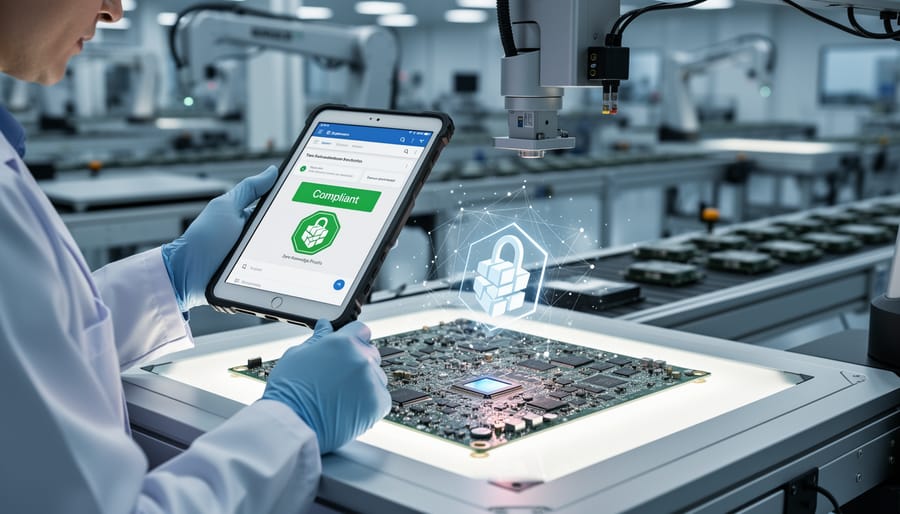
Manufacturers working with 3D printing and digital fabrication face a critical challenge: they need to verify designs, prove licensing compliance, and validate quality standards without exposing their proprietary CAD files or process parameters to competitors or unauthorized parties. Zero-knowledge proof blockchain solves this problem by enabling cryptographic verification that leaves trade secrets intact.
When a manufacturer receives a digital design file, ZKPs allow them to prove the design came from a legitimate source and hasn’t been tampered with, without revealing the actual geometry, material specifications, or manufacturing parameters. The blockchain records a cryptographic commitment to the design, and the supplier generates a zero-knowledge proof demonstrating authenticity. The manufacturer verifies this proof instantly, confirming the file matches the committed design without ever accessing the underlying intellectual property.
For licensing enforcement, ZKPs verify that a fabrication facility has rights to produce a specific part without exposing how many units they’re manufacturing or their production schedule. The license holder submits a proof showing their credentials meet the license requirements, and the blockchain validates it without revealing confidential business data.
Quality control benefits similarly. A manufacturer can prove their 3D-printed components meet specified tolerances, material properties, and structural requirements by generating proofs from sensor data and process logs. Customers or regulators verify compliance without seeing proprietary manufacturing techniques or equipment configurations. This approach works alongside quantum-safe blockchain systems to ensure long-term security of these sensitive workflows.
The result: supply chains maintain transparency and accountability while protecting the competitive advantages that matter most to manufacturers.
Scalability Solutions (Layer 2 Rollups)
zkRollups tackle Ethereum’s scalability bottleneck by processing transactions off the main chain while keeping security guarantees intact. Instead of posting every transaction directly to Ethereum, a zkRollup batches thousands of transactions together, executes them on a separate layer, then submits a single zero-knowledge proof to the mainnet that cryptographically verifies all those transactions were valid.
This compression is dramatic. Where Ethereum mainnet might handle 15 transactions per second, zkRollups push that to 2,000 or more. Transaction fees drop proportionally because you’re splitting the mainnet gas cost across hundreds or thousands of operations rather than paying separately for each one.
The zkRollup operator generates the proof, which could represent an entire block of transfers, swaps, or contract interactions. Ethereum validators only need to verify that compact proof rather than re-executing every transaction. Because the proof is mathematically sound, you inherit Ethereum’s security without its throughput limits.
Projects like zkSync, StarkNet, and Polygon zkEVM have built production rollups using different ZKP implementations. They differ in proof generation speed, EVM compatibility, and developer tooling, but the core benefit remains the same: orders of magnitude more capacity without compromising on decentralization or trustlessness.
Implementing ZKP Blockchain on Raspberry Pi Projects
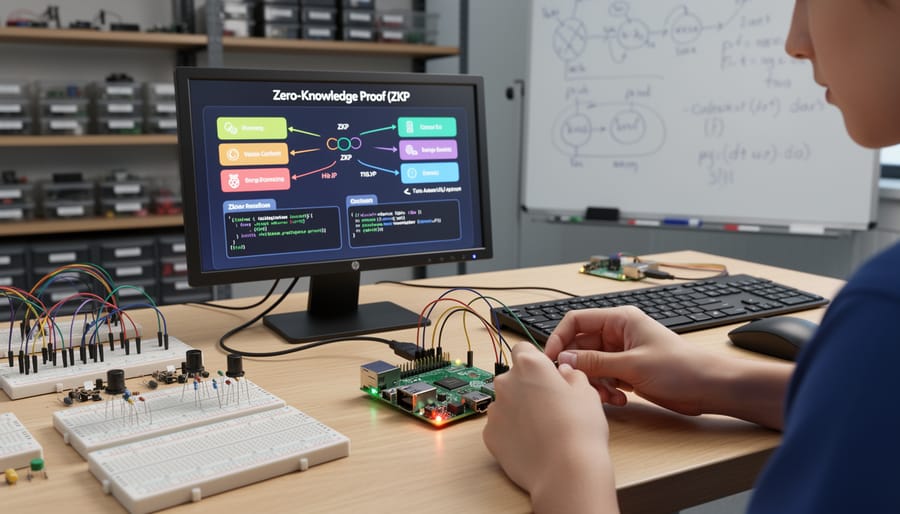
Raspberry Pi boards offer a surprisingly capable platform for learning and experimenting with zero-knowledge proof technology without the overhead of cloud servers or high-end workstations. While production ZKP systems demand serious computational resources, you can run lightweight proof generation, verification demos, and educational implementations on a Pi 4 or Pi 5 with 4GB or 8GB of RAM.
Start by setting up a development environment with the necessary cryptographic libraries. Python-based ZKP frameworks work well on Raspberry Pi OS, and you can install tools like `py_ecc` for elliptic curve operations or `zkp` libraries that provide simplified interfaces for building basic proofs. Rust-based implementations offer better performance if you’re comfortable compiling them on ARM architecture, the Pi 5’s improved processing power makes this more practical than earlier models.
Several ZKP tools and libraries run effectively on Raspberry Pi hardware for educational purposes:
- libsnark: C++ library for zk-SNARKs, though proof generation will be slower on Pi hardware
- bellman: Rust library for building zk-SNARK circuits, compatible with ARM builds
- circom: Domain-specific language for writing ZKP circuits, useful for learning proof construction
- zkutil: Lightweight utilities for ZKP operations that work on resource-constrained devices
- Proof-of-concept implementations from academic papers, often published with minimal dependencies
These tools let you generate and verify small proofs, experiment with circuit design, and understand the mechanics without enterprise infrastructure.
Focus your Pi projects on verification rather than proof generation when possible. Verifying a zero-knowledge proof requires far less computation than creating it, a Pi can verify complex proofs in seconds that might take minutes to generate. This makes Raspberry Pi ideal for building lightweight verification nodes, testing how applications would validate proofs, or creating educational demonstrations where students verify pre-generated proofs.
Consider projects like building a private authentication system where the Pi verifies password knowledge without storing or transmitting the password itself, or implementing a simple zkRollup validator that checks bundled transaction proofs. You could also create a secure data logger that proves sensor readings fall within acceptable ranges without revealing exact values, useful for environmental monitoring or quality control scenarios.
Keep expectations realistic about performance. Generating proofs for production-grade circuits with thousands of constraints will strain Pi hardware and may take considerable time. Treat the Pi as a learning platform and prototyping environment rather than a production ZKP node, and scale up to dedicated hardware when moving beyond experimentation.
Common Questions About Zero-Knowledge Proof Blockchain
Most readers approaching zero-knowledge proof blockchain for the first time share similar concerns about performance, security trade-offs, and practical implementation. These questions often determine whether a project moves forward with ZKP integration or explores alternative approaches.
Do zero-knowledge proofs slow down blockchain transactions significantly?
Generating ZKP proofs requires more computation than standard transactions, but verification remains extremely fast, often faster than traditional signature checks. The proof generation overhead varies by system: zk-SNARKs prove in seconds while verification takes milliseconds, making them practical for real-time applications despite the initial computational cost.
Are zero-knowledge proofs truly secure, or can they be broken?
ZKPs rely on well-established cryptographic assumptions that have withstood decades of scrutiny, making them as secure as the underlying mathematics. The main vulnerability lies in implementation errors or compromised trusted setups (for zk-SNARKs), not in the fundamental cryptographic principles.
What is a trusted setup, and should I be concerned about it?
A trusted setup generates public parameters for certain ZKP systems like zk-SNARKs, requiring that at least one participant destroys their portion of the secret key honestly. Modern ceremonies involve hundreds of participants globally, making compromise practically impossible, and newer systems like zk-STARKs eliminate trusted setups entirely.
Will quantum computers break zero-knowledge proofs?
Many current ZKP implementations, particularly those based on elliptic curve cryptography, would be vulnerable to sufficiently powerful quantum computers. However, zk-STARKs use hash-based cryptography that resists known quantum attacks, and the cryptography community is actively developing quantum-resistant alternatives for other ZKP systems.
Energy consumption concerns come up frequently when discussing ZKP blockchain implementations. While proof generation does require more computational resources than simple signature verification, the process remains far more energy-efficient than proof-of-work mining. A single zkRollup batch processing thousands of transactions consumes a fraction of the energy that validating those same transactions individually on a Layer 1 chain would require. The upfront computational cost pays for itself through consolidated verification and reduced network load.
Implementation difficulty presents another common barrier. Building ZKP systems from scratch demands deep cryptographic expertise, but the ecosystem in 2026 offers mature libraries and frameworks that abstract away most complexity. Developers can integrate ZKP functionality using tools like Circom, ZoKrates, or Cairo without understanding the underlying mathematics in detail. The learning curve resembles adopting any specialized technology, steeper than standard blockchain development but manageable with good documentation and community support.
The question of whether ZKPs add unnecessary complexity for a given use case deserves honest evaluation. If your application doesn’t require privacy or needs to minimize computational overhead at all costs, traditional blockchain verification might suffice. But when confidentiality, scalability, or selective disclosure matter, protecting manufacturing IP, scaling transaction throughput, or proving compliance without exposing sensitive data, the benefits outweigh the added technical requirements.
Key Points to Remember
Zero-knowledge proofs represent a fundamental shift in how blockchain systems handle sensitive data. The core principle is elegant: you can mathematically prove you know something or that a statement is true without exposing any underlying details. This isn’t theoretical anymore, it’s powering real privacy coins, layer 2 scaling solutions, and secure digital fabrication systems today.
The two main implementation types each serve different needs. zk-SNARKs offer compact proofs and fast verification but require a trusted setup ceremony, making them ideal for applications like Zcash and zkSync where proof size matters. zk-STARKs eliminate the trusted setup and resist quantum attacks, though they produce larger proofs, a trade-off that projects like StarkNet accept for enhanced transparency and future-proofing.
Where this matters most: privacy-preserving transactions that keep financial details confidential while proving validity, intellectual property protection for manufacturers who need to verify designs without exposing proprietary data, and blockchain scalability through zkRollups that bundle thousands of transactions into a single verifiable proof. These aren’t niche use cases. They address fundamental limitations that have held blockchain adoption back in privacy-sensitive and high-throughput contexts.
The learning curve is real, ZKP technology involves complex cryptography, but the tooling ecosystem in 2026 has matured enough that developers and hobbyists can experiment with implementations on modest hardware. You don’t need to understand polynomial commitments to appreciate what this technology unlocks, but grasping the basics helps you evaluate where it fits your projects.
Zero-knowledge proof blockchain technology solves a challenge that seemed impossible just years ago: maintaining complete transparency while protecting privacy. You can now verify critical information without exposing the underlying data, whether you’re securing financial transactions, protecting manufacturing designs, or building privacy-preserving applications.
The practical applications extend far beyond cryptocurrency. If you’re working with sensitive data, intellectual property, or user privacy, ZKPs offer real solutions. The secure digital fabrication use case shows how manufacturers can prove compliance and authenticity without revealing trade secrets. That same principle applies to supply chains, identity verification, healthcare records, and anywhere else transparency conflicts with confidentiality.
For Raspberry Pi enthusiasts and developers, 2026 brings more accessible tools than ever. Lightweight ZKP libraries, testing frameworks, and educational resources make it possible to experiment without enterprise infrastructure. Start small: try implementing a simple proof-of-concept, explore existing open-source projects, or adapt ZKP techniques to your current work.
The technology is maturing rapidly. What was once purely theoretical is now powering major blockchain networks, enabling private transactions, and scaling solutions that process thousands of operations efficiently. As the ecosystem grows, the barrier to entry keeps dropping. Whether you’re protecting user privacy or optimizing blockchain performance, zero-knowledge proofs give you powerful new options worth exploring.