

BPC-157 is a synthetic pentadecapeptide consisting of 15 amino acids with the sequence Gly-Glu-Pro-Pro-Pro-Gly-Lys-Pro-Ala-Asp-Asp-Ala-Gly-Leu-Val. This chain, derived from body protection compound found in human gastric juice, has a molecular formula of C62H98N16O22 and a molecular weight of approximately 1419.53 g/mol. The sequence contains no disulfide bridges, making it relatively stable and straightforward to analyze computationally.
For tech enthusiasts working with bioinformatics on accessible hardware, this peptide offers an excellent case study. The compact 15-residue structure is perfect for running molecular modeling and sequence analysis tools on single-board computers like Raspberry Pi 4 or 5 without requiring expensive workstations. You can manipulate the FASTA format sequence, calculate hydrophobicity plots, predict secondary structure, and even perform basic molecular dynamics using open-source tools like BioPython, PyMOL, or GROMACS.
What makes BPC-157 particularly interesting from a computational perspective is its high proline content (four residues) and the characteristic Pro-Pro-Pro triplet motif. These structural features influence the peptide’s conformational flexibility and can be explored through hands-on Python scripts that calculate dihedral angles or predict turn regions. The sequence data integrates smoothly with public databases like UniProt and PDB, allowing you to cross-reference structural information and build practical bioinformatics projects.
Whether you’re a student learning peptide analysis, a hobbyist exploring computational biology, or an educator designing accessible lab exercises, understanding BPC-157’s exact sequence and properties provides a foundation for meaningful experiments. The peptide’s well-documented structure and modest computational requirements make it an ideal starting point for exploring molecular bioinformatics on budget-friendly hardware.
What Is BPC-157? Understanding the Peptide Basics

BPC-157 is a synthetic pentadecapeptide, meaning it consists of 15 linked amino acids in a specific sequence. The name stands for “Body Protection Compound-157,” referencing its origin as a partial sequence derived from gastric juice proteins found naturally in the human stomach. While the body produces protective compounds in the digestive tract, BPC-157 itself is a laboratory-created molecule designed to isolate and study a particular amino acid chain.
Unlike naturally occurring proteins that can span hundreds or thousands of amino acids, BPC-157’s compact structure makes it computationally manageable. This size advantage matters significantly for bioinformatics projects: a 15-residue peptide can be analyzed, modeled, and visualized on modest hardware without requiring specialized computing infrastructure. The sequence remains stable and consistent across all synthetic versions, eliminating the variability you might encounter with naturally extracted proteins.
From a technical perspective, BPC-157’s relatively simple structure provides an excellent starting point for learning peptide analysis techniques. The sequence contains common amino acids found throughout human proteins, yet its short length means computational tools can process it quickly. A Raspberry Pi 4 with 4GB RAM, for instance, can handle molecular dynamics simulations and 3D structure predictions for a peptide of this size, whereas larger proteins might overwhelm the system or require extended processing times.
The peptide’s defined sequence also means you are working with a known molecular entity when building databases or testing analysis pipelines. There is no ambiguity about variants or isoforms, which simplifies validation steps in your code. This predictability makes BPC-157 sequence data particularly valuable for educational projects and prototype development before scaling up to more complex protein analysis tasks.
The Complete BPC-157 Amino Acid Sequence
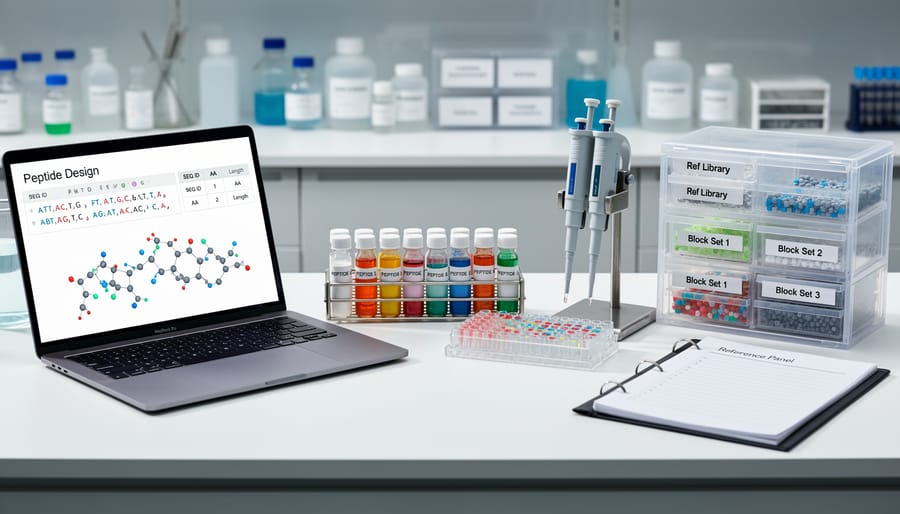
The BPC-157 peptide consists of a precise sequence of 15 amino acids that define its unique properties and computational signature. This pentadecapeptide follows a specific order that researchers and programmers can represent in multiple standardized formats for database entry and bioinformatics analysis.
The complete amino acid sequence reads: Gly-Glu-Pro-Pro-Pro-Gly-Lys-Pro-Ala-Asp-Asp-Ala-Gly-Leu-Val. In single-letter code format, commonly used in FASTA files and Python scripts, this appears as GEPPPGKPADDAGLV. Both representations are functionally equivalent, but the single-letter format offers advantages for computational storage and string manipulation operations on systems with limited resources like Raspberry Pi.
| Position | Amino Acid | Three-Letter Code | Single-Letter Code |
|---|---|---|---|
| 1 | Glycine | Gly | G |
| 2 | Glutamic Acid | Glu | E |
| 3-5 | Proline (×3) | Pro-Pro-Pro | PPP |
| 6 | Glycine | Gly | G |
| 7 | Lysine | Lys | K |
| 8 | Proline | Pro | P |
The sequence continues with alanine (Ala/A) at position 9, followed by two consecutive aspartic acid residues (Asp/D) at positions 10 and 11, another alanine at position 12, glycine at position 13, leucine (Leu/L) at position 14, and valine (Val/V) at the terminal position 15.
When working with this sequence in bioinformatics applications, you will notice the repeated proline residues from positions 3 through 5 and again at position 8. These proline-rich regions significantly affect the peptide’s three-dimensional structure and make it particularly interesting for structural modeling projects. The presence of two glycine residues at positions 1 and 6, plus another at position 13, provides flexibility points in the backbone that influence how the molecule folds.
For database queries and sequence alignment algorithms, you can represent BPC-157 in standard FASTA format by preceding the single-letter sequence with a header line. This format works seamlessly with Biopython libraries and allows efficient searching against larger protein databases to identify similar sequences or structural motifs.
Molecular Structure and Chemical Properties
Molecular Weight and Formula
BPC-157 has a molar mass 1419 Da (approximately 1419.53 Daltons). The precise value depends on which isotopes you account for in your calculations. For computational work on Raspberry Pi systems, using the standard molecular weight of 1419.5 Da provides sufficient accuracy for most bioinformatics applications.
The molecular formula is C62H98N16O22, which breaks down to 62 carbon atoms, 98 hydrogen atoms, 16 nitrogen atoms, and 22 oxygen atoms. This composition reflects the 15 amino acids in the sequence. When storing this data in chemistry databases or Python scripts, use the exact formula to ensure compatibility with molecular visualization tools like Open Babel or RDKit.
Calculate molecular weight programmatically by summing individual amino acid weights and subtracting water molecules lost during peptide bond formation. For BPC-157’s 15 residues, subtract 14 water molecules (252.28 Da) from the sum of all constituent amino acids. This approach works across any peptide sequence analysis you run on limited hardware, giving you consistent results without needing cloud computing resources.
Structural Characteristics
BPC-157 adopts a relatively compact three-dimensional structure characterized by its five proline residues, which constitute one-third of the total sequence. This high proline content (Pro-Pro-Pro segment at positions 3-5 and additional prolines at positions 2 and 8) restricts the peptide’s backbone flexibility and prevents formation of standard alpha-helices or beta-sheets. Instead, the molecule forms polyproline-type turns and loops that create a bent or kinked configuration.
The sequence naturally favors a hairpin-like structure when modeled in aqueous environments. The central proline-rich region acts as a rigid spacer, while the terminal regions (particularly the Gly-Glu at the N-terminus and Leu-Val at the C-terminus) provide more conformational freedom. Two aspartic acid residues at positions 10-11 introduce negative charges that influence folding patterns and affect how the peptide interacts with protein modeling algorithms.
For computational work on Raspberry Pi, this modest size (15 residues) means structure prediction tools like PyMOL or simplified molecular dynamics packages can generate and manipulate 3D models without excessive processing demands. The proline-dominated backbone creates predictable constraints that simplify computational folding simulations compared to more flexible peptides.
Stability and Solubility
BPC-157 demonstrates notable chemical stability across a pH range of 1-11, making it exceptionally robust for long-term database storage and repeated computational simulations. The peptide’s three proline residues contribute to structural rigidity, reducing spontaneous degradation in digital modeling environments.
Solubility characteristics are crucial for simulation parameters. BPC-157 is water-soluble at physiological pH, with solubility increasing in acidic solutions. When storing peptide data for Raspberry Pi projects, record these properties in metadata fields: typical working concentration ranges (0.1-1.0 mg/mL), optimal pH (4-6 for maximum stability), and temperature sensitivity markers. This information ensures accurate simulation conditions when running molecular dynamics calculations or protein-ligand docking studies on single-board computers, preventing errors from unrealistic chemical environment assumptions in your computational models.
Using BPC-157 Sequence Data in Raspberry Pi Bioinformatics Projects
Database Formats and Storage
Storing BPC-157 sequence data on your Raspberry Pi requires minimal disk space but proper file organization. The most common format is FASTA, a simple text file that starts with a description line (beginning with >) followed by the sequence. Create a file named `bpc157.fasta` using terminal commands like `nano` or `vim`, then enter:
“`
>BPC-157 synthetic peptide
GEPPPGKPADDAGLV
“`
For three-dimensional structure work, PDB format stores atomic coordinates, though BPC-157’s experimentally determined structure may not exist in public databases. You can generate predicted structures using modeling tools and save them as `.pdb` files. GenBank format works for longer sequences but is overkill for a 15-residue peptide.
Store all peptide data in a dedicated directory like `/home/pi/bioinformatics/sequences/` on Raspberry Pi OS. Create CSV files for batch analysis projects, with columns for peptide name, sequence, molecular weight, and notes. SQLite databases offer efficient querying for larger collections without requiring a separate database server, making them perfect for Pi’s resource constraints.
Python Libraries for Peptide Analysis
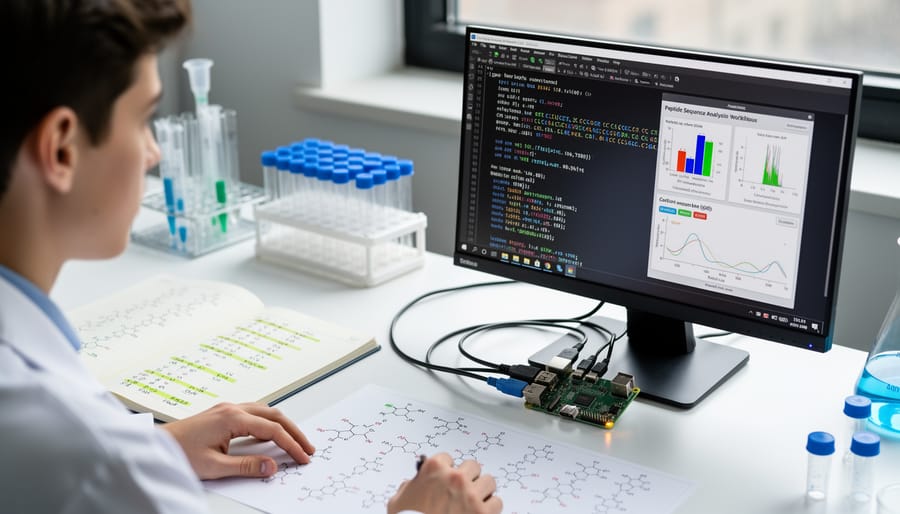
Biopython stands out as the most practical Python library for peptide analysis on Raspberry Pi. Install it with `pip3 install biopython` through SSH access to your Pi, and you’ll have tools for parsing sequences, calculating molecular properties, and performing BLAST searches. The `Bio.SeqUtils.ProtParam` module calculates molecular weight and isoelectric point for BPC-157 directly from its sequence string. For our 15-amino acid peptide, you can analyze hydrophobicity patterns and secondary structure predictions with minimal code.
Beyond Biopython, ProDy offers protein dynamics analysis and runs efficiently on Pi 4 models with 4GB RAM. It handles PDB file parsing and can generate contact maps showing spatial relationships between BPC-157’s amino acids. For simpler tasks like sequence manipulation and basic property calculations, the lightweight peptides package provides fast functions without Biopython’s full overhead.
MDAnalysis represents another option for trajectory analysis if you’re working with molecular dynamics simulations, though it demands more computational resources. For visualization alongside analysis, PyMOL’s open-source version installs on Raspberry Pi OS and integrates with Python scripts to generate structure images programmatically. Combine these libraries in Jupyter notebooks running locally on your Pi for interactive peptide analysis workflows that document your exploration of BPC-157’s properties alongside your code.
Visualization and Modeling Tools
PyMOL open-source builds run smoothly on the Pi 4 model for basic peptide visualization, though you’ll need to compile from source. For lighter alternatives, install VMD (Visual Molecular Dynamics) through apt-get, which handles BPC-157’s 15 residues without performance issues. NGL Viewer offers browser-based rendering that works surprisingly well on Raspberry Pi’s GPU, load your PDB file and rotate the structure in real-time at acceptable frame rates.
For command-line enthusiasts, PyMol’s headless mode generates static images of BPC-157’s folded structure without launching the GUI. RasMol remains the most lightweight option, consuming under 50MB RAM while displaying basic stick, ball-and-stick, or space-filling models. The proline-rich regions in BPC-157 create distinctive kinks that show clearly even in RasMol’s simplified rendering.
Jupyter notebooks running on Raspberry Pi can embed py3Dmol widgets for interactive structure viewing within your analysis code. This approach lets you visualize conformational changes as you modify the sequence computationally, making it ideal for educational demonstrations where students manipulate peptide structures and see immediate visual feedback.
Comparing BPC-157 to Related Peptide Sequences
BPC-157 sits in an interesting position among synthetic peptides, sharing structural similarities with several naturally occurring compounds while maintaining features that make it particularly suitable for computational analysis on systems like Raspberry Pi. Its 15-amino acid length places it squarely in the “short peptide” category, making it manageable for bioinformatics projects without the computational overhead of full proteins.
The most closely related naturally occurring sequence is the parent compound found in human gastric juice, though BPC-157 represents a specific fragment that has been stabilized for research purposes. TB-500 (Thymosin Beta-4) offers an interesting comparison point as another synthetic peptide commonly referenced in peptide databases, but at 43 amino acids it presents significantly higher computational complexity. For educational projects where you want to secure your Pi while running protein analysis tools, BPC-157’s shorter sequence provides a more accessible starting point.
| Peptide | Sequence Length | Molecular Weight (Da) | Key Structural Feature | Computational Load |
|---|---|---|---|---|
| BPC-157 | 15 amino acids | ~1419 | Proline-rich core | Low (ideal for Pi) |
| TB-500 | 43 amino acids | ~4963 | Actin-binding domain | Moderate to high |
| Gastric peptide fragment | Variable (10-20) | ~1200-2000 | Glycine terminals | Low |
| GHK-Cu | 3 amino acids | ~340 | Copper-binding tripeptide | Very low |
What distinguishes BPC-157 for computational study is its sequential arrangement of three consecutive proline residues, creating a structural motif that affects how molecular modeling software predicts its three-dimensional shape. This proline cluster limits backbone flexibility compared to sequences with more varied amino acids, resulting in more predictable computational outputs.
The peptide’s glycine bookends (at positions 1 and 13) also differ from many synthetic analogs, providing flexibility at the termini while maintaining rigidity in the central region. When working with sequence alignment tools in Python or other languages, these structural features create clear markers for comparison algorithms. The balanced hydrophobic and hydrophilic residue distribution makes BPC-157 less prone to aggregation in simulation environments than more hydrophobic peptides like melittin.
For Raspberry Pi projects comparing peptide sequences, BPC-157’s stability and well-documented structure in databases like PDB and UniProt make it an excellent reference point. Its sequence doesn’t contain rare or modified amino acids that might complicate computational analysis, keeping memory requirements modest even when running structure prediction algorithms.
Common Questions About BPC-157 Sequence and Structure
Working with peptide sequence data raises practical questions, especially when you’re setting up bioinformatics projects on accessible hardware. These answers address the most common technical queries about BPC-157’s sequence and how to work with it effectively.
Where can I find the verified BPC-157 amino acid sequence?
The verified BPC-157 sequence (GEPPPGKPADDAGLV) is available through PubChem and various peptide databases, though it’s not always listed under that common name since it’s a synthetic derivative. Search for “pentadecapeptide BPC 157” or use the specific sequence string to locate entries with complete structural data.
What file format should I use for peptide sequence data on Raspberry Pi?
FASTA format works best for basic sequence storage and analysis because it’s lightweight and compatible with most bioinformatics tools. For structural modeling, PDB format provides three-dimensional coordinate data, though these files are larger and require more processing power.
Can a Raspberry Pi handle peptide modeling and analysis?
A Raspberry Pi 4 with 4GB RAM can handle sequence analysis and basic structural visualization for small peptides like BPC-157 without issues. Complex molecular dynamics simulations will be slow, but viewing structures, comparing sequences, and running Biopython scripts work smoothly for educational and hobbyist projects.
How do I verify that a BPC-157 sequence is accurate?
Cross-reference the 15-amino acid sequence against multiple database entries and published literature to confirm it matches the standard Gly-Glu-Pro-Pro-Pro-Gly-Lys-Pro-Ala-Asp-Asp-Ala-Gly-Leu-Val composition. Calculate the molecular weight, which should be approximately 1419 Da, as a quick verification check.
Beyond these basics, you might wonder about practical workflow considerations. When you’re downloading sequence data from public repositories, save copies in multiple formats since different analysis tools have specific requirements. FASTA works for sequence alignment and comparison, while PDB or MOL2 files enable three-dimensional visualization when you want to examine how the proline-rich regions create the peptide’s characteristic structure.
Storage requirements are minimal. A complete dataset including the sequence in multiple formats, structural coordinates, and basic property files typically occupies less than 1MB, making it trivial to store on any Raspberry Pi SD card. This makes BPC-157 an ideal starting point for learning peptide bioinformatics since you can work with the complete dataset without worrying about storage constraints or slow load times.
If you’re comparing BPC-157 to other peptides in your projects, remember that sequence similarity doesn’t always translate to structural similarity. TB-500, for instance, shares no sequence overlap with BPC-157 despite both being studied synthetic peptides. Running alignment algorithms helps identify these differences quantitatively, and most alignment tools run efficiently on Raspberry Pi hardware when working with peptides of this length.
BPC-157 offers a perfect entry point for anyone interested in bioinformatics and computational biology on accessible hardware. Its 15-amino acid sequence, Gly-Glu-Pro-Pro-Pro-Gly-Lys-Pro-Ala-Asp-Asp-Ala-Gly-Leu-Val, is short enough to work with on a Raspberry Pi yet complex enough to teach fundamental principles of peptide analysis, structure prediction, and molecular modeling.
The peptide’s well-documented structure, with a molecular weight of approximately 1419 Da and distinctive proline-rich regions, makes it an ideal test subject for learning protein chemistry computationally. You can store its sequence in standard formats, analyze it with Python libraries, and even visualize its three-dimensional structure without needing expensive workstations or specialized lab equipment. This hands-on approach transforms abstract biochemistry concepts into tangible programming challenges.
Starting a bioinformatics project with BPC-157 teaches you skills that transfer directly to analyzing more complex proteins and biological sequences. You’ll learn to work with FASTA files, query sequence databases, calculate molecular properties, and interpret structural data, all fundamental techniques in modern computational biology. The Raspberry Pi’s capabilities match these learning tasks perfectly, proving you don’t need high-end hardware to explore this field.
Whether you’re a student building a portfolio, an educator designing classroom projects, or a hobbyist curious about the intersection of biology and computing, peptide analysis represents an underexplored niche in the maker community. BPC-157’s sequence data is freely available, the tools are open-source, and the learning curve rewards persistence with practical knowledge. Set up your Raspberry Pi, download Biopython, and start experimenting. The combination of accessible tech and fascinating molecular science creates endless possibilities for learning and discovery.