

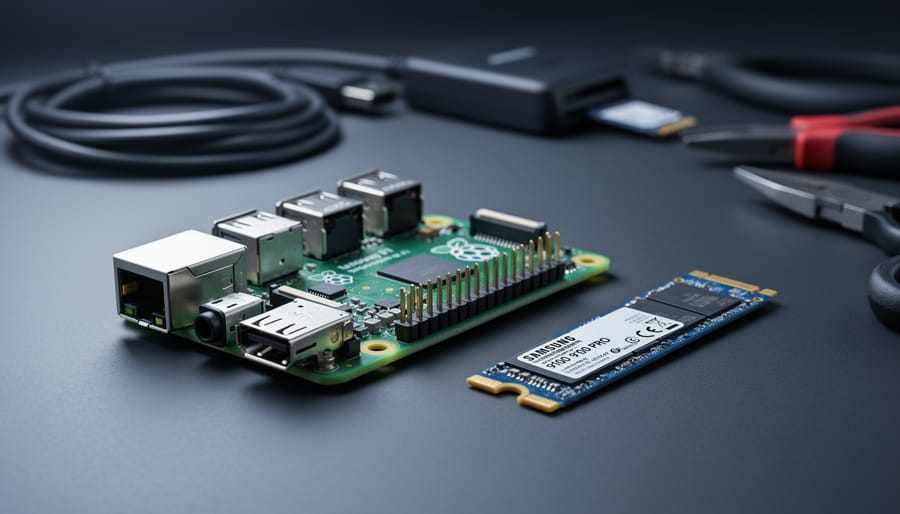
The Raspberry Pi 5’s PCIe slot opened up a world of storage possibilities, and the best choice for most users is a 1TB or 2TB PCIe 4.0 NVMe SSD. These drives deliver read speeds between 5,000 and 7,400 MB/s, far outpacing microSD cards and USB storage while remaining fully compatible with the Pi 5’s PCIe 2.0 interface. You’ll find models from trusted brands like the SAMSUNG 990 PRO SSD 1TB PCIe Gen4 NVMe M.2 Internal Solid State Hard and Samsung 990 EVO Plus that strike the right balance between performance and cost.
Choosing the right NVMe drive requires understanding PCIe generations, since the Pi 5 supports PCIe 2.0 through its M.2 HAT+ adapter while most modern SSDs use PCIe 3.0 or 4.0 interfaces. The good news? PCIe 5.0 SSDs are backward compatible with PCIe 4.0 and PCIe 3.0 interfaces, though they’ll operate at the maximum speed of the older system when used in older systems. Current Gen 5 SSDs may yield up to 2.5x faster read speeds and up to 5x faster write speeds than PCIe 4.0 NVMe M.2 SSDs, but those performance gains only matter if your system can support them.
This guide cuts through the marketing hype to show you six proven drives across budget, mid-range, and performance tiers. Whether you’re building a media server that needs capacity or a development workstation demanding speed, you’ll find a tested recommendation that fits your project.
Understanding NVMe SSD Generations for Raspberry Pi 5
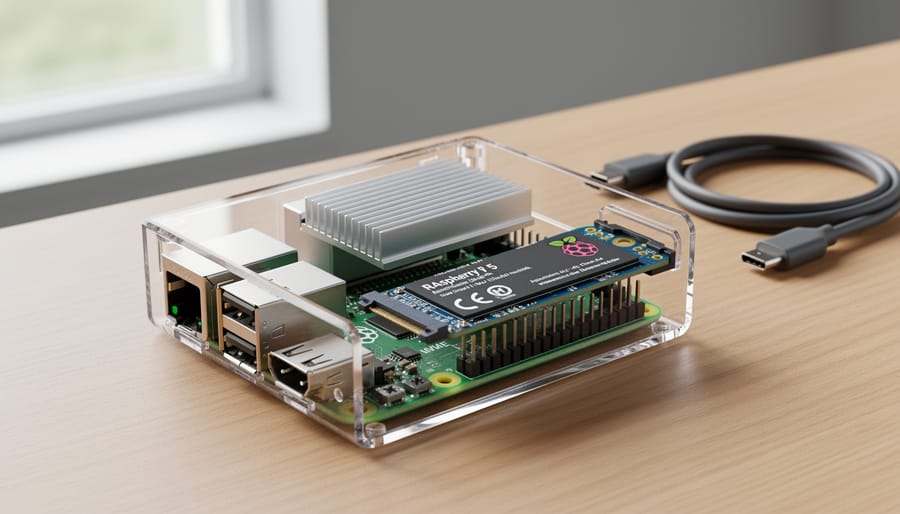
The Raspberry Pi 5 uses a PCIe 2.0 single-lane interface, which limits the practical speeds you’ll achieve regardless of your SSD’s generation. Understanding the differences between PCIe 3.0, 4.0, and 5.0 drives helps you make a smart buying decision without overpaying for capabilities your Pi can’t fully exploit.
PCIe generations represent bandwidth increases in the standard’s evolution. Gen 5 drives deliver theoretical sequential reads up to 14,000 MB/s and writes around 12,000 MB/s, offering up to 2.5x faster read speeds and up to 5x faster write speeds compared to Gen 4 counterparts. Gen 4 drives typically reach 7,000-7,500 MB/s reads and 5,000-6,500 MB/s writes, while Gen 3 drives cap out around 3,500 MB/s reads and 3,000 MB/s writes.
Here’s what matters for your Pi 5:
| PCIe Generation | Max Read Speed | Max Write Speed | Best For (Raspberry Pi Context) |
|---|---|---|---|
| PCIe 3.0 | ~3,500 MB/s | ~3,000 MB/s | Budget builds, learning projects, basic OS storage |
| PCIe 4.0 | ~7,000 MB/s | ~6,000 MB/s | General enthusiast projects, media servers, development work |
| PCIe 5.0 | ~14,000 MB/s | ~12,000 MB/s | Future-proofing, multi-system use, high-end applications |
PCIe 5.0 SSDs are backward compatible with older interfaces like the Pi 5’s PCIe 2.0 connection. When you install a Gen 5 drive in your Pi, it operates at the maximum speed of that older system, which means you won’t see anywhere near those 14,000 MB/s figures. The Pi 5’s single PCIe 2.0 lane bottlenecks speeds to roughly 500 MB/s in real-world transfers.
Does this mean Gen 5 drives are pointless for Pi projects? Not necessarily. If you plan to use the drive across multiple systems or want maximum future compatibility, a Gen 5 SSD works fine. It just won’t deliver its headline speeds in your Pi. For most users, a 1TB or 2TB PCIe 4.0 drive hits the sweet spot between price, capacity, and adequate performance for the Pi’s actual bandwidth limits.
Gen 3 drives remain perfectly viable for budget-conscious builders. You’ll still get faster boot times and application loading compared to microSD cards or USB storage, and the price difference funds other project components.
What to Look for When Choosing Your NVMe SSD
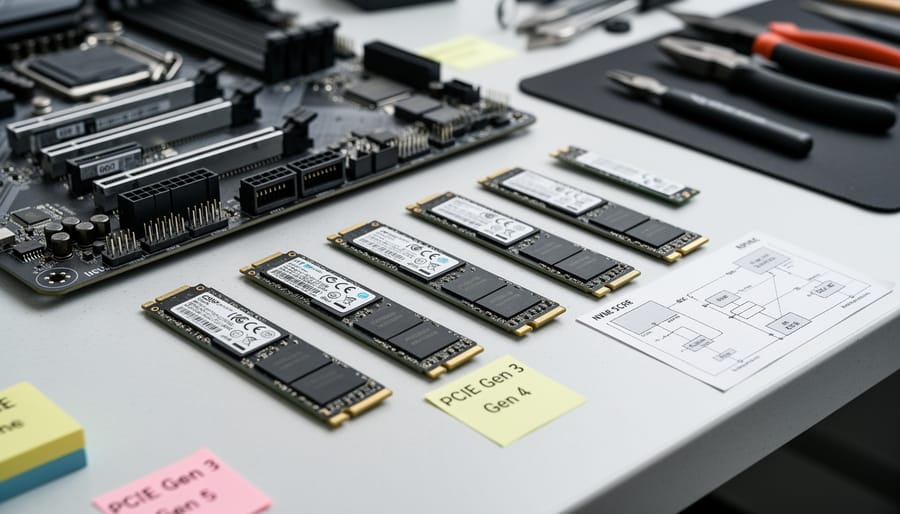
Choosing the right NVMe SSD for your Raspberry Pi 5 requires balancing several technical specifications with your project’s actual demands. Here’s what matters most when you’re comparing drives.
Start with capacity. A basic OS installation with light development tools fits comfortably in 256GB, but that fills up fast once you add Docker containers, development environments, or media files. If you’re building a media server with a growing library or running multiple simultaneous projects, 1TB becomes the practical minimum. Development work with virtual machines, extensive Git repositories, and testing environments pushes you toward 2TB. Match your capacity to your realistic storage trajectory over the next two years, not just what you need today.
Form factor compatibility is non-negotiable. The Pi 5 officially supports M.2 2280 drives (22mm wide, 80mm long). Other lengths like 2242 or 2260 won’t physically fit the mounting points in most Pi 5 HATs and cases. Verify the 2280 specification before purchasing.
Performance requirements depend on your workload. PCIe 3.0 drives delivering 2,000-3,000 MB/s read speeds handle OS operations and general file access without bottlenecks. PCIe 4.0 drives pushing 5,000-7,000 MB/s benefit database-heavy applications, video editing workflows, and compile-intensive development. The Pi 5’s PCIe 2.0 interface caps real-world throughput around 500 MB/s, but faster drives still improve random read performance and responsiveness under load.
When evaluating drives, prioritize these criteria:
- Capacity sufficient for your workload plus 30% growth margin
- Form factor compatibility (M.2 2280 for Pi 5)
- Read/write speeds matching your application demands
- Temperature management features for enclosed setups
- Power draw under 3W to avoid straining the Pi’s power supply
- Customer reviews averaging 4.5+ stars with hundreds of ratings
Thermal management becomes critical in compact Pi enclosures. NVMe drives generate significant heat under sustained writes, and the NVMe thermal throttling explanation shows how temperatures above 70°C trigger performance reductions. Drives with integrated heatspreaders or graphene cooling stickers help, but enclosed Pi projects often need active cooling solutions to maintain peak performance during intensive tasks.
Power consumption affects stability. Most modern NVMe drives draw 2-4W under load, but the Pi 5’s limited power budget means choosing efficient drives matters. High-performance PCIe 5.0 drives can exceed 5W during peak writes, potentially causing brownouts if you’re running other power-hungry USB peripherals.
Customer ratings reveal reliability patterns. A drive with 4.7+ stars across thousands of reviews signals consistent quality control and longevity. Pay attention to negative reviews mentioning early failures or incompatibility issues, as these often highlight batch-specific problems worth avoiding.
NVMe SSD Types Compared: Budget, Mid-Range, and Performance
Choosing the right NVMe SSD for your Raspberry Pi 5 means understanding how three distinct tiers balance cost against capabilities. Budget options typically use PCIe 3.0 technology and offer 256GB to 500GB capacities, delivering read speeds around 2,800MB/s, plenty for lightweight operating systems, learning projects, or setups where you’re primarily running text-based applications and small databases. These drives keep your initial investment low while providing a significant upgrade over microSD cards, though you’ll sacrifice some headroom for media libraries or complex development environments.
Mid-range drives represent the sweet spot for most enthusiasts: PCIe 4.0 models with 1TB capacity strike an excellent balance between performance, storage space, and value. You’ll see read speeds jumping to 7,000MB/s or higher, which matters when you’re compiling large codebases, running Docker containers, or serving multiple simultaneous media streams. The 1TB capacity gives you room to grow your projects without constantly managing storage, and these drives typically include better endurance ratings (measured in terabytes written) than their budget counterparts.
High-performance options feature PCIe 4.0 or 5.0 controllers with capacities starting at 1TB and climbing to 4TB. These deliver theoretical read speeds up to 14,000MB/s, though your Pi 5’s PCIe 2.0 interface will cap actual performance well below that ceiling. The real advantage here isn’t raw speed but sustained performance under heavy workloads, better thermal management, and longer warranties. Power draw increases with performance tier, so factor that into your decision if you’re running battery-powered or thermally-constrained setups.
Samsung 9100 PRO Series

The Samsung 9100 PRO Series represents the cutting edge of NVMe technology for Raspberry Pi 5 enthusiasts who demand maximum performance. Built on PCIe 5.0 architecture, this drive delivers speeds that dwarf previous generations, up to 2.5x faster reads and 5x faster writes compared to PCIe 4.0 alternatives, though it will operate at the Pi 5’s PCIe 3.0 speeds due to hardware limitations. The backward compatibility ensures you’re not wasting money; you’ll simply be running a high-performance drive at a more moderate pace.
What makes the 9100 PRO particularly attractive for advanced Pi projects is its robust build quality and proven track record, evidenced by its 4.7 out of 5 rating from 1,716 verified buyers. The drive’s architecture handles intensive workloads gracefully, making it ideal for high-end media servers that transcode multiple streams simultaneously or development environments where compile times matter. If you’re running Docker containers, hosting databases, or managing complex automated builds, this drive won’t become your bottleneck.
One crucial consideration: PCIe 5.0 drives generate significantly more heat than their predecessors. In a Raspberry Pi 5 setup, proper heat management isn’t optional, it’s mandatory. You’ll want an enclosure with active cooling or at minimum a quality heatsink in direct contact with the drive. Without adequate thermal dissipation, you risk throttling that negates the performance advantages you paid for. The good news? This model is currently in stock, so you can start your high-performance Pi build right away.
Samsung 990 EVO Plus

The Samsung 990 EVO Plus occupies an interesting middle ground with its hybrid PCIe Gen 4 x4 and Gen 5 x2 interface, delivering sequential read speeds up to 7,150MB/s, more than enough bandwidth for even the most demanding Raspberry Pi 5 projects. While your Pi 5 will negotiate a PCIe Gen 3 connection and won’t hit those theoretical peaks, this drive’s architecture ensures consistently fast real-world performance across random reads, writes, and mixed workloads that matter most for everyday use.
Two technologies make this drive particularly well-suited for Pi power users. Host Memory Buffer (HMB) borrows a small portion of system RAM to cache mapping tables, which keeps the drive responsive during heavy multitasking without requiring expensive onboard DRAM. Intelligent TurboWrite dynamically allocates a portion of the drive as a high-speed SLC write buffer, so large file transfers, whether you’re cloning repositories, recording video streams, or syncing a network-attached storage setup, maintain speed even under sustained load.
The 1TB capacity hits the sweet spot for serious hobbyists running multiple containers, development environments, or media libraries without constant storage management. With a 4.7 out of 5 rating from 6,793 customer reviews and current in-stock availability, this drive has earned its reputation through real-world reliability. It’s an excellent choice when you need more headroom than budget drives provide but don’t want to overspend on capacity or features your Pi can’t fully utilize.
SAMSUNG 990 PRO SSD 1TB PCIe Gen4 NVMe M.2 Internal Solid State Hard

The Samsung 990 PRO earns its reputation as a workhorse for Raspberry Pi 5 enthusiasts who need reliable performance without premium pricing. This PCIe Gen 4 drive delivers sequential read speeds up to 7,450 MB/s and write speeds reaching 6,900 MB/s, comfortably exceeding what most Pi projects demand while staying within the Gen 4 sweet spot that maximizes value.
At 1TB, this drive provides enough headroom to run Raspberry Pi OS alongside development tools, Docker containers, local databases, and media libraries without constant storage juggling. Home lab enthusiasts use it for self-hosted services like Nextcloud or Plex servers, while developers appreciate the breathing room for multiple virtual environments and project repositories. The capacity handles typical NAS duties comfortably, though media hoarders may eventually need more space.
Samsung includes Dynamic Thermal Guard technology to throttle performance before temperatures damage the drive, though sustained heavy writes in a poorly ventilated Pi 5 case can still trigger thermal limits. Pairing this SSD with an M.2 heatsink or a case with active cooling prevents throttling during extended file transfers or compile jobs.
With 13,148 customer reviews averaging 4.7 out of 5 stars, the 990 PRO has proven durability across thousands of real-world installations. Reviewers consistently praise its stability and endurance rating of 600 TBW, which translates to years of daily Pi use before wear becomes a concern. This track record makes it a safe choice when you need dependable storage that won’t quit mid-project.
SANDISK 500GB Optimus 5100 NVMe SSD

The SanDisk 500GB Optimus 5100 strikes a practical middle ground for Raspberry Pi 5 users who need more than basic storage but don’t want to pay for a full terabyte. With PCIe 4.0 x4 architecture and read speeds reaching 6,600 MB/s, this M.2 2280 drive delivers solid performance that the Pi 5 can leverage for responsive system operation and faster data access.
Half a terabyte works well for focused Pi projects. If you’re running a dedicated media center with locally stored content, building a small-scale home server, or developing software where project files and dependencies accumulate but won’t reach massive sizes, 500GB provides breathing room beyond a 256GB drive without the cost jump to 1TB. It’s enough for a full operating system installation, development tools, libraries, and several substantial projects or a curated media collection.
The M.2 2280 form factor fits standard Pi 5 NVMe HAT adapters and enclosures without clearance issues. At these speeds, you’ll notice quicker boot times, snappier application launches, and improved responsiveness when working with databases or compiling code compared to microSD cards or older SATA storage. PCIe 4.0 bandwidth means the drive won’t bottleneck typical Pi workloads.
What sets this drive apart is its exceptional 4.9 out of 5 rating from 50 customer reviews, suggesting consistent real-world reliability. Users report stable performance and good thermal behavior in compact Pi setups. The drive remains in stock, making it accessible when you’re ready to upgrade.
Consider this capacity if you know your storage needs fall below 1TB. It’s ideal for single-purpose Pi builds where you’ve calculated your space requirements and have confidence 500GB covers your project scope with room to grow.
fanxiang S500 Pro 256GB NVMe SSD M.2 2280 PCIe Gen3x4 2800MB/s TLC 3D

The fanxiang S500 Pro delivers respectable entry-level performance for Pi 5 users who need basic storage without breaking the budget. Its PCIe Gen 3×4 interface pushes sequential reads up to 2800MB/s, which remains more than adequate for Raspberry Pi OS installations, small-scale coding projects, and educational setups where cutting-edge speed isn’t critical.
At 256GB, you’re looking at enough room for a lean operating system, essential development tools, and a modest collection of project files. This capacity works well if you’re building a headless server that logs data, experimenting with different Linux distributions, or setting up a dedicated retro gaming station with a curated library. The moment you plan to store large media files or run Docker containers with multiple images, you’ll hit the ceiling fast.
The drive’s 200TBW endurance rating translates to writing roughly 55GB per day over a 10-year span, which exceeds typical Pi workloads by a comfortable margin. TLC 3D NAND keeps the price accessible while maintaining reliability for hobbyist use. Thermal management remains straightforward at Gen 3 speeds; you won’t face the heat challenges that higher-performance drives introduce in enclosed Pi cases.
With 4.5 stars across 6,229 customer ratings, the S500 Pro has earned solid marks from users who value dependable budget storage. It’s a sensible starting point for newcomers testing the NVMe waters or anyone assembling multiple Pi nodes where cost per unit matters more than peak throughput.
Ediloca EN600 PRO SSD 256GB PCle 3.0×4

The Ediloca EN600 PRO delivers a practical entry point for Raspberry Pi 5 users who want NVMe performance without stretching their budget. This PCIe 3.0×4 drive reaches up to 2800MB/s read speeds and combines 3D NAND TLC storage with an SLC cache layer that accelerates everyday file operations. At 256GB, it offers enough room for a full Raspberry Pi OS installation, essential development tools, and a modest collection of project files, ideal for learners testing different configurations or running single-purpose applications like lightweight web servers or learning platforms.
The included graphene cooling sticker addresses thermal management head-on. Pi 5 enclosures trap heat, and even modest NVMe drives can throttle under sustained workloads. The sticker dissipates warmth through conductive material, helping maintain consistent speeds during prolonged file transfers or compile jobs. It’s a small detail that matters when your Pi runs inside a compact case without active cooling.
This drive earned 4.3 out of 5 from 960 customer ratings, a solid endorsement for a budget model. Most reviewers appreciate the balance between price and everyday reliability. The M.2 2280 form factor slots directly into Pi 5’s PCIe connector without adapters or spacers.
Where 256GB falls short is storage-heavy projects: media libraries, large datasets, or Docker containers with multiple services quickly consume available space. If your Pi will collect sensor logs over months or host multiple virtual environments, you’ll outgrow this capacity. But for focused, single-task builds or initial exploration of NVMe performance gains over microSD cards, the EN600 PRO removes barriers to entry.
Common Mistakes to Avoid When Buying an NVMe SSD for Pi 5
Even experienced Pi enthusiasts make avoidable mistakes when selecting NVMe storage. Here are the critical errors to watch for before you buy:
- Choosing the wrong form factor, The Raspberry Pi 5 requires M.2 2280 drives specifically. Double-check dimensions before ordering, as M.2 2242 or other shorter drives won’t fit your Pi’s M.2 HAT+ correctly.
- Ignoring thermal management in enclosed setups, NVMe SSDs generate heat, and Pi enclosures trap it. If you’re building a compact case without ventilation, that high-performance drive might throttle when temperatures climb, negating the speed advantages you paid for.
- Over-speccing with PCIe 5.0 when 4.0 delivers everything you need, Yes, Gen 5 drives work with Pi 5 thanks to backward compatibility, but they run at your system’s maximum interface speed anyway. You’re paying a premium for performance your Pi can’t utilize. Most users get better value from a quality PCIe 4.0 drive at 1TB or 2TB capacity.
- Under-buying capacity for projects that will grow, That 256GB drive looks tempting at a low price, but media libraries expand, development environments accumulate dependencies, and multiple Docker containers eat storage faster than you expect. Budget for headroom.
- Overlooking power consumption impacts, Higher-performance drives draw more power, which matters when your Pi shares a limited power budget with peripherals. In battery-powered or solar projects, an efficient PCIe 3.0 drive might serve you better than a power-hungry flagship model.
- Ignoring customer review patterns across thousands of ratings, A 4.7 rating from 13,000 reviews tells you far more about real-world reliability than a 5.0 rating from twenty early adopters. Look for consistent praise around endurance and thermal behavior, not just peak benchmark numbers.
Match your drive selection to your actual project requirements rather than chasing specifications that sound impressive on paper. The Pi 5’s interface and your specific use case determine what performance you’ll actually experience, so prioritize compatibility, proven reliability, and appropriate capacity over maximum theoretical speed.
Frequently Asked Questions
Can I use a PCIe 5.0 SSD with Raspberry Pi 5?
Yes, PCIe 5.0 SSDs are backward compatible with the Pi 5’s PCIe 3.0 interface. However, the drive will operate at PCIe 3.0 speeds rather than its maximum Gen 5 performance, so you won’t benefit from the higher speed capabilities unless you plan to use the drive in future systems.
What’s the minimum capacity I need for a Raspberry Pi 5?
For a basic OS installation and lightweight projects, 256GB works fine. Most enthusiasts find 1TB hits the sweet spot for multi-purpose setups with room for media files, development environments, and project data without constant storage management.
Do I need a heatsink for my NVMe SSD on Pi 5?
If you’re using an enclosed case or running sustained workloads, a heatsink helps prevent thermal throttling. Many SSDs include graphene cooling stickers or compatible heatsinks, and some Pi 5 cases feature built-in thermal solutions for M.2 drives.
What speeds will I actually see on Raspberry Pi 5?
The Pi 5’s PCIe 3.0 interface caps real-world speeds around 500-700 MB/s for sequential reads and writes. While Gen 4 and Gen 5 drives advertise much higher numbers, those peak speeds require PCIe 4.0 or 5.0 host interfaces to materialize.
Brand reputation matters more than raw specifications when choosing an NVMe SSD for your Pi 5. Drives from established manufacturers like Samsung and SanDisk typically feature better firmware, more consistent performance under load, and longer warranties. Customer review patterns reveal reliability issues that spec sheets hide, look for drives with thousands of reviews maintaining ratings above 4.5 stars rather than chasing the highest advertised speed from an unknown brand.
Installation on the Raspberry Pi 5 requires a compatible M.2 HAT or adapter board that connects to the board’s PCIe slot. The process involves attaching the HAT to the Pi’s GPIO headers, securing the NVMe drive into the M.2 slot at a 30-degree angle, then pressing it flat and fastening the retention screw. You’ll need to configure the Pi 5’s bootloader to prioritize the NVMe drive, which involves updating the EEPROM settings through the Raspberry Pi Imager or command-line tools. Most modern Pi 5 setups detect the drive automatically once properly seated.
Capacity planning depends on your project scope. A 256GB drive suffices for experimenting with different operating systems or running simple automation tasks. Media server projects, game emulation setups, or development environments with multiple containers benefit from the breathing room a 1TB or 2TB drive provides. Consider your growth trajectory, upgrading storage later means reinstalling your entire setup or cloning drives, both more time-consuming than buying adequate capacity upfront.
Choosing the right NVMe SSD for your Raspberry Pi 5 comes down to matching storage to your actual project demands. If you’re experimenting with basic installations or single-purpose projects, the budget 256GB PCIe 3.0 drives give you a solid entry point without overspending. Most Pi enthusiasts will find their ideal balance in a 1TB PCIe 4.0 SSD, the sweet spot that handles everything from media servers to development environments with room to grow. Power users running demanding applications or planning intensive workloads can look toward PCIe 5.0 options for substantial performance headroom and future-proofing, knowing they’ll still work perfectly with the Pi 5’s current capabilities.
Think honestly about what you’ll store and run. A lightweight OS and a few applications fit comfortably in 256GB. Projects involving Docker containers, large datasets, or multiple services benefit from 1TB or more. Don’t pay for speeds your Pi 5 can’t fully harness, but don’t cripple a capable build with insufficient capacity either.
Every drive covered here is currently in stock and proven by thousands of user reviews. Pick the capacity and generation that fits your budget and ambitions, install it with confidence, and enjoy the performance boost over traditional storage.
Editorial disclosure: retail links in this article may pay us a commission. This does not influence our coverage. As an Amazon Associate I earn from qualifying purchases.