

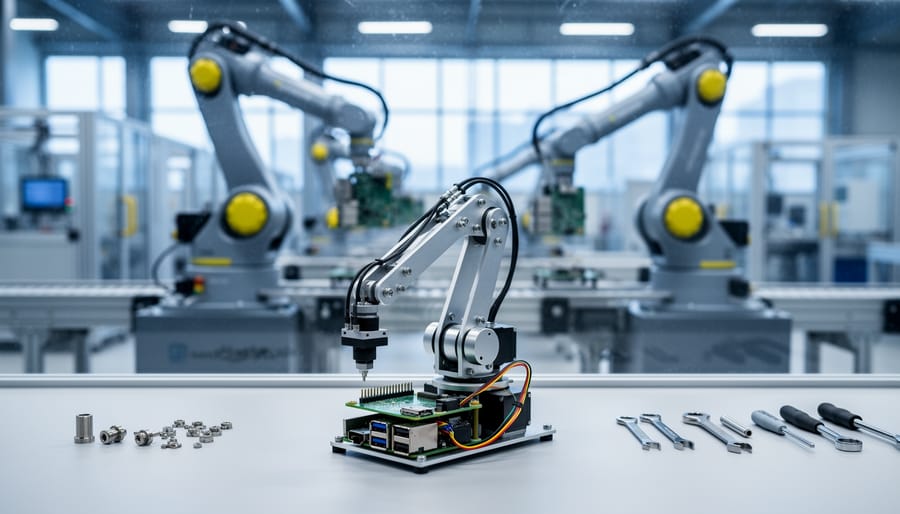
Robots have transformed factory floors from automotive assembly lines to electronics manufacturing, performing tasks with precision that would take human workers significantly more time. Tesla uses collaborative robots alongside workers to assemble vehicle components, while Amazon deploys over 520,000 robotic units in warehouses for sorting and moving inventory. Electronics giant Foxconn replaced 60,000 workers with robots in a single factory, demonstrating automation’s massive scale.
Understanding these industrial applications isn’t just for engineers at Fortune 500 companies. The same principles driving factory automation—sensor integration, precise motor control, and programmed movement—are accessible through Raspberry Pi-based projects. A robotic arm sorting products in a BMW facility operates on similar logic to a Pi-powered desktop robot you can build at home for under $150.
This article examines real manufacturing robots across automotive, electronics, food processing, and pharmaceutical industries, then connects each example to achievable Raspberry Pi projects. You’ll discover how Fanuc’s painting robots inspired DIY CNC machines, how collaborative robots (cobots) translate to educational robotic kits, and why understanding industrial pick-and-place systems helps you create your own automated sorting projects.
Whether you’re an educator seeking practical robotics examples, a hobbyist planning your next build, or simply curious about factory automation, these examples bridge the gap between million-dollar industrial systems and affordable, hands-on learning experiences. The technology powering modern manufacturing is now within reach of your workbench.
Assembly Line Robots: The Workhorses of Modern Production
Automotive Industry Automation
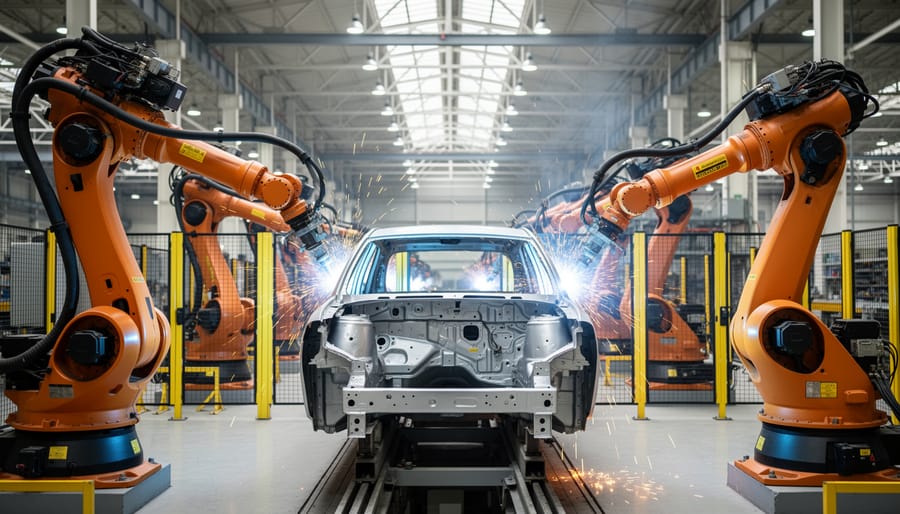
The automotive industry leads the way in robotic automation, with major manufacturers deploying thousands of robots across their production lines. Tesla’s Fremont factory utilizes over 160 automotive manufacturing robots for welding alone, performing precise spot welds on vehicle frames at speeds impossible for human workers. These robotic welders complete a Model 3 body assembly in under 90 seconds, showcasing incredible efficiency.
BMW’s Spartanburg plant employs collaborative robots that work alongside human technicians, handling repetitive tasks like windshield installation and door fitting. Their painting robots apply multiple layers of coating with precision accuracy, eliminating overspray and reducing paint waste by 30 percent compared to manual methods.
Toyota pioneered the use of robotic assembly stations in the 1980s and continues innovating today. Their Georgetown plant uses vision-guided robots for engine assembly, identifying parts through camera systems and adjusting grip positions automatically. These robots perform quality checks simultaneously, detecting defects that might escape human inspection.
For Raspberry Pi enthusiasts, these industrial examples offer exciting learning opportunities. You can replicate basic concepts using robotic arm kits controlled by your Pi, programming simple pick-and-place operations or experimenting with computer vision for part identification. Understanding how major manufacturers implement automation provides valuable insights for developing your own scaled-down manufacturing projects, from small production runs to educational demonstrations.
Electronics Manufacturing Robots
The electronics industry relies heavily on pick-and-place robots to handle delicate components with extraordinary precision. These nimble machines are the backbone of printed circuit board assembly, capable of placing thousands of tiny components per hour with accuracy measured in micrometers.
Companies like Foxconn use SCARA robots in their smartphone production lines, positioning microscopic chips and sensors onto circuit boards. These robots work alongside automated optical inspection systems that verify each placement, catching defects before they reach consumers. Samsung’s factories employ similar robotic systems that can switch between different product models within minutes, enabling flexible manufacturing at massive scale.
Component testing is another crucial application where robots excel. Automated test equipment uses robotic arms to probe circuit boards, checking electrical connections and functionality far faster than human technicians could manage. Delta robots, known for their spider-like appearance and lightning-fast movements, are particularly popular for sorting tested components into pass or fail bins.
What makes this fascinating for hobbyists is that you can explore these same concepts at home. Using a Raspberry Pi with camera modules and servo motors, you can build simplified pick-and-place systems for personal projects. Community members have created impressive DIY PCB assembly machines that demonstrate core principles used in professional factories. While your homemade version won’t match industrial speed, it provides invaluable hands-on experience with computer vision, motion control, and automation programming. These projects bridge the gap between learning about manufacturing robots and actually understanding how they work through practical experimentation.
Collaborative Robots (Cobots) Working Alongside Humans
Small-Scale Manufacturing Applications
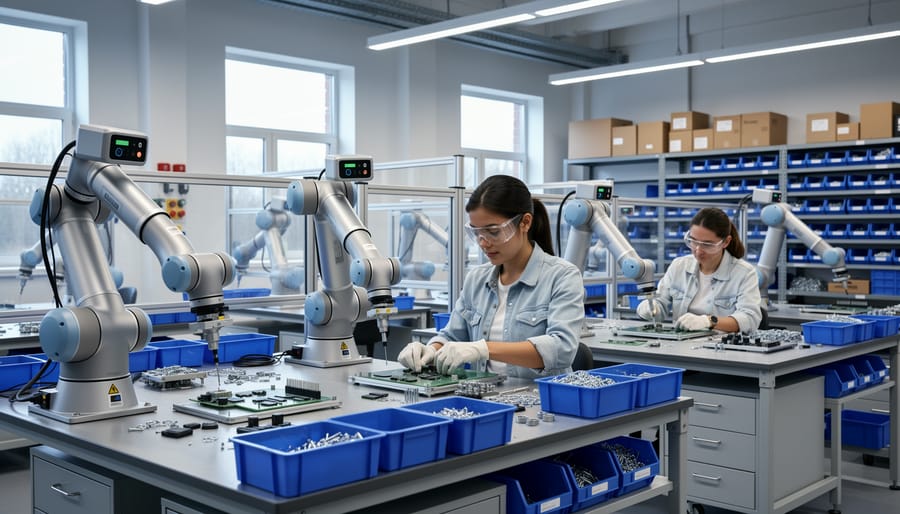
Small-scale manufacturers are discovering that collaborative robots (cobots) offer affordable automation without requiring massive factory overhauls. These compact robots excel at repetitive tasks that previously demanded dedicated human attention.
Danish company Universal Robots leads this space, with their UR series cobots helping small businesses automate packaging operations. For example, a small electronics manufacturer in Ohio uses a UR5 cobot to box circuit boards, handling quality checks through integrated vision systems while human workers focus on complex assembly tasks.
Machine tending represents another popular application. Tennessee-based precision machining shop Crenlo uses cobots to load and unload CNC machines overnight, effectively doubling production capacity without adding shifts. The robots maintain consistent part placement accuracy within 0.1mm tolerances.
Quality inspection gets a boost too. Small automotive parts suppliers deploy vision-equipped cobots to detect surface defects at rates impossible for human inspectors to match consistently.
For tech enthusiasts and educators, these real-world applications translate beautifully to Raspberry Pi projects. You can build simplified cobot controllers using Pi boards with stepper motors and camera modules, creating hands-on learning experiences that mirror industrial automation principles. Many hobbyists start by programming Pi-controlled robotic arms for pick-and-place operations, gaining practical insights into manufacturing automation fundamentals.
Building Your Own Cobot with Raspberry Pi
You can build your own collaborative robot using Raspberry Pi to understand how industrial cobots operate. Start with a Raspberry Pi 4 as your control hub, paired with servo motors or stepper motors for movement. The key difference between cobots and traditional robots is their ability to work safely alongside humans, so incorporating the right sensors is essential.
For safety, integrate ultrasonic sensors or PIR motion detectors to create awareness zones around your robot. When the sensors detect human presence within a certain distance, program your Raspberry Pi to slow down or pause operations automatically. You can use Python libraries like GPIO Zero to simplify sensor integration and motor control.
Consider adding a camera module for basic vision capabilities, allowing your cobot to identify objects or track movements. This mirrors how industrial cobots use computer vision for quality control tasks. Start with simple projects like a robotic arm that can sort objects or a mobile platform that navigates while avoiding obstacles.
Safety protocols are paramount in your design. Implement emergency stop functionality using a physical button connected to your GPIO pins. Test your cobot’s response times thoroughly and ensure all moving parts have adequate padding or guards. By building your own cobot, you’ll gain hands-on insight into the same principles that guide manufacturing automation, creating a practical learning experience that bridges hobby projects with industrial applications.
Warehouse and Material Handling Robots
Amazon’s Robotic Fulfillment Centers
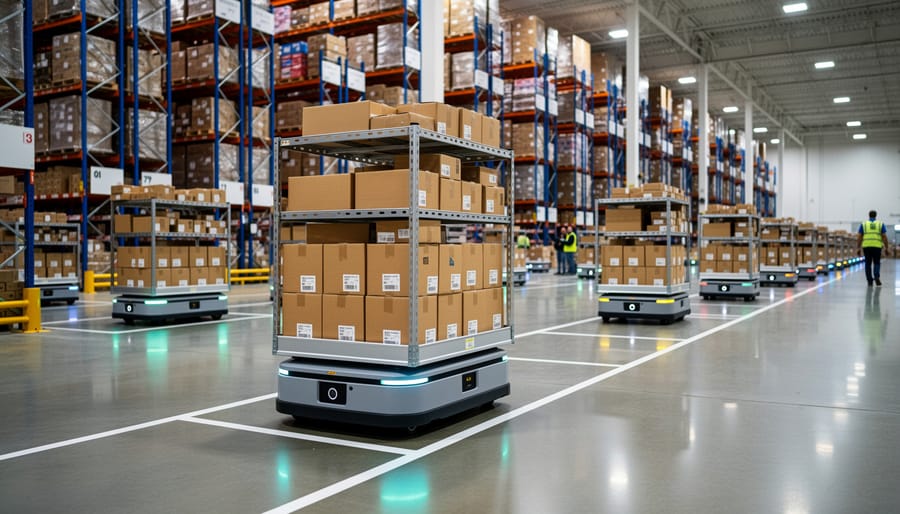
Amazon’s robotic fulfillment centers showcase automation at an impressive scale, processing millions of packages daily. The company’s Kiva robots, now branded as Amazon Robotics, revolutionized warehouse operations after Amazon acquired the technology in 2012. These orange, autonomous mobile robots navigate massive warehouses, lifting entire shelving units weighing up to 750 pounds and delivering them directly to human workers at packing stations.
The system operates with military precision. Over 200,000 mobile robots work across Amazon’s global network, moving inventory across specially marked floor grids. Each robot uses QR codes and sensors to navigate, communicating with a central management system that optimizes routes and prevents collisions. This eliminates the need for workers to walk miles daily searching for items, reducing order processing time from hours to minutes.
Beyond mobile robots, Amazon employs sophisticated sorting systems using computer vision and machine learning. Robotic arms equipped with cameras identify packages, read labels, and route items to correct shipping lanes at speeds exceeding 600 packages per hour. The company’s newest facilities integrate palletizing robots that stack boxes for shipping and autonomous delivery vehicles for last-mile transport.
For DIY enthusiasts, these systems offer fascinating learning opportunities. You can build simplified warehouse automation projects using Raspberry Pi, motor controllers, and line-following sensors. Creating a basic automated sorting system or building a small-scale mobile robot that delivers items between stations provides hands-on experience with the same concepts Amazon uses, just at a hobbyist scale. These projects teach valuable lessons in robotics, programming, and logistics optimization.
DIY Navigation Robots with Raspberry Pi
Warehouse robots in manufacturing rely on sophisticated navigation techniques, but you can explore these same concepts at home using a Raspberry Pi. Two popular approaches are line-following robots and SLAM-based navigation systems, both offering hands-on learning opportunities that mirror industrial applications.
Line-following robots represent the simplest entry point into warehouse automation concepts. Using infrared sensors connected to your Raspberry Pi’s GPIO pins, you can create a robot that tracks colored tape paths, similar to how Amazon’s mobile robots follow floor markers. This project requires basic components like a Pi Zero W, motor driver board, infrared sensors, and a chassis kit. The Python code reads sensor data and adjusts motor speeds to keep the robot centered on the line, teaching fundamental concepts of automated guided vehicles used in factories.
For a more advanced challenge, SLAM (Simultaneous Localization and Mapping) enables your robot to navigate without predefined paths. By adding a Lidar sensor or Raspberry Pi Camera Module to your bot, you can implement autonomous navigation systems that map environments in real-time. Open-source tools like ROS (Robot Operating System) work excellently on Raspberry Pi 4, allowing you to experiment with the same mapping algorithms warehouse robots use to avoid obstacles and optimize routes.
Start with line-following to grasp basic sensor integration and motor control, then progress to SLAM when you’re comfortable with more complex programming. Both projects demonstrate how manufacturing automation principles translate directly into achievable DIY robotics, helping you understand the technology reshaping modern factories while building practical skills.
Quality Inspection and Vision Systems
Industrial Vision Systems in Action
Major vision system providers like Cognex and Keyence demonstrate how machine vision revolutionizes quality control in manufacturing. Cognex’s vision systems inspect everything from pharmaceutical packaging to automotive parts, catching defects invisible to human eyes at speeds exceeding 1,000 parts per minute. Their systems use advanced algorithms to verify label placement, detect surface scratches, and ensure dimensional accuracy across production lines.
Keyence takes a similar approach with their CV-X series vision systems, which manufacturers use for everything from checking solder joints on circuit boards to verifying food packaging seals. These systems combine high-resolution cameras with powerful processing units to make split-second decisions about product quality.
What’s exciting for makers and educators is that you can explore these same principles using affordable hardware. A Raspberry Pi equipped with a camera module and OpenCV software library lets you build your own inspection systems. You can create projects that detect color variations, measure object dimensions, or identify defects in 3D-printed parts. While industrial systems process thousands of items per minute, your Raspberry Pi setup can handle quality checks for small-batch production or educational demonstrations, teaching the same core concepts that power million-dollar factory installations.
Raspberry Pi Camera Inspection Projects
Building your own manufacturing inspection system with a Raspberry Pi is more accessible than you might think. These projects teach fundamental concepts used in industrial automation while remaining budget-friendly and beginner-approachable.
Start with a defect detection system using a Raspberry Pi 4 and Camera Module V2. Mount the camera above a conveyor belt or rotating platform to capture images of objects. Using OpenCV and Python, you can write scripts that compare captured images against known good samples, identifying scratches, dents, or missing components. This mirrors quality control systems in automotive and electronics manufacturing.
For color sorting applications, combine your Pi camera with edge computing capabilities to process images in real-time. Train a simple machine learning model using TensorFlow Lite to classify objects by color, then trigger servo motors or air jets to sort items accordingly. This replicates candy sorting or recycling systems used industrially.
Measurement systems offer another practical application. By implementing calibration techniques and image analysis, your Raspberry Pi can measure dimensions, count items, or detect positioning errors. Add LED ring lights for consistent illumination, ensuring accurate readings regardless of ambient conditions.
These hands-on projects provide direct insight into how vision-guided robots function in modern factories, making complex manufacturing concepts tangible and educational.
3D Printing and Additive Manufacturing Robots
Industrial Additive Manufacturing Examples
GE Aviation has revolutionized jet engine manufacturing with robotic 3D printing systems that create fuel nozzles in a single piece, replacing what previously required 20 welded components. Their LEAP engine features these additively manufactured parts, reducing weight by 25% while improving durability. Stratasys customers like Boom Supersonic use robotic additive manufacturing to produce complex aircraft components that would be impossible with traditional methods.
Siemens employs robotic metal printing systems to create gas turbine burners with intricate cooling channels, achieving designs that optimize airflow and heat management. Desktop Metal’s production systems demonstrate how smaller manufacturers can access this technology, with companies like Pankl Racing Systems producing high-performance automotive parts.
For tech enthusiasts, understanding these industrial examples provides valuable insights into how robotic motion control and layered manufacturing work. While industrial systems cost millions, the fundamental principles mirror what hobbyists explore with DIY 3D printer projects using Raspberry Pi controllers. These professional applications showcase the endpoint of additive manufacturing technology, inspiring makers to experiment with automated printing solutions and multi-axis robotic arms at smaller scales.
Controlling 3D Printers with Raspberry Pi
Manufacturing automation isn’t limited to factory floors—you can control your own production line at home using a Raspberry Pi and 3D printer. OctoPrint is the most popular open-source solution that transforms your Pi into a powerful print server, letting you monitor and control your printer remotely from any device with a web browser.
Once installed, OctoPrint provides a clean web interface where you can upload G-code files, start or pause prints, and adjust temperatures in real-time. The built-in webcam support lets you watch your prints progress from anywhere, catching potential failures before they waste filament. You can even create time-lapse videos of your manufacturing process automatically.
The real power comes through plugins that extend functionality. Add automatic bed leveling, integrate with your smart home system, or set up email notifications when prints complete. For educators and hobbyists, this setup demonstrates the same monitoring and automation principles used in industrial manufacturing, just scaled down.
Beyond OctoPrint, alternatives like Repetier-Server and Mainsail offer different features, but all share the same goal: transforming standalone 3D printers into connected manufacturing tools. This hands-on experience gives you practical insight into Industry 4.0 concepts while producing useful objects.
Getting Started: Your First Manufacturing-Inspired Raspberry Pi Robot
Essential Components and Tools
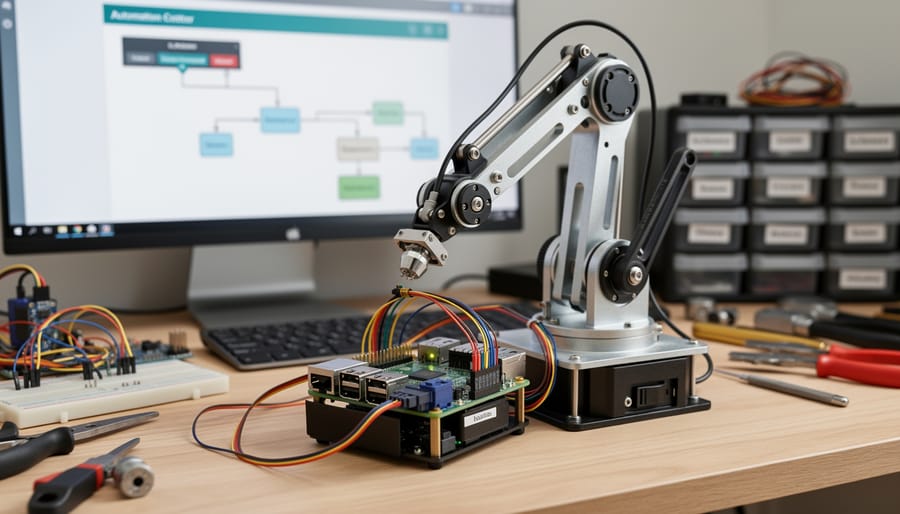
Ready to build your own manufacturing-inspired robot? Here’s your essential shopping list to get started. For the brain of your operation, choose a Raspberry Pi 4 Model B (4GB or 8GB RAM) for demanding tasks, or a Raspberry Pi Zero 2 W for compact, lightweight projects. You’ll need motors to create movement—consider DC motors with L298N motor drivers for basic conveyor systems, or servo motors like the SG90 for precise robotic arm joints.
Sensors are crucial for replicating what automation engineers use in real factories. Pick up ultrasonic sensors (HC-SR04) for distance measurement and obstacle detection, infrared sensors for line-following capabilities, and a Raspberry Pi Camera Module V2 for basic computer vision tasks like quality inspection.
Don’t forget the accessories: a reliable power supply (5V 3A), breadboards and jumper wires for prototyping, GPIO extension boards for easier connections, and a microSD card (32GB minimum) for your operating system. For mechanical components, consider buying or 3D printing robot chassis kits, gripper mechanisms for pick-and-place operations, and mounting brackets. This foundation lets you experiment with manufacturing concepts while keeping costs manageable for hobbyists and educators alike.
Three Starter Projects to Try
Ready to bring manufacturing concepts to life with your Raspberry Pi? Here are three approachable projects that mirror real industrial applications, each designed to build your skills progressively.
Project 1: Simple Pick-and-Place Arm
Difficulty: Beginner (2/5)
Start with a basic robotic arm using servo motors controlled by your Raspberry Pi. This project replicates the fundamental task performed by industrial robots like those in electronics assembly. You’ll program the arm to pick up small objects from one location and place them in another, learning about servo control, GPIO programming, and basic coordinate systems. Use Python libraries like RPi.GPIO or gpiozero to send precise commands. This build requires minimal investment—just a few servos, a basic arm kit, and jumper wires—making it perfect for first-time robot builders.
Project 2: Line-Following AGV
Difficulty: Intermediate (3/5)
Create your own automated guided vehicle using a Raspberry Pi, motor driver, and infrared sensors. This project mimics the warehouse robots used by companies like Amazon. Your AGV will follow black tape lines on the floor, teaching you about sensor integration, motor control, and decision-making algorithms. Add complexity by implementing intersection detection or obstacle avoidance using ultrasonic sensors. The programming involves reading sensor data continuously and adjusting motor speeds accordingly—a fundamental skill in robotics.
Project 3: Basic Vision Inspection System
Difficulty: Advanced (4/5)
Build a quality control system using the Raspberry Pi Camera Module and OpenCV. This project mirrors industrial vision systems that detect defects in products. Program your setup to identify color variations, measure dimensions, or detect missing components in objects passing before the camera. You’ll explore image processing, machine learning basics, and real-time analysis—skills directly applicable to modern smart manufacturing environments.
The industrial robotics examples we’ve explored throughout this article demonstrate that automation principles aren’t exclusive to massive factories with million-dollar budgets. Whether it’s Tesla’s assembly line robots, Amazon’s warehouse automation, or precision electronics manufacturing, the core concepts translate remarkably well to DIY projects using affordable platforms like Raspberry Pi.
The beauty of starting your robotics journey today is accessibility. A Raspberry Pi, some servo motors, and basic sensors can replicate many foundational automation concepts used by major manufacturers. You don’t need to build a complete assembly line on day one. Start with a simple pick-and-place mechanism, experiment with computer vision for quality inspection, or create a basic conveyor sorting system. Each small project builds your understanding of sensors, actuators, programming logic, and system integration.
The learning curve from hobbyist projects to understanding industrial applications is shorter than you might think. The same Python code controlling your Raspberry Pi robot arm uses similar logic to industrial programmable logic controllers. Computer vision techniques you implement with a Pi Camera mirror those used in factory inspection systems. Motion control principles remain consistent whether you’re moving a small stepper motor or coordinating multiple industrial robots.
Don’t let the scale of manufacturing robotics intimidate you. Every expert started with basic circuits and simple programs. Your Raspberry Pi is the perfect gateway to understanding automation, offering hands-on experience with real-world robotics principles. Start experimenting today, embrace the learning process, and watch your automation skills grow from simple projects to increasingly sophisticated systems.