

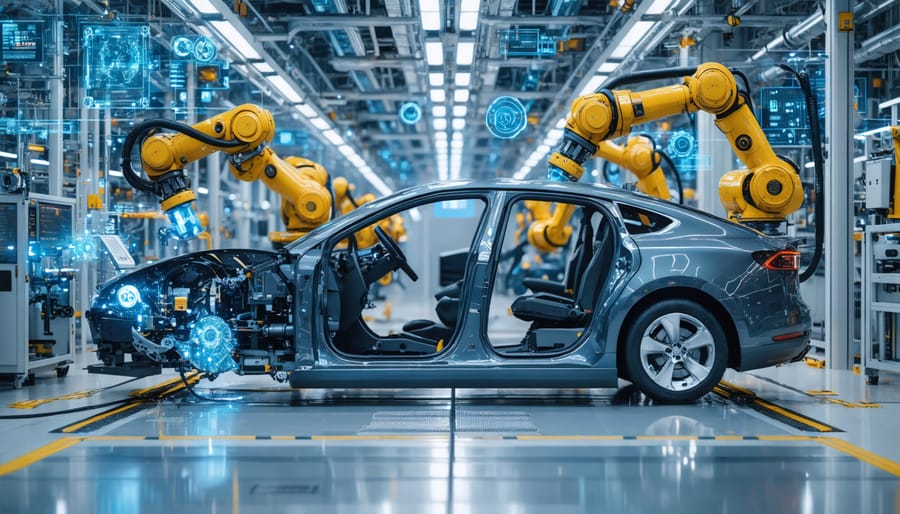
Robotics has revolutionized automotive manufacturing, transforming vehicle production from a labor-intensive process into a high-precision, automated symphony of mechanical efficiency. Today, over 50% of all automotive assembly operations are performed by robots, enabling manufacturers to produce a new car every 45-90 seconds while maintaining exceptional quality standards. These mechanical marvels perform everything from welding and painting to complex assembly tasks, working alongside human operators in sophisticated collaborative environments.
The integration of advanced robotics has not only accelerated production speeds and improved consistency but has also enhanced workplace safety by taking over hazardous tasks and reducing human exposure to dangerous conditions. Modern automotive plants employ thousands of robots, each programmed with incredible precision to perform specific tasks within tolerances of less than a millimeter. This technological evolution represents one of the most successful implementations of industrial automation, setting new benchmarks for manufacturing efficiency and product quality.
As we enter an era of smart manufacturing and Industry 4.0, robotics continues to evolve, incorporating artificial intelligence, machine learning, and advanced sensors to create even more adaptive and intelligent production systems. This technological convergence is reshaping the future of automotive manufacturing, promising even greater efficiency, flexibility, and innovation in vehicle production.
The Evolution of Automotive Manufacturing Robots
From Manual Assembly to Smart Factories
The automotive manufacturing landscape has undergone a remarkable transformation since Henry Ford’s revolutionary assembly line in 1913. The journey from manual assembly to today’s automated manufacturing systems showcases the industry’s commitment to innovation. In the 1960s, General Motors introduced the first industrial robot, Unimate, marking the beginning of robotics in automotive assembly. The 1980s saw widespread adoption of robotic welding and painting systems, significantly improving precision and worker safety.
The 1990s brought sophisticated programmable logic controllers (PLCs) and more advanced sensors, enabling smarter automation. By the early 2000s, collaborative robots began working alongside humans, breaking down traditional barriers between machines and workers. Today’s smart factories feature AI-powered robots, IoT connectivity, and real-time data analytics, creating an interconnected ecosystem that optimizes production efficiency while maintaining unprecedented quality standards. This evolution continues as manufacturers integrate more sophisticated technologies, paving the way for Industry 4.0 innovations.
Key Technological Breakthroughs
Several groundbreaking innovations have revolutionized automotive manufacturing robotics. The introduction of advanced sensors and machine vision systems enabled robots to precisely identify and handle components with unprecedented accuracy. This was complemented by the development of six-axis industrial robots, which provided the flexibility to perform complex assembly tasks from multiple angles.
The integration of artificial intelligence and machine learning algorithms marked another crucial milestone, allowing robots to adapt to manufacturing variations and optimize their movements in real-time. Force-feedback technology emerged as a game-changer, enabling robots to apply just the right amount of pressure during delicate operations like windshield installation and paint application.
Collaborative robots (cobots) represent a more recent breakthrough, featuring advanced safety systems that allow them to work alongside human operators without protective barriers. The development of modular programming interfaces has also simplified robot deployment and reconfiguration, making it easier for manufacturers to adapt their production lines to new vehicle models.
These innovations collectively transformed automotive manufacturing from rigid assembly lines into flexible, intelligent production systems capable of handling multiple vehicle variants simultaneously.
Core Robotic Systems in Modern Car Manufacturing
Welding and Assembly Robots
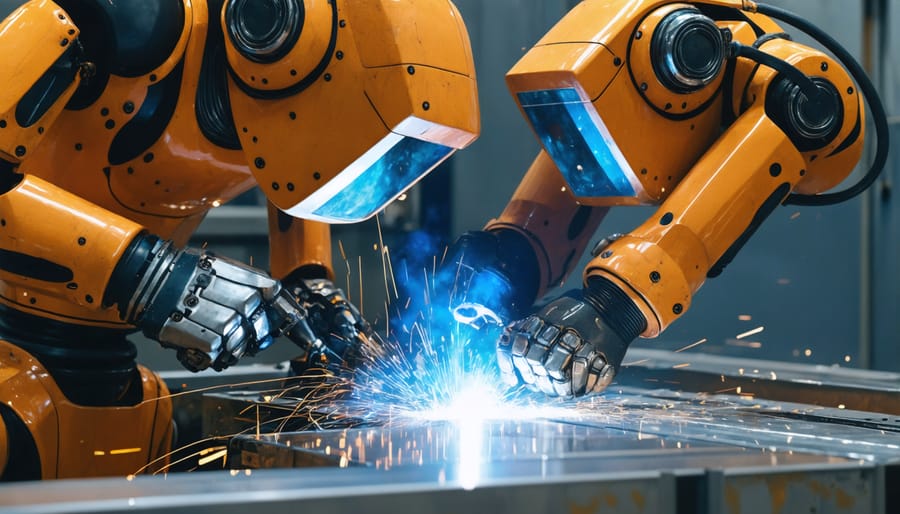
Welding and assembly robots form the backbone of modern automotive manufacturing, performing complex tasks with unprecedented precision and consistency. These sophisticated machines utilize advanced sensors, computer vision systems, and precise control mechanisms to execute thousands of welds per vehicle with microscopic accuracy. In a typical automotive assembly line, multiple robotic arms work in synchronized harmony, performing spot welding, arc welding, and various assembly operations.
Modern welding robots can adapt to different vehicle models in real-time, thanks to advanced programming and artificial intelligence integration. They’re equipped with force-feedback sensors that ensure optimal pressure during welding operations and can detect and correct errors automatically. The integration of collaborative robots in manufacturing has further enhanced the flexibility of assembly lines, allowing humans and robots to work together safely in shared spaces.
These robotic systems typically achieve welding speeds of up to 60 inches per minute while maintaining consistent quality across thousands of welds. The precision they offer has significantly reduced material waste and improved overall vehicle structural integrity. Additionally, modern assembly robots can handle multiple tasks beyond welding, including applying adhesives, installing windshields, and mounting various components, all while communicating with other automated systems through industrial IoT networks.
Paint Application Systems
Automotive paint application has been revolutionized by robotic systems, offering unprecedented precision and consistency in finish quality. Modern painting robots utilize advanced spray guns mounted on six-axis arms, capable of maintaining optimal distance and angle from vehicle surfaces throughout the entire process. These robots can apply multiple layers of primer, base coat, and clear coat with microscopic accuracy, typically achieving thickness variations of less than 1 micron.
The robots are equipped with sophisticated vision systems and real-time feedback sensors that monitor paint thickness, coverage uniformity, and environmental conditions. This ensures perfect color matching and finish across different body panels. A typical automotive paint shop employs multiple robots working in synchronized harmony, completing a full vehicle paint job in under 2 hours – a task that would take human painters significantly longer.
These automated systems also incorporate advanced paint recycling and filtration mechanisms, reducing waste by up to 95% compared to traditional methods. Modern paint robots can switch colors rapidly without cross-contamination, allowing manufacturers to paint vehicles of different colors back-to-back on the same production line. The precision of robotic painting not only improves aesthetic quality but also enhances corrosion protection and durability of the finish, contributing to longer vehicle lifespans and higher customer satisfaction.
Material Handling and Logistics Robots
Material handling and logistics robots have revolutionized automotive manufacturing by streamlining the movement of parts, components, and finished vehicles throughout the factory floor. Automated Guided Vehicles (AGVs) and Autonomous Mobile Robots (AMRs) navigate factory floors using sophisticated sensor systems and AI algorithms, delivering materials to assembly stations with precision timing.
These robots work tirelessly to manage inventory systems, employing RFID tracking and real-time monitoring to ensure just-in-time delivery of components. Modern automotive facilities utilize smart warehousing systems where robotic storage and retrieval systems (AS/RS) can automatically locate, pick, and transport parts from high-density storage racks.
Collaborative mobile robots, or “cobots,” work alongside human operators to handle heavy components and awkward loads, reducing workplace injuries and improving efficiency. These systems can lift and transport anything from engine blocks to complete chassis assemblies, maintaining consistent workflow throughout the production line.
The integration of IoT sensors and cloud-based management systems allows these robots to communicate with each other and central control systems, optimizing routes and preventing bottlenecks. This smart logistics network can adapt in real-time to production changes, equipment maintenance needs, or unexpected delays, ensuring smooth operations across the facility.
Modern automotive plants typically employ hundreds of these automated material handlers, resulting in significant reductions in operational costs and improved production efficiency while maintaining strict quality control standards.
Integration with IoT and AI
Smart Sensors and Real-time Monitoring
Modern automotive manufacturing relies heavily on sophisticated sensor networks that transform factory floors into intelligent, data-driven environments. These smart sensors form the backbone of real-time monitoring systems, enabling robots to perform complex tasks with unprecedented precision and adaptability.
Advanced vision sensors equipped with AI capabilities allow robots to identify and inspect components, detect defects, and make split-second adjustments during assembly. Pressure sensors and force-feedback systems ensure proper component placement and joining operations, while proximity sensors prevent collisions and maintain safe distances between robots and human workers.
The implementation of edge computing in robotics has revolutionized how these sensor networks process and respond to data. Instead of sending all information to a central server, robots can now make instant decisions based on local sensor input, significantly reducing latency and improving overall efficiency.
These sensor systems also collect valuable manufacturing data, including cycle times, quality metrics, and maintenance indicators. This information feeds into predictive maintenance algorithms that can forecast potential equipment failures before they occur, minimizing downtime and maintaining consistent production flow.
Real-time monitoring extends beyond individual robots to encompass entire production lines, creating a synchronized network where each machine communicates and coordinates with others to optimize workflow and maintain quality standards.
Predictive Maintenance and Quality Control
In modern automotive manufacturing, AI-powered predictive maintenance systems have revolutionized how robots and equipment are monitored and maintained. These smart systems continuously analyze data from sensors embedded throughout the production line, detecting potential issues before they cause costly breakdowns. Machine learning algorithms process vibration patterns, temperature readings, and performance metrics to predict when components might fail, allowing maintenance teams to schedule repairs during planned downtime.
Quality control has similarly evolved with the integration of computer vision and AI. Advanced cameras and sensors inspect every component with superhuman precision, checking for defects in welding, paint finish, and assembly alignment. These systems can detect irregularities as small as a fraction of a millimeter, ensuring consistent quality across thousands of vehicles.
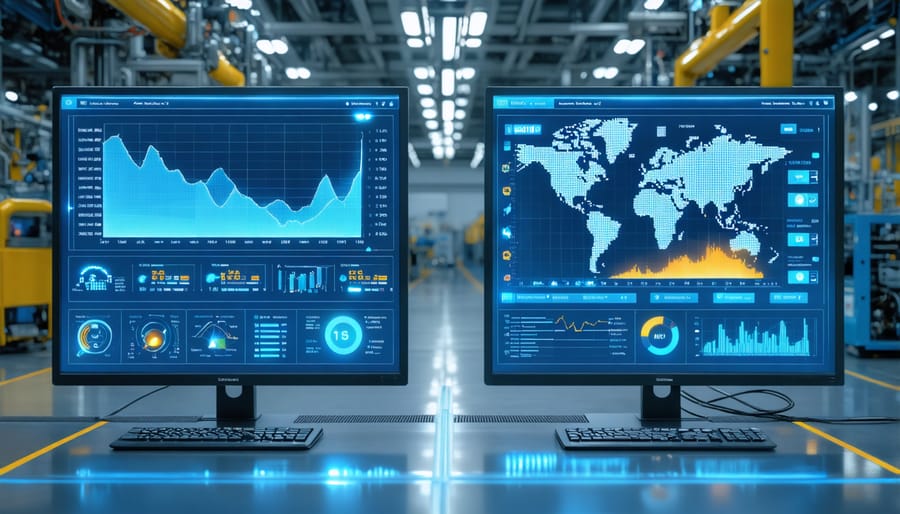
Real-time monitoring dashboards provide factory operators with instant feedback on production quality and equipment health. When potential issues are detected, the system automatically alerts relevant personnel and can even adjust robot parameters to maintain optimal performance. This proactive approach has significantly reduced defect rates and maintenance costs while improving overall production efficiency.
The combination of predictive maintenance and automated quality control has led to a remarkable 99.9% first-time-through rate in many modern automotive plants, meaning fewer repairs and rework are needed. This level of precision and reliability was unimaginable just a decade ago, demonstrating how AI and robotics continue to transform automotive manufacturing.
Impact on Production Efficiency
Production Speed and Accuracy Improvements
The implementation of robotic process automation in automotive manufacturing has led to remarkable improvements in both production speed and accuracy. Modern robotic systems can perform repetitive tasks up to 50% faster than human workers while maintaining a consistent error rate of less than 0.1%. This translates to significant improvements in overall production metrics.
For instance, automated welding robots can complete up to 140 spot welds per minute, compared to the human average of 20-25 welds. Paint application robots achieve 20% better coverage uniformity while reducing overspray waste by 30%. Assembly line robots working on components like dashboards and engines demonstrate 99.9% accuracy in part placement, dramatically reducing the need for quality control inspections and rework.
These improvements have helped manufacturers reduce production time per vehicle from an average of 24 hours to just 13 hours, while simultaneously improving build quality and consistency. The precision of robotic systems has also contributed to a 35% reduction in material waste across various manufacturing processes.
Cost Savings and ROI Analysis
The implementation of robotics in automotive manufacturing presents compelling financial benefits, with most manufacturers seeing ROI within 2-3 years of initial deployment. Studies show that robotic systems can reduce labor costs by 40-50% while increasing production efficiency by up to 30%. A single robotic welding cell, for instance, can perform the work of 3-4 human welders while maintaining consistent quality and operating 24/7.
The initial investment for industrial robots varies significantly, typically ranging from $50,000 to $200,000 per unit, with additional costs for programming, installation, and maintenance. However, these costs are offset by reduced waste (15-20% decrease), lower warranty claims due to improved quality control, and decreased workplace injury expenses.
Modern automotive plants using advanced robotics report annual savings of $3-5 million in operating costs per production line. Energy efficiency improvements through precise movement control and optimized operation schedules contribute an additional 10-15% cost reduction. When factoring in increased production capacity and reduced material waste, the total cost benefit can exceed $8 million annually for a medium-sized manufacturing facility.
Robotics has revolutionized automotive manufacturing, transforming it from a labor-intensive industry into a highly efficient, precise, and quality-driven operation. The integration of robots has not only increased production capacity and consistency but has also improved workplace safety and reduced costs significantly. Today’s automotive plants showcase the perfect harmony between human expertise and robotic capabilities, setting new standards for manufacturing excellence.
Looking ahead, the future of robotics in automotive manufacturing appears even more promising. The emergence of collaborative robots (cobots), artificial intelligence, and machine learning is pushing the boundaries of what’s possible on the production line. We’re seeing developments in more adaptive and flexible robotic systems that can handle multiple tasks and respond to real-time changes in production requirements.
As electric vehicles gain prominence and manufacturing processes become more complex, robotics will play an increasingly crucial role. The industry is moving towards smarter factories with interconnected robotic systems, real-time data analytics, and predictive maintenance capabilities. This evolution will not only enhance production efficiency but also contribute to more sustainable manufacturing practices.
While automation continues to advance, the human element remains irreplaceable. The future will likely see an even greater emphasis on human-robot collaboration, with workers focusing on strategic oversight, programming, and maintenance while robots handle repetitive and physically demanding tasks. This symbiotic relationship will continue to drive innovation and excellence in automotive manufacturing.