
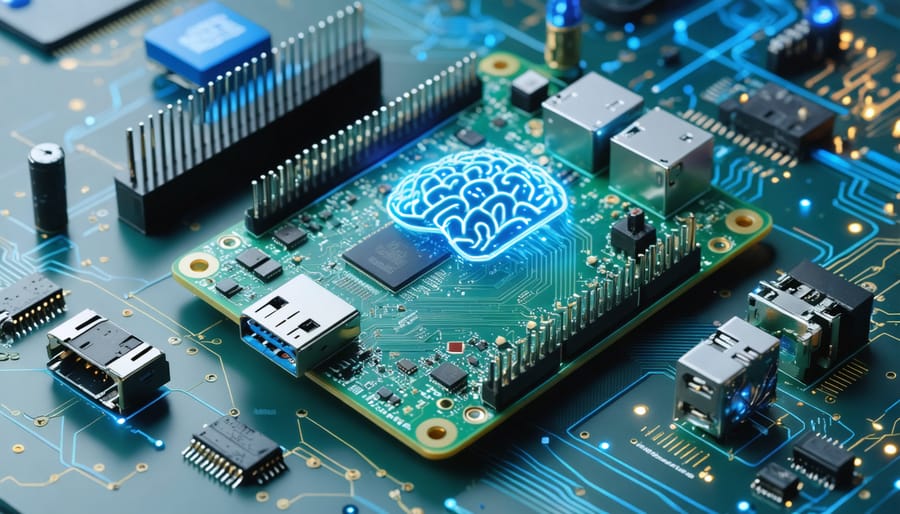
Machine learning on embedded systems represents a revolutionary frontier where computational intelligence meets real-world applications. By bringing AI capabilities directly to edge devices, we’re witnessing a fundamental shift in how smart devices operate, process data, and make decisions without constant cloud connectivity.
The convergence of ML and embedded systems addresses critical challenges in latency, privacy, and power consumption that cloud-based solutions can’t match. Imagine a security camera that doesn’t just record but instantly recognizes threats, or a medical device that monitors vital signs and predicts emergencies in real-time – all while operating within strict resource constraints.
Today’s embedded systems, from microcontrollers to single-board computers like Raspberry Pi, are increasingly capable of running sophisticated ML models. This capability opens doors to innovations in predictive maintenance, autonomous systems, and intelligent IoT devices. However, successful implementation requires careful consideration of memory limitations, processing power, and energy efficiency.
For developers and engineers, this intersection presents both exciting opportunities and unique challenges. The key lies in optimizing ML models for embedded deployment while maintaining accuracy and performance. Through techniques like model quantization, pruning, and efficient architecture design, it’s possible to create powerful AI solutions that run effectively on resource-constrained devices.
As we continue to push the boundaries of what’s possible with embedded ML, we’re not just creating smarter devices – we’re fundamentally changing how we interact with technology in our daily lives.
Getting Your Raspberry Pi Ready for Machine Learning
Hardware Requirements and Recommendations
For successful machine learning implementation on embedded systems, specific hardware requirements must be met to ensure optimal performance. At minimum, you’ll need a processor with at least 1GHz clock speed and support for ARM architecture. The Raspberry Pi 4 Model B with 4GB RAM serves as an excellent baseline platform, though 8GB is recommended for more complex models.
Storage requirements vary based on your project scope, but a minimum of 16GB is necessary, with 32GB or more recommended for larger datasets and models. Using a high-quality Class 10 microSD card or USB 3.0 SSD can significantly improve data transfer speeds and overall system responsiveness.
Power supply considerations are crucial – a stable 5V/3A power source is essential to prevent performance throttling. Learning to optimize power consumption can help maintain system stability during intensive processing tasks.
For neural network operations, consider adding a USB accelerator like the Google Coral TPU or Intel Neural Compute Stick 2. These dedicated AI processors can dramatically improve inference speed while reducing main CPU load.
Cooling solutions are often overlooked but vital – a heatsink and small fan can prevent thermal throttling during extended ML operations. For portable applications, factor in battery capacity and charging solutions to ensure consistent performance in the field.
Software Stack Configuration
Setting up the right software stack is crucial for successful machine learning implementation on your Raspberry Pi. The most popular and efficient ML framework for Pi is TensorFlow Lite, specifically optimized for embedded systems. This lightweight version maintains core functionality while reducing resource requirements.
Python-based libraries like NumPy and scikit-learn provide essential tools for data preprocessing and basic ML algorithms. For deep learning tasks, you can also use PyTorch Mobile, which offers good compatibility with Pi’s ARM architecture. Remember to secure your Raspberry Pi before installing these frameworks to protect your ML applications.
OpenCV is invaluable for computer vision projects, while Edge Impulse provides an excellent platform for developing and deploying ML models specifically for embedded systems. For beginners, Google’s Coral framework offers pre-compiled libraries and models optimized for Pi.
Installation tips:
– Use pip3 for Python package management
– Install 32-bit versions of frameworks when available
– Optimize your swap space for better performance
– Consider using virtual environments to manage dependencies
Most of these frameworks can be installed through simple terminal commands, making setup straightforward even for newcomers to embedded ML development.
Optimizing ML Models for Embedded Systems
Model Compression Techniques
Running machine learning models on embedded systems like the Raspberry Pi often requires clever optimization to fit within limited resources. Model compression techniques help achieve this balance between performance and efficiency, making sophisticated AI applications possible on modest hardware.
Quantization is one of the most effective compression methods, reducing the precision of weights from 32-bit floating-point numbers to 8-bit integers or even lower. This technique can shrink model size by up to 75% while maintaining most of the accuracy. For instance, a neural network that originally required 100MB might run comfortably at 25MB after quantization.
Pruning is another powerful approach that removes unnecessary connections in neural networks. Think of it as trimming away the least important branches of a tree while keeping the essential structure intact. By identifying and removing neurons that contribute little to the final output, pruning can reduce model size by 30-90% with minimal impact on accuracy.
Knowledge distillation transfers learning from a larger “teacher” model to a smaller “student” model. The student learns to mimic the behavior of the more complex teacher, achieving similar results with a fraction of the parameters. This technique is particularly useful when you need to deploy sophisticated models like BERT or ResNet on resource-constrained devices.
Weight sharing groups similar parameters together, allowing multiple connections to use the same weights. This technique can significantly reduce memory requirements while preserving model performance. Combined with Huffman coding for efficient storage, weight sharing can achieve compression ratios of up to 40x.
When implementing these techniques, it’s important to start with the least aggressive compression and gradually increase it while monitoring performance. Many modern deep learning frameworks include built-in compression tools, making it easier to experiment with different approaches until you find the right balance for your specific application.

Quantization and Optimization
When deploying machine learning models on embedded systems like the Raspberry Pi, optimizing your model is crucial for achieving better performance with limited resources. Quantization is one of the most effective techniques, reducing model size and improving inference speed without significantly impacting accuracy.
Model quantization converts floating-point weights to lower-precision formats, such as 8-bit integers. This process can reduce your model’s memory footprint by up to 75% while potentially increasing inference speed by 2-4 times. For instance, a typical image classification model might shrink from 100MB to 25MB after quantization, making it much more suitable for embedded deployment.
Several optimization strategies can further enhance your model’s performance:
1. Pruning: Remove unnecessary connections and neurons from your model, reducing complexity while maintaining accuracy. Start with a larger model and gradually remove the least important components based on their impact on performance.
2. Knowledge Distillation: Train a smaller “student” model to mimic a larger “teacher” model’s behavior. This technique often results in compact models that retain most of the original performance characteristics.
3. Layer Fusion: Combine multiple layers that perform sequential operations into a single optimized layer, reducing memory access and computational overhead.
4. Weight Sharing: Group similar weights together and represent them with a single shared value, significantly reducing model size while maintaining reasonable accuracy.
Popular frameworks like TensorFlow Lite and PyTorch Mobile provide built-in tools for these optimizations. For example, using TensorFlow Lite’s post-training quantization on a MobileNet model can reduce inference time from 200ms to 80ms on a Raspberry Pi 4.
Remember to benchmark your model before and after optimization to ensure the trade-off between performance and accuracy meets your application’s requirements. Start with the simplest optimization technique (usually quantization) and progressively apply more advanced methods if needed.
Practical ML Projects for Your Raspberry Pi
Image Recognition System
Building a basic image recognition system on your embedded device starts with gathering the essential components: a Raspberry Pi (preferably 3B+ or newer), a camera module, and necessary software libraries. Let’s walk through the process of creating a simple yet effective computer vision system.
First, install the required libraries on your Raspberry Pi. You’ll need OpenCV for image processing, TensorFlow Lite for the machine learning framework, and NumPy for numerical computations. Use pip to install these packages:
“`
pip3 install opencv-python
pip3 install tflite-runtime
pip3 install numpy
“`
Next, connect your camera module to the Raspberry Pi and enable it through raspi-config. Test the camera using a simple Python script to ensure it’s working correctly:
“`python
import cv2
cap = cv2.VideoCapture(0)
ret, frame = cap.read()
cv2.imwrite(‘test_image.jpg’, frame)
cap.release()
“`
For the machine learning component, we’ll use a pre-trained MobileNetV2 model, which offers a good balance between accuracy and performance on embedded systems. Download the model and labels file from TensorFlow’s model repository.
Here’s a basic implementation that captures images and performs real-time classification:
“`python
import tflite_runtime.interpreter as tflite
import numpy as np
interpreter = tflite.Interpreter(model_path=”mobilenet_v2.tflite”)
interpreter.allocate_tensors()
input_details = interpreter.get_input_details()
output_details = interpreter.get_output_details()
while True:
ret, frame = cap.read()
resized = cv2.resize(frame, (224, 224))
input_data = np.expand_dims(resized, axis=0)
interpreter.set_tensor(input_details[0][‘index’], input_data)
interpreter.invoke()
output_data = interpreter.get_tensor(output_details[0][‘index’])
“`
To optimize performance, consider these tips:
– Use model quantization to reduce memory usage
– Implement frame skipping if real-time performance isn’t critical
– Resize images to the minimum required resolution
– Use threading to separate image capture from processing
This basic system can be enhanced by adding features like object detection, face recognition, or custom model training for specific use cases. Remember to monitor your system’s resource usage and adjust parameters accordingly to maintain stable performance.
Sensor Data Analysis
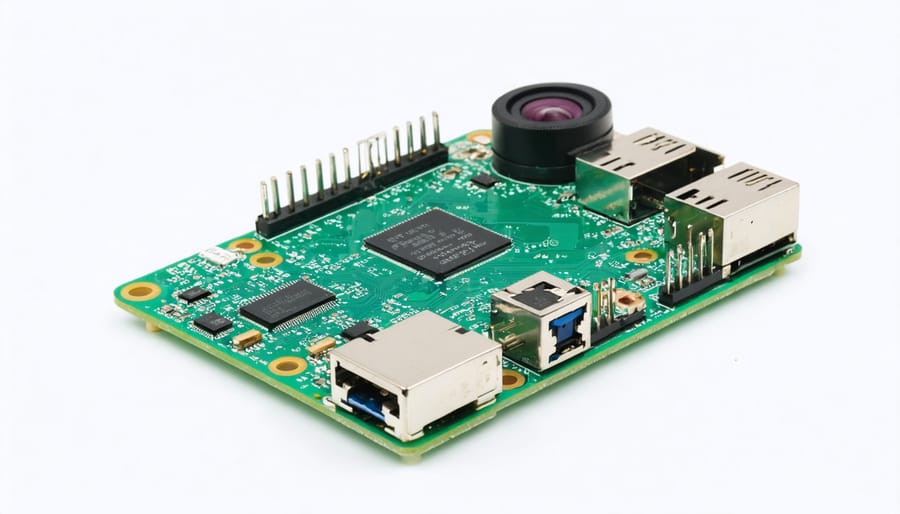
Sensor data analysis forms the backbone of many machine learning applications on embedded systems. When it comes to connecting sensors to Raspberry Pi, the quality of your data processing pipeline can make or break your project’s success.
The first step in creating an effective ML model for sensor data is preprocessing. Raw sensor data often contains noise, outliers, and missing values that need to be addressed. Common preprocessing techniques include:
– Moving average filters to smooth noisy data
– Interpolation to handle missing values
– Normalization to scale data within consistent ranges
– Feature extraction to identify meaningful patterns
For real-time applications, it’s crucial to implement efficient data collection methods. The process of IoT sensor integration should focus on both accuracy and processing speed. Consider using sliding window techniques to process streaming data in chunks, which helps maintain system responsiveness while preserving computational resources.
Popular algorithms for sensor data analysis include:
1. Random Forest for classification tasks
2. LSTM networks for time-series prediction
3. K-means clustering for pattern detection
4. Simple neural networks for anomaly detection
When selecting an algorithm, consider your embedded system’s constraints. For instance, a Raspberry Pi 4 can handle more complex models compared to simpler microcontrollers. It’s often beneficial to start with lighter algorithms and gradually increase complexity as needed.
To optimize your model’s performance:
– Use dimensional reduction techniques like PCA
– Implement efficient data storage methods
– Consider edge computing to reduce latency
– Monitor system resource usage regularly
Remember to validate your model’s accuracy under various conditions and maintain a balance between precision and processing speed. Regular model retraining may be necessary to adapt to changing patterns in your sensor data.
For beginners, starting with simple classification tasks using basic sensors (like temperature or motion) can provide a solid foundation before moving to more complex applications. As you gain experience, you can experiment with sensor fusion and more sophisticated analysis techniques.
Performance Monitoring and Troubleshooting
When deploying machine learning models on embedded systems, effective performance monitoring and troubleshooting are crucial for maintaining optimal operation. Start by monitoring resource usage through built-in tools like top, htop, or custom Python scripts that track CPU, memory, and temperature metrics.
For ML model performance monitoring, implement logging mechanisms that record inference times, prediction accuracy, and any anomalies in model behavior. Tools like TensorBoard Lite can help visualize these metrics over time, making it easier to identify performance degradation or unexpected behavior patterns.
Common issues to watch for include:
– Memory leaks from continuous inference operations
– Thermal throttling affecting model performance
– Unexpected latency spikes during inference
– Battery drain in portable applications
– Model accuracy drift over time
To troubleshoot effectively, maintain a systematic approach:
1. Set up automated alerts for critical threshold violations
2. Log both system-level and model-specific metrics
3. Implement graceful degradation modes for resource constraints
4. Use debugging tools specifically designed for embedded ML, such as Edge Impulse Monitor
Consider implementing A/B testing capabilities to compare different model versions or optimization techniques in real-world conditions. This helps in making data-driven decisions about model updates and system improvements.
For long-term stability, establish baseline performance metrics and regularly compare current performance against these benchmarks. This practice helps identify gradual degradation that might otherwise go unnoticed. Remember to include error handling mechanisms that can automatically restart services or switch to fallback modes when critical issues are detected.

Machine learning on embedded systems represents an exciting frontier in technology, combining the power of AI with the accessibility of small-scale computing devices. Throughout this guide, we’ve explored the essential aspects of implementing ML solutions on resource-constrained platforms, from selecting appropriate algorithms to optimizing models for better performance.
Remember that successful implementation requires careful consideration of your hardware limitations, thorough model optimization, and proper testing before deployment. Start with simple projects and gradually work your way up to more complex applications as you gain experience. Consider joining online communities and forums where you can share experiences and learn from others working on similar projects.
For your next steps, try implementing one of the example projects we’ve discussed, focusing on optimization techniques that work best for your specific hardware. Experiment with different model compression methods and quantization approaches to find the right balance between performance and accuracy. Keep up with the latest developments in TinyML and embedded AI, as this field continues to evolve rapidly with new tools and techniques emerging regularly.
By applying these principles and continuing to learn and experiment, you’ll be well-equipped to create innovative ML solutions on embedded systems that make a real impact in your projects.