
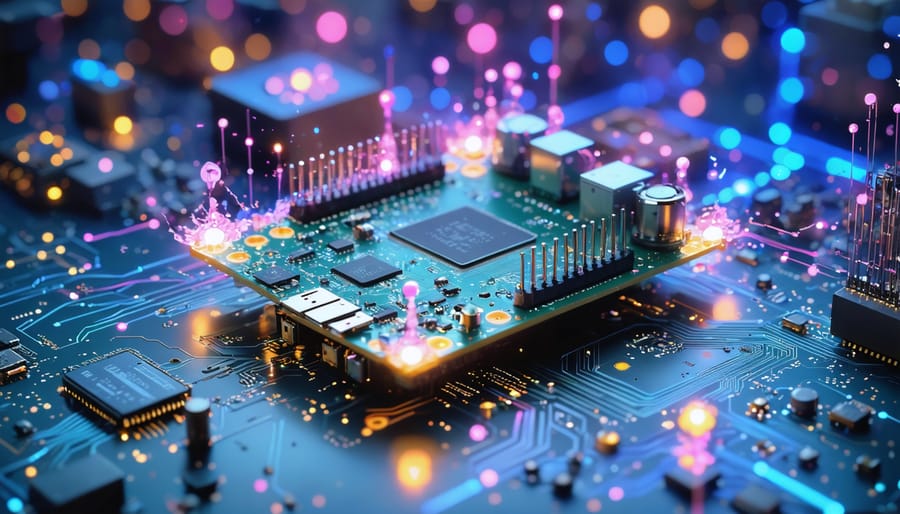
Quantum computing stands poised to revolutionize artificial intelligence by solving complex computational problems that traditional single-board computer projects and classical systems cannot tackle. While conventional computers process bits in binary states (0 or 1), quantum computers harness quantum bits (qubits) that exist in multiple states simultaneously, enabling them to perform millions of calculations in parallel. This fundamental shift promises to accelerate AI training, optimize neural networks, and unlock new possibilities in machine learning algorithms.
For AI practitioners and researchers, quantum computing offers three game-changing advantages: exponentially faster processing of large datasets, more efficient optimization of complex AI models, and the ability to simulate quantum systems for advanced machine learning applications. As major tech companies invest heavily in quantum-AI integration, we’re witnessing the early stages of a computational paradigm shift that could transform everything from drug discovery to climate modeling.
The convergence of quantum computing and AI isn’t just theoretical – practical applications are already emerging in fields like financial modeling, cryptography, and pattern recognition. Though still in its infancy, this powerful combination represents the next frontier in computing, promising to solve problems that would take classical computers millions of years to process.
Understanding Quantum Computing Basics for AI
Qubits vs Classical Bits
While traditional computers use classical bits that can only be in one of two states (0 or 1), quantum computers operate with qubits that leverage the principles of quantum mechanics. Qubits can exist in multiple states simultaneously through a phenomenon called superposition, making them fundamentally different from classical bits.
Think of classical bits like a light switch that’s either on or off. Qubits, on the other hand, are more like a spinning coin – while it’s spinning, it’s effectively in both heads and tails states at once. This unique property allows quantum computers to process vast amounts of information simultaneously, rather than sequentially like classical computers.
Another fascinating property of qubits is entanglement, where the state of one qubit can instantly affect another, regardless of the distance between them. This enables quantum computers to solve complex problems exponentially faster than classical computers, particularly in areas like machine learning and artificial intelligence.
However, qubits are extremely sensitive to environmental interference and must be maintained at near-absolute zero temperatures, making them challenging to work with in practical applications.

Quantum Advantage in AI Processing
Quantum computing offers several groundbreaking advantages for AI processing that traditional computers simply can’t match. The most significant benefit is the ability to process multiple states simultaneously through quantum superposition, allowing AI algorithms to evaluate countless possibilities in parallel rather than sequentially.
This quantum advantage becomes particularly evident in machine learning tasks that involve complex pattern recognition and optimization problems. For instance, a quantum computer can analyze vast datasets for training AI models exponentially faster than classical computers, potentially reducing training time from weeks to minutes.
The unique properties of quantum bits (qubits) also enable more efficient handling of high-dimensional data spaces, which is crucial for deep learning applications. This means AI systems can process more complex relationships between data points and identify patterns that might be impossible to detect using traditional computing methods.
Additionally, quantum computing excels at solving optimization problems common in AI, such as finding the most efficient route in a network or optimizing neural network architectures. This capability could lead to more sophisticated AI models that require significantly less computational resources to achieve superior results.
Quantum-Inspired Algorithms on Single-Board Computers
Quantum Simulators for Raspberry Pi
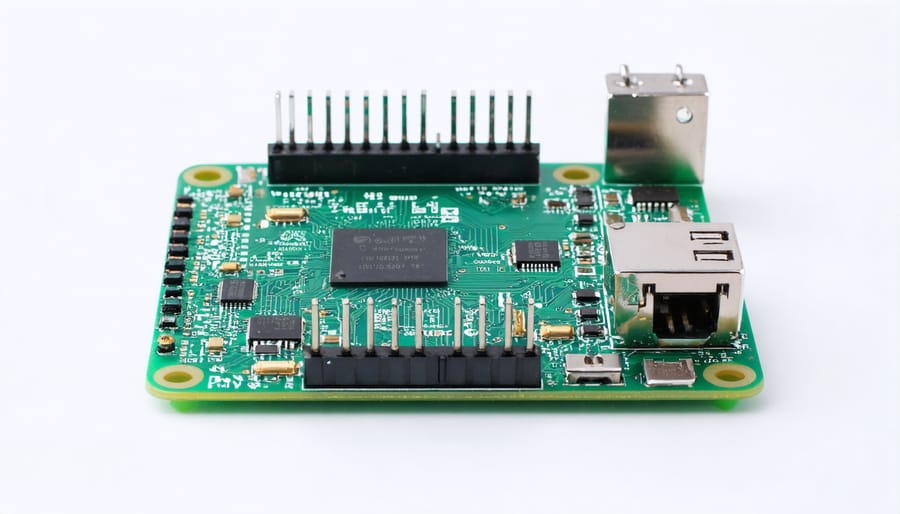
Several quantum computing simulators are available for enthusiasts looking to experiment with quantum algorithms on their Raspberry Pi server setup. Qiskit, developed by IBM, stands out as a popular choice that runs efficiently on the Pi’s ARM architecture. This open-source framework allows users to write quantum circuits and simulate their behavior, making it an excellent starting point for quantum computing exploration.
Another notable option is Cirq, Google’s quantum computing framework, which can be installed on Raspberry Pi with some modifications. While it may require more setup effort, Cirq offers powerful simulation capabilities and integrates well with machine learning libraries like TensorFlow Quantum.
For beginners, ProjectQ provides a more straightforward approach to quantum simulation. Its Python-based interface makes it accessible for those familiar with basic programming concepts, and it runs smoothly on Raspberry Pi’s limited resources.
These simulators allow users to experiment with quantum algorithms at a fraction of the cost of actual quantum hardware. While they can’t match the processing power of real quantum computers, they serve as valuable educational tools and testing platforms for quantum AI concepts.
Remember that performance will depend on your Pi’s specifications, and you may need to optimize your simulations for the available resources. Start with simple circuits and gradually increase complexity as you become more familiar with the tools.
Running Quantum-Inspired AI Models
Getting started with quantum-inspired AI models doesn’t require specialized quantum hardware. Here’s a practical approach to implementing basic quantum-inspired algorithms on your regular computer or single-board device.
First, install the necessary Python libraries like Qiskit or PennyLane, which provide quantum computing simulators. These frameworks allow you to experiment with quantum concepts without actual quantum hardware.
Start with a simple quantum-inspired neural network:
1. Define your classical input data
2. Create a quantum circuit layer that transforms classical data into quantum states
3. Apply quantum gates to process the information
4. Measure the results and convert them back to classical format
Here’s a basic implementation pattern:
“`python
def quantum_layer(input_data):
# Convert classical data to quantum states
quantum_state = encode_classical_to_quantum(input_data)
# Apply quantum operations
processed_state = apply_quantum_gates(quantum_state)
# Measure results
return measure_quantum_state(processed_state)
“`
For best results, start with small-scale problems and gradually increase complexity. Focus on algorithms that benefit from quantum principles, such as optimization problems or pattern recognition tasks. Remember to validate your results against classical implementations to ensure your quantum-inspired approach provides meaningful improvements.
Practice with example datasets and pre-built models before creating custom solutions. This helps you understand the fundamental differences between classical and quantum-inspired approaches while building practical experience.
Real-World Applications and Projects
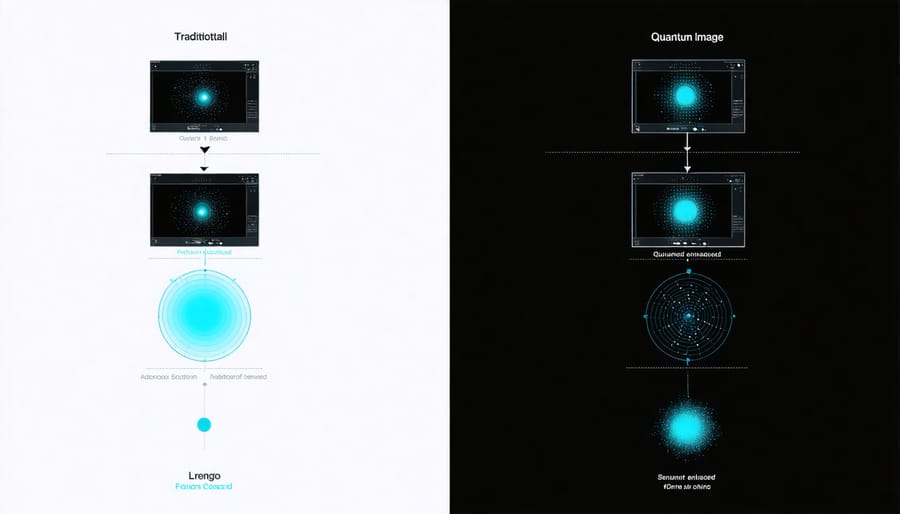
Image Recognition Enhancement
Quantum computing brings remarkable enhancements to AI image recognition capabilities through its unique ability to process multiple image features simultaneously. Unlike traditional computers that analyze pixels sequentially, quantum systems can evaluate entire images in parallel, dramatically reducing processing time and improving accuracy.
One of the most significant advantages is the quantum computer’s ability to handle complex pattern recognition tasks. When processing images, quantum algorithms can explore multiple possible interpretations of an image at once, leading to more accurate object identification and classification. This is particularly valuable in scenarios where traditional AI might struggle, such as distinguishing between similar objects or recognizing patterns in low-quality images.
For example, in medical imaging, quantum-enhanced AI can simultaneously analyze multiple layers of an MRI scan, potentially identifying subtle anomalies that conventional systems might miss. Similarly, in security applications, quantum image recognition can process surveillance footage more efficiently, tracking multiple objects and identifying potential threats in real-time.
The quantum advantage also extends to training AI models. Quantum computers can process vast datasets of images more efficiently, leading to faster and more effective training of neural networks. This means AI systems can learn from larger image libraries and develop more sophisticated recognition capabilities in less time.
While still in early stages, quantum image recognition shows promising results in tasks like facial recognition, object detection, and scene understanding. As quantum hardware continues to evolve, we can expect even more sophisticated applications, potentially revolutionizing fields from autonomous vehicles to medical diagnostics.
Pattern Recognition Optimization
Quantum-inspired pattern recognition represents a fascinating bridge between classical computing systems and quantum principles, offering enhanced capabilities for AI applications. These algorithms leverage quantum computing concepts like superposition and entanglement to improve pattern detection and classification tasks, even when running on traditional hardware.
On platforms like Raspberry Pi, developers can implement simplified versions of quantum-inspired pattern recognition algorithms through specialized libraries and frameworks. These implementations focus on key quantum principles while working within the constraints of classical hardware. For example, quantum-inspired neural networks can process multiple patterns simultaneously by simulating quantum states, leading to faster pattern matching and improved accuracy in image recognition tasks.
One practical approach involves using quantum-inspired tensor networks, which can efficiently handle complex pattern recognition problems by breaking them down into manageable components. This method is particularly effective for tasks like handwriting recognition and facial detection, where traditional algorithms might struggle with varying input patterns.
To optimize pattern recognition on single-board computers, developers often employ hybrid approaches that combine quantum-inspired algorithms with classical machine learning techniques. This fusion allows for better resource utilization while maintaining improved pattern recognition capabilities. Common optimization strategies include:
– Implementing quantum-inspired feature selection algorithms
– Using quantum-inspired clustering methods for data preprocessing
– Applying quantum-inspired dimensionality reduction techniques
– Optimizing network architectures based on quantum principles
While these implementations don’t achieve the full potential of true quantum computing, they provide a practical way to enhance AI pattern recognition capabilities on accessible hardware platforms, making quantum-inspired algorithms more approachable for hobbyists and developers.
Future Possibilities and Limitations
Hardware Challenges
Building quantum computers for AI applications presents significant technical hurdles that researchers and engineers are actively working to overcome. The primary challenge lies in maintaining quantum coherence, as quantum bits (qubits) are extremely sensitive to environmental interference. Even minor temperature fluctuations or electromagnetic disturbances can cause decoherence, making these systems challenging to scale.
Current hardware considerations focus on developing more stable qubit architectures and better error correction methods. Researchers are exploring superconducting circuits, trapped ions, and topological qubits as potential solutions. Each approach offers unique advantages but comes with its own set of technical challenges.
Temperature control remains a critical factor, as most quantum systems require near-absolute zero conditions to function properly. This necessitates sophisticated cooling systems that are both expensive and complex to maintain. However, recent innovations in room-temperature quantum computing show promise for more accessible implementations.
Scaling quantum systems is another significant challenge. While current quantum computers can handle dozens of qubits, AI applications may require thousands or even millions of coherent qubits. Engineers are developing new architectures and control systems to address these scaling issues, with promising advances in quantum error correction and noise reduction techniques pointing toward more robust systems in the near future.
Next Generation Integration
The future of quantum computing in single-board computers is rapidly evolving, with promising developments that could revolutionize how we approach AI processing at the edge. While full-scale quantum computers remain massive and complex, researchers are making significant progress in developing quantum-inspired algorithms and hybrid systems that could work with traditional single-board computers.
Several research teams are exploring the possibility of quantum-inspired processors that could be integrated into future versions of popular single-board computers. These processors would simulate certain quantum effects to enhance AI processing capabilities without requiring true quantum hardware. This approach could bring some of the advantages of quantum computing to smaller, more affordable devices.
The potential applications are exciting: imagine a Raspberry Pi-sized device capable of running complex machine learning models with quantum-inspired optimizations, or edge computing systems that leverage quantum principles for enhanced pattern recognition and data processing. While we’re still years away from true quantum processing on single-board computers, the groundwork being laid today points to a future where quantum-enhanced AI could become accessible to hobbyists and makers.
Key areas of development include quantum-classical hybrid architectures, room-temperature quantum effects, and miniaturized quantum sensors. These innovations could lead to single-board computers that bridge the gap between classical and quantum computing, offering unprecedented processing capabilities for AI applications while maintaining the accessibility and affordability that makes single-board computers so popular.
The convergence of quantum computing and artificial intelligence represents an exciting frontier in technology, offering unprecedented possibilities for solving complex problems and advancing machine learning capabilities. As we’ve explored throughout this article, quantum computers have the potential to revolutionize AI by dramatically increasing processing power, optimizing algorithms, and enabling new approaches to deep learning.
For tech enthusiasts and hobbyists interested in getting started with quantum computing and AI, several practical next steps are available. Begin by familiarizing yourself with quantum programming frameworks like Qiskit or Cirq, which offer user-friendly interfaces for experimenting with quantum algorithms. Many of these platforms provide free access to quantum simulators, allowing you to test and develop quantum AI concepts without requiring actual quantum hardware.
Consider joining online communities and forums dedicated to quantum computing and AI development. These spaces offer valuable opportunities to collaborate with like-minded individuals, share knowledge, and stay updated on the latest developments in the field.
To further your understanding, explore online courses focused on quantum machine learning, many of which are available through platforms like Coursera and edX. Start with basic quantum computing concepts before diving into more complex applications in AI and machine learning.
Remember that while full-scale quantum computers may still be in development, the foundations you build today will be invaluable as this technology becomes more accessible. Stay curious, keep experimenting, and be part of the quantum computing revolution that’s reshaping the future of artificial intelligence.