

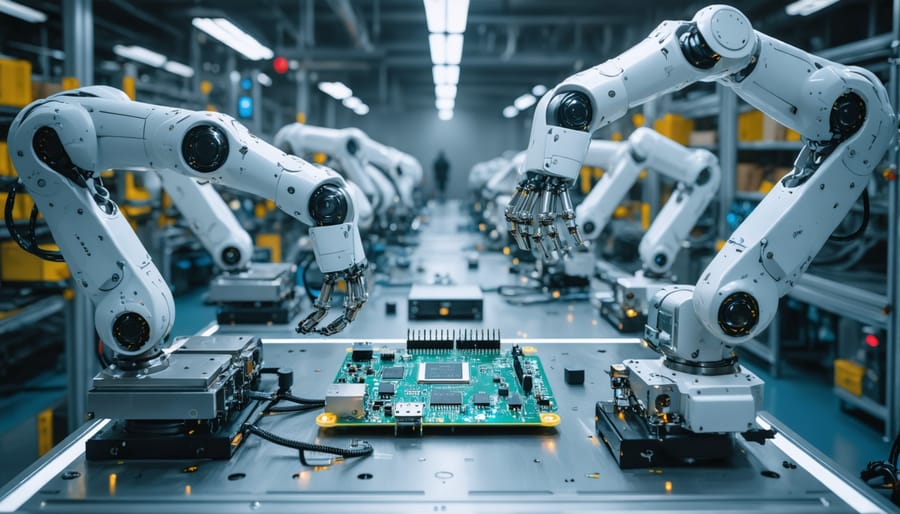
Transform your manufacturing operations today through automation in manufacturing powered by robotic process automation (RPA). Modern manufacturing facilities deploy autonomous robots to handle repetitive tasks with 99.9% accuracy, reducing operational costs by up to 70% while maintaining 24/7 production cycles. RPA systems now integrate seamlessly with existing machinery through standardized protocols, enabling real-time monitoring and predictive maintenance across entire production lines. Smart sensors and machine learning algorithms automatically optimize workflow processes, identify bottlenecks, and adjust production parameters – all without human intervention.
This revolution in manufacturing automation isn’t limited to industry giants. Small and medium-sized manufacturers implement cost-effective RPA solutions using accessible technologies like Raspberry Pi and open-source software, achieving ROI within months rather than years. The key to successful implementation lies in identifying high-volume, rule-based processes that can be standardized and automated, then scaling up systematically while maintaining quality control protocols.
By 2025, experts predict that 85% of manufacturing operations will incorporate some form of RPA, making it essential for companies to adapt now or risk falling behind in an increasingly automated marketplace.
The Building Blocks of RPA in Manufacturing
Key Software Components
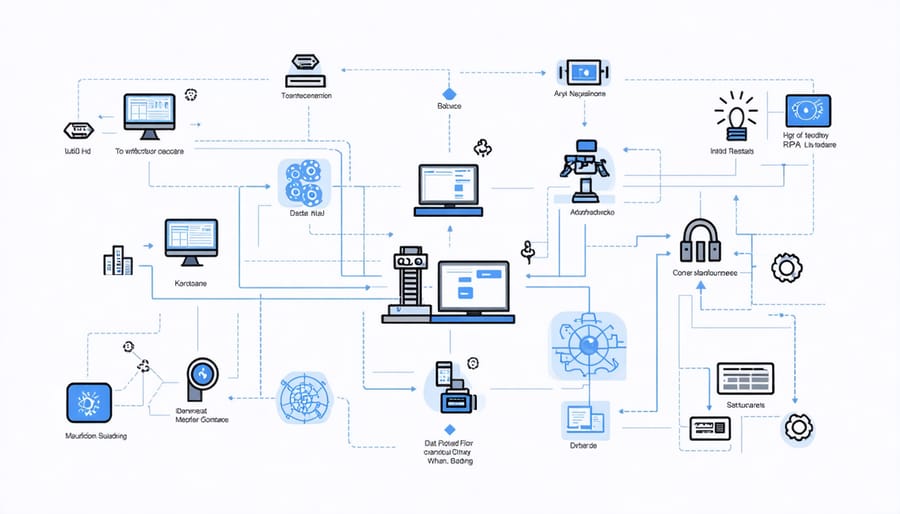
The successful implementation of RPA in manufacturing relies on several key software components working together seamlessly. At the core, robotic process automation platforms serve as the foundation, offering visual programming interfaces and workflow designers that make automation accessible even to those without extensive coding experience. These platforms integrate with essential elements like process recorders, which capture and analyze human actions to create automation templates.
Task orchestrators play a crucial role in managing multiple automation workflows, ensuring smooth operation across different manufacturing processes. When combined with cognitive technologies and machine learning algorithms, these systems can evolve into autonomous systems capable of making decisions based on real-time data.
Analytics and reporting tools provide valuable insights into automation performance, while integration adapters ensure compatibility with existing manufacturing execution systems (MES) and enterprise resource planning (ERP) software. Security modules protect sensitive manufacturing data and control access to automated processes, making RPA implementation both efficient and secure.
Hardware Requirements
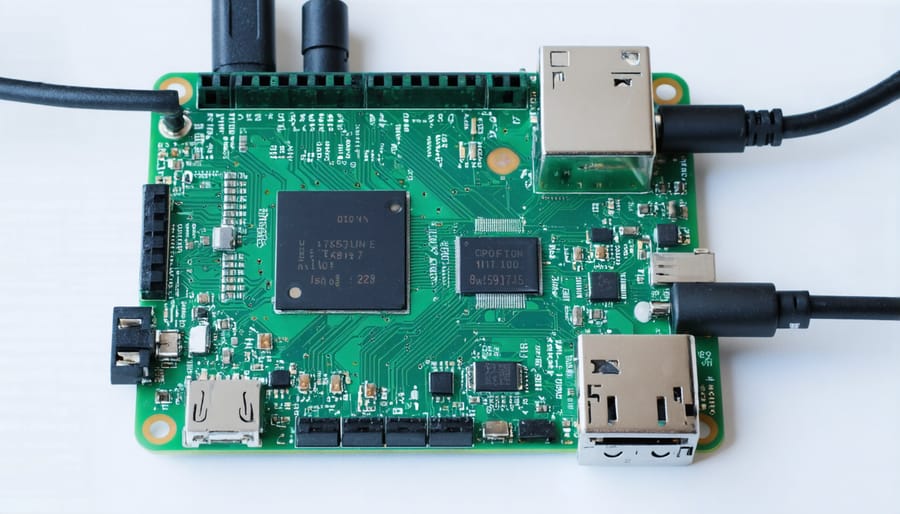
The hardware requirements for implementing RPA in manufacturing settings are surprisingly accessible, with Raspberry Pi serving as an excellent foundation. At its core, you’ll need a Raspberry Pi 4 Model B (8GB recommended) to handle the processing demands of automation tasks. This should be paired with a reliable power supply unit and a high-capacity microSD card (32GB minimum) for storing your automation scripts and operating system.
For physical automation tasks, servo motors and stepper motors are essential components, allowing for precise movement control. Digital cameras or webcams enable computer vision capabilities, while sensors (proximity, temperature, and pressure) provide vital environmental feedback. A robust network interface, either through Ethernet or Wi-Fi, ensures seamless communication between your RPA system and other manufacturing equipment.
To protect your hardware, invest in proper enclosures rated for industrial environments (IP65 or higher). Consider adding a touch-screen display for local monitoring and control. For more complex implementations, additional hardware might include relay boards for controlling industrial equipment, ADC/DAC converters for analog signal processing, and industrial-grade USB hubs for connecting multiple peripherals.
Remember to include redundancy in critical components and maintain proper cooling solutions to ensure reliable 24/7 operation in manufacturing environments.
Practical RPA Applications in Manufacturing
Quality Control Automation
Quality control automation through RPA represents a significant leap forward in manufacturing precision and efficiency. By implementing automated inspection systems, manufacturers can achieve consistent quality checks without human error or fatigue. These systems use computer vision and sensor technology to detect defects, measure dimensions, and verify product specifications in real-time.
RPA solutions can monitor multiple quality parameters simultaneously, from surface finish and color consistency to dimensional accuracy and assembly completeness. For instance, a basic RPA setup using a Raspberry Pi and camera module can perform visual inspections on production lines, identifying defects that might be missed by human inspectors.
The automation of quality control processes also enables real-time data collection and analysis. This continuous monitoring allows manufacturers to identify trends, predict potential quality issues before they become problems, and maintain detailed documentation for compliance purposes. The system can automatically generate reports, trigger alerts when quality metrics fall outside acceptable ranges, and initiate corrective actions without human intervention.
One particularly effective application is in end-of-line testing, where RPA systems can perform comprehensive quality checks before products are packaged. These automated inspections can include functional testing, safety verification, and appearance checks, all while maintaining consistent standards across multiple production shifts.
By integrating quality control automation with existing manufacturing execution systems, companies can create a closed-loop quality management process that continuously improves product quality while reducing inspection costs and minimizing waste.

Inventory Management Systems
Inventory management is a critical aspect of manufacturing where RPA solutions can deliver significant efficiency gains. Modern automated inventory systems utilize a combination of sensors, RFID tags, and networked devices to maintain real-time tracking of materials, work-in-progress items, and finished products throughout the production cycle.
These systems can automatically monitor stock levels, generate purchase orders when supplies run low, and update inventory records without human intervention. For example, when components arrive at a facility, RFID scanners can instantly record their entry into the system, while smart shelving solutions equipped with weight sensors can track usage patterns and current stock levels.
Small-scale manufacturers can implement basic automated inventory tracking using affordable hardware like barcode scanners and Raspberry Pi computers. These setups can be programmed to maintain digital inventory logs, send notifications for low stock situations, and generate reports for analysis.
More advanced systems incorporate machine learning algorithms to predict demand patterns and optimize stock levels. These predictive capabilities help prevent both stockouts and excess inventory, reducing carrying costs while ensuring production continuity.
The integration of inventory management systems with other manufacturing processes creates a seamless flow of information. When connected to production planning systems, these automated solutions can ensure just-in-time material availability and reduce warehouse space requirements, ultimately leading to more efficient operations and reduced costs.
Production Line Monitoring
Production line monitoring through RPA represents a significant advancement in manufacturing efficiency, combining sensor technology with intelligent automation systems. By implementing RPA solutions, manufacturers can continuously track production metrics, detect anomalies, and optimize workflow processes in real-time. These systems work alongside collaborative robotics systems to create a comprehensive monitoring environment.
Modern RPA implementations utilize smart sensors and cameras to collect data about production speed, quality control metrics, and equipment performance. This data is processed through automated analysis tools that can identify bottlenecks, predict maintenance needs, and adjust production parameters automatically. For instance, when a production line shows signs of slowdown, the RPA system can automatically alert maintenance teams or adjust upstream processes to maintain optimal flow.
The beauty of RPA in production monitoring lies in its scalability and adaptability. Starting with basic monitoring tasks, manufacturers can gradually expand their automation capabilities as needs grow. Popular entry-level solutions often utilize Raspberry Pi-based systems for data collection and basic automation, making it accessible for smaller operations to begin their automation journey.
Key benefits include reduced downtime, improved quality control, and enhanced operational visibility. By automating the monitoring process, human operators can focus on higher-value tasks while maintaining comprehensive oversight of production activities through intuitive dashboards and real-time alerts.
Building Your First Manufacturing RPA Project
Setting Up Your Raspberry Pi
Before diving into Raspberry Pi automation projects, it’s essential to properly configure your Raspberry Pi for optimal performance in manufacturing environments. Start by downloading the latest Raspberry Pi OS and flashing it onto a microSD card using the Raspberry Pi Imager tool. For industrial applications, we recommend using the 64-bit version of the OS for better performance.
Once your Pi boots up, open the terminal and run ‘sudo apt update’ followed by ‘sudo apt upgrade’ to ensure all system packages are current. Next, install the essential Python libraries for automation: pip install opencv-python for computer vision capabilities, and pip install RPi.GPIO for hardware interface control.
For manufacturing automation, you’ll need to configure several key settings. Enable I2C and SPI interfaces through the Raspberry Pi Configuration tool (sudo raspi-config) to support various sensors and actuators. Set up a static IP address to ensure reliable network connectivity in your factory environment.
Install Node-RED for visual programming and workflow automation by running: bash <(curl -sL https://raw.githubusercontent.com/node-red/linux-installers/master/deb/update-nodejs-and-nodered). This tool will be crucial for creating manufacturing automation flows.
Finally, secure your Pi by changing the default password, enabling SSH with key-based authentication, and configuring the UFW firewall. These security measures are vital for protecting your automation system from unauthorized access. Remember to regularly backup your configuration files to prevent potential downtime.
Programming Your First Automation Script
Creating your first automation script doesn’t have to be intimidating. Let’s start with a simple example that automates a basic manufacturing task: monitoring and logging temperature readings from a sensor.
First, open your preferred IDE or text editor. For beginners, Python is an excellent language choice due to its readable syntax and extensive libraries for automation. Begin by importing the necessary libraries:
“`python
import time
import datetime
import csv
“`
Next, create a basic function that simulates reading temperature data from a sensor:
“`python
def read_temperature():
# Placeholder for actual sensor reading
return round(random.uniform(20.0, 25.0), 2)
“`
Now, let’s write the main automation routine:
“`python
def main():
while True:
temp = read_temperature()
timestamp = datetime.datetime.now()
# Log data to CSV file
with open(‘temperature_log.csv’, ‘a’) as file:
writer = csv.writer(file)
writer.writerow([timestamp, temp])
# Add basic error checking
if temp > 24.0:
print(“Temperature alert: Above threshold”)
time.sleep(60) # Check every minute
“`
Test your script with small datasets first, and gradually increase complexity as you become more comfortable. Remember to add error handling and validation checks to make your automation more robust. Start with simple tasks like data logging or basic monitoring before moving on to more complex manufacturing processes.
This basic framework can be expanded to include multiple sensors, automated alerts, or integration with other manufacturing systems as your automation needs grow.
Integration and Testing
Integrating RPA systems into existing manufacturing processes requires careful planning and systematic testing to ensure smooth operations. Begin by mapping out all connection points between your RPA solution and the manufacturing equipment, including sensors, actuators, and control systems. Create a detailed integration plan that outlines the sequence of connections and necessary protocols for communication.
Start with small-scale testing in a controlled environment before implementing the full system. This allows you to identify and resolve potential issues without disrupting production. Use simulation tools to validate your automation sequences and verify that all safety protocols are functioning correctly.
When connecting physical components, ensure proper calibration of sensors and testing of all input/output signals. Implement error handling mechanisms and failsafes to prevent system crashes or safety hazards. Document all connection points and create detailed troubleshooting guides for maintenance teams.
Conduct thorough testing phases:
– Unit testing of individual components
– Integration testing of connected systems
– End-to-end testing of complete workflows
– Performance testing under various conditions
– Safety and emergency response testing
Monitor system performance during initial implementation using data logging and analytics tools. This helps identify bottlenecks and optimization opportunities. Regular maintenance checks and system updates should be scheduled to ensure continued reliable operation.
Remember to train operators and maintenance staff on the new system, including proper startup procedures, monitoring practices, and emergency protocols. This ensures smooth adoption and minimal disruption to existing workflows.
Robotic Process Automation has emerged as a game-changing technology in manufacturing, offering unprecedented opportunities for efficiency, accuracy, and cost reduction. By automating repetitive tasks and streamlining workflows, RPA has proven its worth in boosting productivity while minimizing human error. The implementation of RPA solutions, particularly those built on accessible platforms like Raspberry Pi, has made automation more attainable for businesses of all sizes.
Looking ahead, the future of RPA in manufacturing appears even more promising. As artificial intelligence and machine learning capabilities continue to advance, we can expect to see more sophisticated automation solutions that can handle increasingly complex tasks. The integration of IoT sensors with RPA systems will enable more responsive and adaptive manufacturing processes, while improved analytics capabilities will provide deeper insights into production efficiency.
For manufacturers considering RPA implementation, the key to success lies in starting small, focusing on well-defined processes, and gradually scaling up as expertise grows. The accessibility of modern RPA tools and platforms means that even smaller operations can begin their automation journey without significant capital investment.
As we move forward, RPA will undoubtedly play a crucial role in shaping the future of smart manufacturing, enabling businesses to remain competitive in an increasingly automated world. The combination of accessibility, scalability, and continuous technological advancement makes RPA an essential tool for manufacturing innovation.