
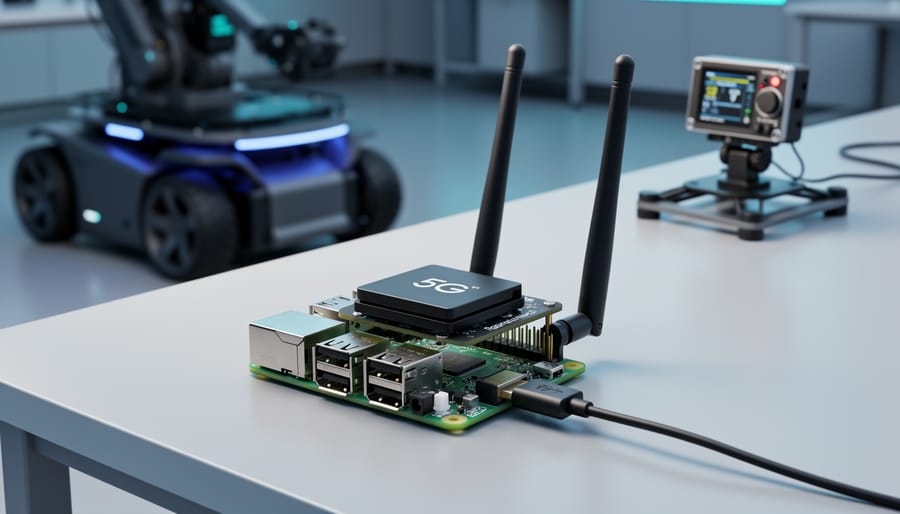
Understand that 5G technology operates on three frequency bands—low-band (sub-1GHz), mid-band (1-6GHz), and high-band millimeter wave (24-100GHz)—each offering different trade-offs between speed, range, and penetration. For Raspberry Pi projects, this matters because current USB-based 5G modems primarily support sub-6GHz bands, delivering speeds of 100Mbps to 2Gbps with latency as low as 10ms, making them suitable for real-time data applications like remote sensing, IoT gateways, and mobile robotics.
Equip your Raspberry Pi 4 or 5 with a compatible 5G HAT or USB modem like the Quectel RM500Q-GL or Simcom SIM8200EA-M2, ensuring your board has sufficient power delivery through a 5A USB-C adapter since 5G modules draw 2-3A during peak transmission. Install the necessary kernel modules and use tools like ModemManager or libqmi to establish connections, recognizing that 5G’s network slicing capability allows you to prioritize traffic for specific applications—crucial when running multiple services simultaneously.
Leverage 5G’s enhanced Mobile Broadband (eMBB) for high-bandwidth projects like video streaming and cloud backups, Ultra-Reliable Low-Latency Communication (URLLC) for time-sensitive robotics control, and Massive Machine-Type Communication (mMTC) when deploying multiple connected sensors. The technology’s edge computing compatibility means you can process data closer to your Raspberry Pi rather than routing everything through distant servers, reducing response times from 50ms on 4G to under 10ms.
Expect initial hardware costs between $80-200 for 5G modules, with carrier plans varying significantly based on data caps and whether you need static IP addresses for remote access to your projects.
What Makes 5G Different from 4G and WiFi?
The Three Pillars of 5G Technology
At its core, 5G technology rests on three fundamental pillars, each designed to serve different needs in our connected world. Think of them as specialized tools in your maker toolkit—each excels at specific tasks.
Enhanced Mobile Broadband (eMBB) is what most people think of when they hear “5G.” It’s all about delivering blazing-fast internet speeds—up to 20 Gbps in ideal conditions. For your Raspberry Pi projects, this means downloading large datasets, streaming high-definition video feeds from multiple cameras, or deploying cloud-connected applications with minimal wait times. Imagine updating your entire project repository in seconds rather than minutes.
Ultra-Reliable Low-Latency Communications (URLLC) focuses on speed of response rather than raw bandwidth. We’re talking about latency as low as 1 millisecond—that’s practically instantaneous. This pillar is critical for applications where timing matters, like robotics, autonomous vehicles, or real-time sensor networks. If you’re building a Raspberry Pi robot that needs to react to obstacles immediately, URLLC makes that responsiveness possible.
Massive Machine-Type Communications (mMTC) is the IoT enthusiast’s dream. This pillar supports connecting up to one million devices per square kilometer. Each connection uses minimal power and bandwidth, perfect for deploying sensor arrays, environmental monitoring stations, or smart home networks using multiple Raspberry Pi Zero boards. Your devices can remain connected for years on small batteries, sending periodic updates without draining resources.
Together, these three pillars make 5G incredibly versatile for physical computing projects.
Speed and Latency Numbers That Actually Matter
Understanding the actual performance differences between wireless technologies helps you choose the right solution for your Raspberry Pi projects. Here’s what you can expect in real-world conditions:
WiFi (802.11ac) typically delivers 50-200 Mbps download speeds with 30-50ms latency, perfect for most home automation and media streaming projects. It’s reliable and widely supported across all Raspberry Pi models.
4G LTE networks provide 20-50 Mbps downloads and 10-20 Mbps uploads with latency around 30-50ms. This works well for remote monitoring stations or mobile IoT applications where WiFi isn’t available.
5G technology dramatically improves performance with download speeds of 100-1000 Mbps, uploads reaching 50-200 Mbps, and latency as low as 1-10ms. These improvements matter most for demanding applications like real-time video processing, autonomous robots, or projects requiring instant cloud connectivity.
For Raspberry Pi enthusiasts, 5G’s low latency is the real game-changer. Imagine controlling a robot with virtually no delay or streaming high-definition sensor data for instant analysis. While 4G suffices for basic data logging, 5G opens possibilities for truly responsive, bandwidth-intensive projects that previously weren’t feasible on single-board computers.
5G Hardware Options for Raspberry Pi
USB 5G Modems vs. HAT Solutions
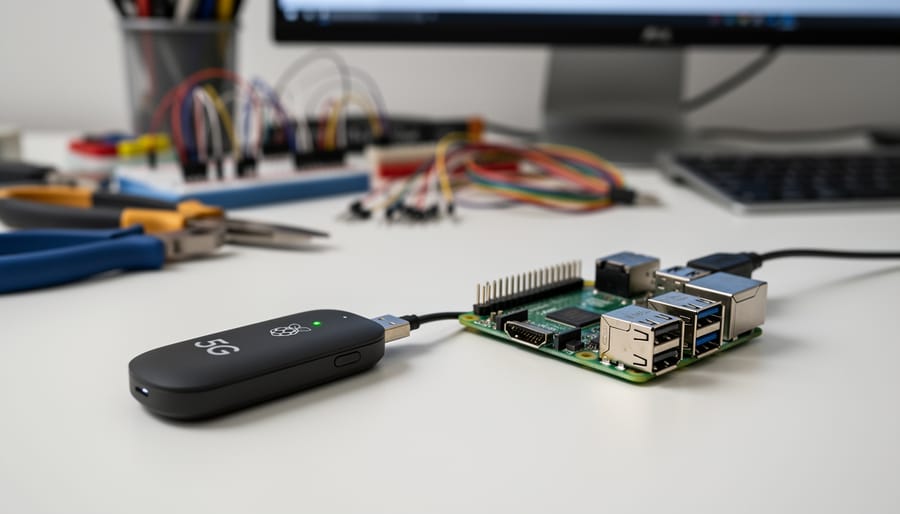
When integrating 5G into your Raspberry Pi projects, you’ll encounter two primary hardware solutions: USB 5G modems and Hardware Attached on Top (HAT) modules. Each approach offers distinct advantages depending on your project requirements.
USB 5G modems are the plug-and-play option. These dongles connect directly to your Pi’s USB ports and work much like traditional USB Wi-Fi adapters. They’re incredibly versatile since you can easily swap them between different Raspberry Pi models or even other computers. Setup is typically straightforward, often requiring minimal configuration beyond installing the necessary drivers. The main drawbacks include higher power consumption, which can strain your Pi’s power supply, and the bulky external form factor that may not suit compact builds. USB modems are ideal for prototyping, testing different 5G modules, or projects where portability between devices matters.
HAT solutions mount directly onto your Raspberry Pi’s 40-pin GPIO header, creating a compact, integrated system. These boards typically include additional features like GPS modules, battery management, or extra antenna connections. HATs offer better power efficiency and a cleaner, more professional appearance for permanent installations. However, they’re less flexible since they occupy the GPIO pins and are specific to certain Pi models. They also tend to cost more upfront.
For beginners experimenting with 5G connectivity, USB modems provide an easier entry point. Choose HAT solutions when building permanent installations like remote sensors, IoT gateways, or mobile robotics where space efficiency and GPIO integration matter most.
Power Requirements and Performance Considerations
Adding 5G connectivity to your Raspberry Pi project introduces important considerations around power consumption and heat management that differ significantly from traditional wireless technologies. Understanding these factors ensures your projects run reliably and efficiently.
5G modems and HATs typically draw between 2-4 watts during active data transmission, which represents a substantial increase compared to standard WiFi modules. This elevated power requirements means you’ll need to carefully evaluate your power supply capacity. For Raspberry Pi 4 models, we recommend using a quality USB-C power adapter rated for at least 3A (15W) when incorporating 5G modules. Battery-powered projects require particular attention, as 5G connectivity can significantly reduce runtime compared to 4G or WiFi alternatives.
Thermal management becomes equally critical, especially in enclosed project cases. 5G modules generate considerable heat during data transfers, and when combined with the Raspberry Pi’s own thermal output, temperatures can quickly reach throttling thresholds. Installing heatsinks on both your Pi’s processor and the 5G module is essential. Consider adding active cooling with a small fan for projects involving sustained data transfers or when operating in warm environments.
Monitor your system temperature using built-in tools like vcgencmd. If temperatures consistently exceed 70°C, improve ventilation or upgrade your cooling solution. For mobile or outdoor projects, factor in ambient temperature variations that can further impact thermal performance and power efficiency.
Real-World Applications: Where 5G Shines in Physical Computing
IoT Sensor Networks and Remote Monitoring
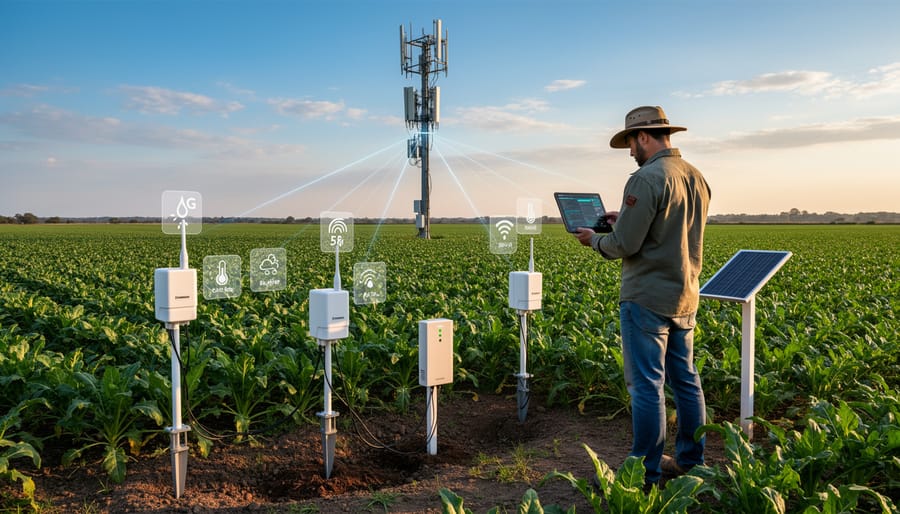
5G technology transforms how we build and deploy sensor networks for real-world monitoring applications. With latency reduced to just 1-5 milliseconds and support for up to one million devices per square kilometer, 5G creates opportunities for dense IoT deployments that were previously impractical with 4G or Wi-Fi.
For Raspberry Pi projects, this means you can deploy environmental sensors across larger areas without worrying about connection dropouts. Imagine building a neighborhood air quality monitoring system where each Pi-powered sensor station reliably transmits data in near real-time. In agriculture, 5G enables precision farming setups where soil moisture sensors, weather stations, and automated irrigation controllers communicate seamlessly across expansive fields.
Smart home enthusiasts benefit from 5G’s improved reliability and device density. Your Raspberry Pi home automation hub can coordinate dozens of sensors, cameras, and actuators simultaneously without bandwidth bottlenecks. The network slicing feature even lets you prioritize critical sensor data, like security alerts, over less urgent information.
Getting started requires 5G-compatible modems or HATs for your Raspberry Pi, which are becoming more affordable as the technology matures. The enhanced connectivity opens doors for ambitious monitoring projects that demand both scale and responsiveness.
Real-Time Video Processing and Streaming
5G technology transforms video-intensive Raspberry Pi projects by delivering the bandwidth and minimal latency required for smooth, high-quality streaming. For robotics applications, this means you can control remote rovers or drones with live camera feeds that respond instantly to your commands, eliminating the frustrating delays common with 4G connections. Security camera projects become far more capable too—imagine deploying multiple Pi-powered cameras across a property, each streaming 1080p or even 4K footage simultaneously without network congestion.
Live streaming enthusiasts will appreciate 5G’s ability to handle high-bitrate video uploads directly from portable setups. Whether you’re broadcasting events, creating outdoor content, or building multi-camera systems, 5G provides the upload speeds that traditionally required wired connections. The technology particularly shines when combined with real-time data processing, enabling applications like automated surveillance systems that analyze footage on-the-fly or telepresence robots that respond immediately to user input.
The practical benefit is clear: projects that once required careful bandwidth management or suffered from latency issues now operate seamlessly, opening new possibilities for mobile and remote applications that were previously impractical with consumer hardware.
Mobile and Edge Computing Projects
5G connectivity opens exciting possibilities for mobile Raspberry Pi projects that demand reliable, high-speed data transmission away from traditional WiFi networks. Field researchers can deploy portable sensor stations that continuously upload environmental data, weather measurements, or wildlife monitoring footage in real-time. The ultra-low latency of 5G makes it ideal for remote-controlled robotics projects, where operators need immediate response feedback without the lag that can plague 4G connections.
Emergency response teams benefit from portable Pi setups equipped with 5G modules for rapid deployment of communication hubs during disasters when standard infrastructure fails. These devices can stream live video, coordinate rescue efforts, and maintain critical data links. Educators conducting outdoor STEM activities can create mobile learning stations that access cloud resources, run collaborative experiments, and share results instantly with distant classrooms.
Agricultural applications shine with 5G-enabled Pi devices mounted on drones or rovers, providing real-time crop analysis and soil monitoring across large farms. The combination of edge computing capabilities and 5G bandwidth allows these systems to process data locally while seamlessly uploading results to central databases, making them perfect for projects requiring both field autonomy and cloud connectivity.

Getting Started: Setting Up 5G on Your Raspberry Pi
Software Requirements and Driver Installation
Getting your Raspberry Pi ready for 5G connectivity requires installing the right software packages and drivers. The specific requirements depend on your chosen hardware, but we’ll cover the most common setup scenarios to get you started.
For USB-based 5G modems, you’ll need the ModemManager package, which handles communication between your Raspberry Pi and the modem. Install it using the command: sudo apt-get install modemmanager network-manager. This package automatically detects most commercial 5G dongles and configures them for use.
If you’re working with a HAT-based 5G module like the Waveshare SIM8262 series, you’ll need additional libraries. Install the required Python packages with: pip3 install pyserial and pip3 install gpiozero. These allow your Raspberry Pi to communicate with the module through GPIO pins and serial interfaces. You’ll also need to enable the serial port by editing /boot/config.txt and adding enable_uart=1.
For Quectel modules, download the manufacturer-specific QMI drivers from their official website. Extract the driver package and run the installation script with sudo permissions. Most Quectel modules also require you to configure the APN settings for your carrier, which you can do through the qmicli command-line tool.
Don’t forget to update your system first with sudo apt-get update && sudo apt-get upgrade to ensure compatibility. Testing your connection is simple: use mmcli -L to list detected modems and verify everything is working correctly before diving into your project.
Testing and Troubleshooting Your Connection
Once you’ve got your 5G hardware connected to your Raspberry Pi, it’s time to verify everything is working properly. Start by checking your connection status through the terminal using the command `mmcli -m 0` to view modem details and network registration. You should see confirmation of 5G connectivity with signal strength indicators.
Next, run speed tests to confirm you’re getting true 5G performance. Install the speedtest-cli tool with `sudo apt install speedtest-cli` and execute tests using `speedtest-cli –simple`. Expected results should show download speeds ranging from 100 Mbps to several Gbps, depending on your carrier and location. For more detailed network diagnostics, use `ping -c 10 google.com` to test latency, which should typically be under 20ms on 5G networks.
Common troubleshooting issues include weak signal strength, which you can address by repositioning your antenna or relocating your Raspberry Pi closer to windows. If your modem isn’t detected, verify it appears in `lsusb` output and ensure you’ve installed the necessary ModemManager packages. Authentication failures usually require double-checking your APN settings in NetworkManager or your carrier’s configuration portal.
For persistent connection drops, monitor your system logs using `journalctl -f` while securing your Raspberry Pi with proper cooling solutions, as 5G modems can generate significant heat under sustained loads. Remember to keep your firmware updated through your modem manufacturer’s support channels for optimal performance and compatibility.
Limitations and Practical Considerations

Coverage, Cost, and Data Plans
Before diving into 5G projects, it’s important to understand the practical realities of coverage and costs. Unlike WiFi or traditional cellular options, 5G availability remains limited to urban areas and select locations in most countries. Check your local carrier’s coverage maps before purchasing any 5G hardware for your Raspberry Pi projects.
Data plans for 5G-enabled devices vary significantly by provider. Expect monthly costs ranging from $15 to $50 for IoT-specific plans, depending on data allocation. Some carriers offer pay-as-you-go options starting around $10 monthly for light data usage, which works well for remote sensors or occasional monitoring projects. Enterprise plans with higher data caps can exceed $100 monthly.
Compared to WiFi, 5G involves ongoing subscription costs but offers mobility and wider range. Traditional 4G LTE modules remain more economical for most hobbyist projects, with broader coverage and cheaper data plans. However, 5G becomes worthwhile when your project requires ultra-low latency, high bandwidth for video streaming, or operation in areas with 5G infrastructure. Consider starting with 4G modules to test your concept before upgrading to 5G hardware.
When WiFi or 4G Makes More Sense
Before jumping into 5G for your Raspberry Pi project, consider whether existing technologies might better suit your needs. WiFi remains the go-to choice for most home and educational projects, offering excellent speeds up to 1.3 Gbps with WiFi 6, minimal latency for local applications, and zero ongoing costs beyond your internet subscription. It’s perfect for IoT sensors, home automation systems, and media streaming projects where devices stay within router range.
Similarly, 4G LTE provides a mature, cost-effective solution for mobile projects. With nationwide coverage, affordable data plans starting around $10-15 monthly, and speeds sufficient for most remote monitoring applications, 4G handles tasks like weather stations, wildlife cameras, and GPS tracking brilliantly. The hardware is also more affordable, with reliable 4G HATs available for under $50.
Choose 5G only when your project genuinely requires sub-10ms latency, needs to handle massive data throughput in real-time, or involves cutting-edge applications like augmented reality or autonomous systems. For typical maker projects focused on learning wireless communication fundamentals, WiFi and 4G deliver excellent performance without the premium cost or complexity of 5G infrastructure.
As we’ve explored throughout this guide, 5G technology opens exciting possibilities for Raspberry Pi projects, from real-time IoT applications to high-speed data streaming and edge computing solutions. While full 5G implementation on Raspberry Pi currently requires external modems or HAT modules, the ecosystem is rapidly evolving with more accessible hardware options emerging regularly.
Before diving into a 5G-enabled project, carefully evaluate your specific requirements. Consider whether your application truly needs 5G’s ultra-low latency and high bandwidth, or if 4G LTE might suffice for your current needs. Factor in costs, power consumption, and network availability in your area when making hardware decisions.
The future looks promising for makers and hobbyists interested in 5G experimentation. We can expect more affordable USB modems, improved software support through updated drivers and libraries, and enhanced integration with popular platforms like Python and Node-RED. As 5G networks expand globally and standalone 5G becomes standard, the barrier to entry will continue lowering.
Start small with a basic connectivity test, then gradually build toward more complex applications as you gain confidence. The combination of Raspberry Pi’s versatility and 5G’s capabilities puts professional-grade wireless communication within reach of every enthusiast willing to experiment and learn.