
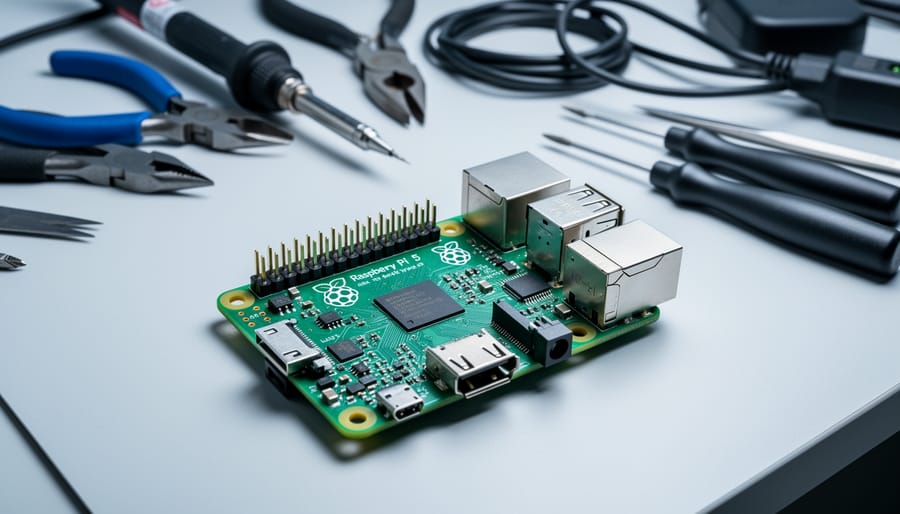
Let’s clear something up right away: The Corsair Vengeance DDR5 CMK32GX5M2E6000Z36 cannot be installed in a Raspberry Pi 5. If you searched for this thinking DDR5 memory could upgrade your Pi 5, you’re not alone in that confusion, but the Pi 5 uses soldered LPDDR4X memory that’s permanently attached to the board. There’s no memory slot, no upgrade path, and no way to add desktop RAM modules to any Raspberry Pi model.
Here’s why this matters and what you actually need to know. When you buy a Raspberry Pi 5, you’re choosing between 4GB or 8GB configurations at purchase time, and that decision is final. The memory architecture is completely different from desktop PCs. The LPDDR4X chips are soldered directly to the board for space efficiency and lower power consumption, which is exactly what makes the Pi 5 such a capable single-board computer in the first place.
So why talk about Corsair Vengeance DDR5 at all? Because many Pi enthusiasts do need desktop RAM, just not for the Pi itself. If you’re building a dedicated development workstation to compile code for Pi projects, running virtual machines to test Pi OS configurations, or setting up a powerful desktop that works alongside your Pi cluster, the Corsair Vengeance DDR5 6000 kit (updated with new authenticity-verified packaging as of February 2026) delivers the performance you need for those companion systems.
This article will help you understand what memory options actually exist for Pi 5 projects and when desktop DDR5 legitimately fits into your broader maker setup.
The Raspberry Pi 5 Memory Reality Check
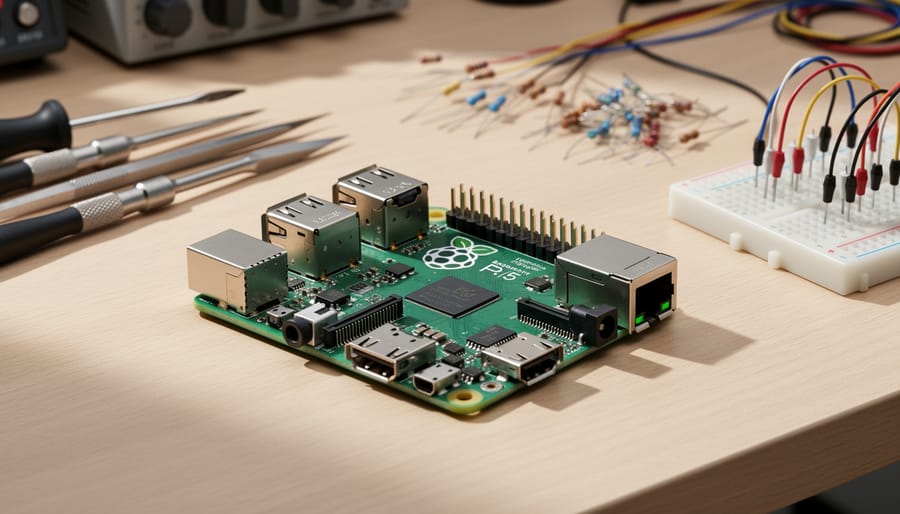
The Raspberry Pi 5 cannot use DDR5 memory modules. Period. If you’re searching for Corsair Vengeance DDR5 CMK to upgrade your Pi 5’s memory, you’re chasing an impossibility.
Here’s why: the Raspberry Pi 5 ships with LPDDR4X memory soldered directly onto the board. This isn’t a limitation you can work around with the right adapter or a clever hack. The memory chips are permanently attached during manufacturing, just like in smartphones or tablets. You get what you bought, either the 4GB or 8GB version, and that’s what you’ll always have.
Desktop DDR5 memory modules like the Corsair Vengeance CMK32GX5M2E6000Z36 are DIMM sticks designed for motherboards with DIMM slots. The Pi 5 has no such slots. It doesn’t have the physical interface to accept these modules, nor the chipset architecture to support DDR5 protocols. The Pi’s BCM2712 processor is designed to work exclusively with its soldered LPDDR4X memory running at 4267MT/s.
Think of it this way: you can’t install laptop RAM into a smartphone, even though both are memory. Different form factors, different interfaces, different power requirements, different everything. The same principle applies here. DDR5 desktop modules are physically and electrically incompatible with the Pi 5’s architecture.
This misconception likely stems from people wanting more RAM for demanding projects or confusing desktop PC upgrades with single-board computer capabilities. The Pi 5 is an incredible machine within its design parameters, but expandable memory isn’t one of its features. If you need more than 8GB of RAM, you’re looking at a different computing platform entirely, which is where desktop DDR5 memory actually belongs.
What the Corsair Vengeance DDR5 CMK Actually Is
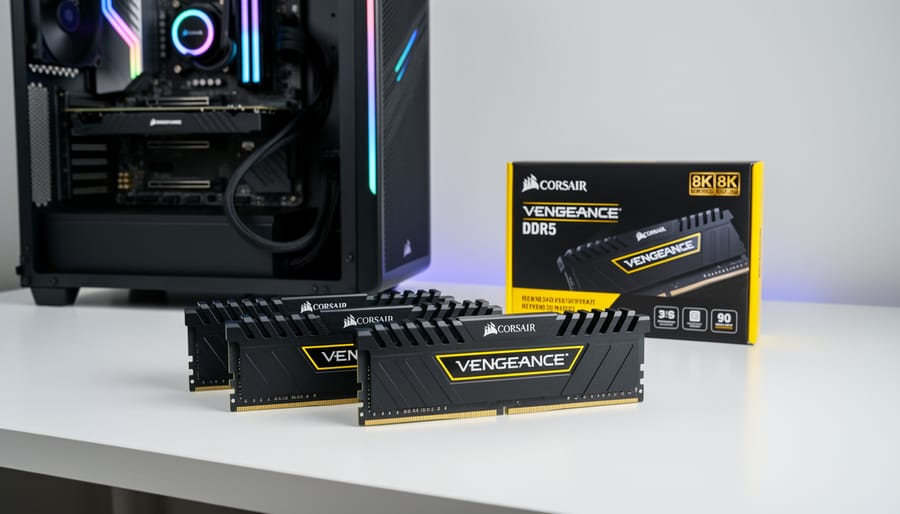
The Corsair Vengeance DDR5 CMK32GX5M2E6000Z36 is a desktop-class memory kit built for modern x86 motherboards with DDR5 support. This 32GB package contains two 16GB modules rated for DDR5 6000 speeds with CL36 latency, making it a mid-range option for gaming PCs, workstations, and content creation builds. The modules use the standard DIMM (dual in-line memory module) form factor, long, rectangular cards that slot into motherboard memory sockets.
| Specification | Details |
|---|---|
| Capacity | 32GB (2 × 16GB) |
| Speed | DDR5 6000 (PC5-48000) |
| Latency | CL36 |
| Form Factor | DIMM (288-pin) |
| Intended Platform | Desktop PCs with DDR5-compatible motherboards (Intel 12th-gen+, AMD AM5) |
These modules are designed exclusively for desktop motherboards with 288-pin DDR5 slots. That means they’re compatible with recent Intel platforms (12th-generation Core processors and newer) or AMD’s AM5 socket (Ryzen 7000 series and later). They won’t physically fit into laptop memory slots, and they’re completely incompatible with single-board computers like Raspberry Pi, which use soldered memory rather than socketed modules.
Corsair updated the Vengeance DDR5 packaging in February 2026 to help buyers verify product authenticity. The new packaging design includes security features that make it easier to spot counterfeit modules, a growing concern as DDR5 prices have fluctuated and knock-off products have entered distribution channels. If you’re purchasing this kit, look for the updated packaging to confirm you’re getting genuine Corsair hardware.
The Vengeance line sits in Corsair’s mainstream performance tier. It’s not their budget offering, nor is it their enthusiast-grade Dominator series. For someone building a development workstation or a home server that complements Pi projects, this represents solid value: enough speed to handle compilation tasks and multitasking without overpaying for extreme overclocking potential you might not use.
Building a Pi-Powered Desktop: Where DDR5 Fits In
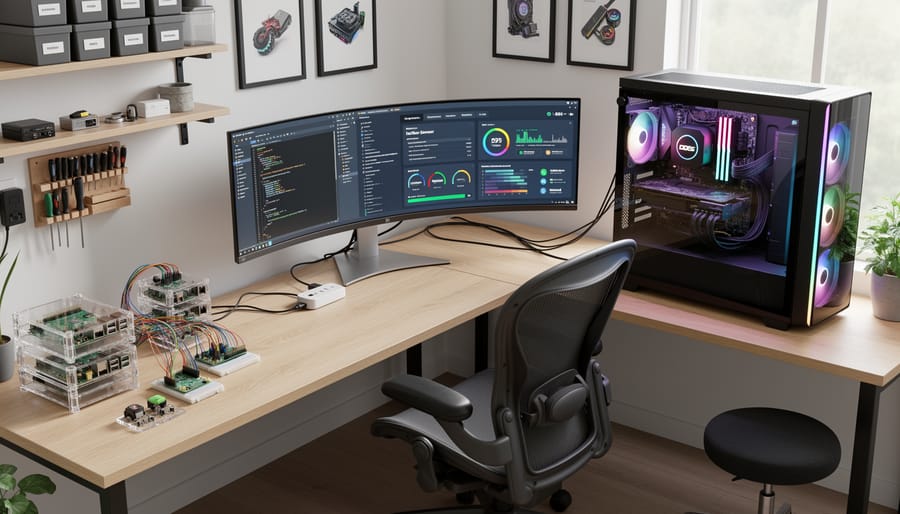
If you’re building a serious Raspberry Pi project ecosystem, a separate desktop PC with DDR5 memory can become your most valuable companion tool, not by connecting to the Pi, but by handling the heavy lifting your Pi can’t.
Development Workstation Setup
Compiling large projects directly on a Raspberry Pi 5 takes hours. A desktop PC equipped with the Corsair Vengeance DDR5 CMK32GX5M2E6000Z36 turns that waiting game into minutes. Set up your x86 machine to cross compile ARM binaries for your Pi projects. The 32GB of fast DDR5 memory handles massive build environments, multiple Docker containers, and simultaneous virtual machines running ARM emulation. You write and compile code on the desktop, then deploy finished binaries to your Pi fleet for testing and production.
This setup shines when you’re developing kernel modules, custom operating systems, or complex multi-dependency applications. Your Pi stays dedicated to running and testing code while your desktop does the computational grunt work.
Home Lab Coordination
A DDR5-equipped desktop serves as the orchestration center for multi-Pi projects. Run your NAS backend, database server, or container registry on the desktop while your Raspberry Pi devices handle edge computing, sensor collection, or display outputs. The desktop becomes the data warehouse and processing hub; the Pis become your distributed sensors and controllers.
For media server setups, the desktop transcodes 4K video streams while Pi devices run Kodi clients throughout your home. The 6000MHz DDR5 speed handles real-time transcoding without stuttering, and 32GB means you can buffer multiple streams simultaneously.
Continuous Integration Pipeline
Serious Pi developers build automated testing pipelines. Your desktop runs Jenkins or GitLab CI, spinning up multiple ARM virtual machines to test code across different Pi configurations. When you push code changes, your desktop automatically compiles, tests across virtual Pi environments, and flags issues before you ever touch real hardware. The DDR5 memory keeps virtual machines responsive even when running four or five simultaneously.
This companion approach maximizes what each platform does best: your Pi handles embedded tasks efficiently, your desktop provides the horsepower for everything else.
Memory Options for Your Actual Raspberry Pi Project
Your Raspberry Pi 5’s memory situation is straightforward: you picked either 4GB or 8GB when you bought the board, and that’s what you’re working with. Since the RAM is soldered directly to the PCB, there’s no upgrade path through swapping modules.
For most projects, retro gaming stations, media centers, basic home automation controllers, the 4GB Pi 5 handles things comfortably. You’ll rarely push against memory limits if you’re running a single focused application. The 8GB variant makes sense when you’re running multiple services simultaneously, hosting Docker containers, or building development environments where you’ll have browsers, IDEs, and compilation processes fighting for resources. Understanding your Pi 5 memory needs before purchasing saves you from either overpaying or hitting frustrating bottlenecks mid-project.
Once you’ve got your Pi, optimizing what you’ve got matters more than raw capacity. Raspberry Pi OS Lite strips out the desktop environment entirely, freeing up roughly 200-300MB that would otherwise sit idle on headless servers. Disable services you don’t need, Bluetooth, Wi-Fi, and various daemons consume memory even when unused. Monitor actual usage with `htop` rather than guessing; I’ve seen builders panic over memory warnings while still having 2GB sitting free.
Switching to a memory-efficient OS like DietPi or Alpine Linux cuts baseline consumption dramatically, sometimes dropping idle usage below 150MB. These lightweight distributions excel for dedicated single-purpose builds, NAS boxes, VPN gateways, or print servers where you need maximum headroom for your actual workload rather than desktop polish.
Compression matters too. Enable zswap to create a compressed memory cache that effectively stretches your available RAM by 20-40% depending on your workload. The CPU overhead is negligible on Pi 5’s processor, and the swap performance boost over microSD or even SSD swap is substantial.
Comparing Desktop Memory to Pi Memory: What You Need to Know
The desktop memory modules you install in a PC tower and the memory chips soldered onto a Raspberry Pi board serve the same fundamental purpose, storing data for quick processor access, but that’s where the similarities end. Understanding why these two technologies cannot be swapped requires looking at their physical design, power requirements, and intended use cases.
| Feature | Desktop DDR5 (Corsair CMK) | Raspberry Pi LPDDR4X |
|---|---|---|
| Form Factor | DIMM module (133mm stick) | Soldered BGA chips |
| Upgradability | User-replaceable | Permanent, set at manufacture |
| Speed | 6000 MT/s | 4267 MT/s |
| Power Draw | 1.1V standard voltage | 0.5V ultra-low power |
| Use Case | Performance desktops | Power-efficient embedded systems |
Desktop DDR5 modules like the Corsair Vengeance CMK are designed as standardized, removable sticks that slot into DIMM sockets on a motherboard. This modularity lets PC builders upgrade capacity or swap failed modules. The Pi 5, by contrast, uses ball grid array (BGA) memory chips soldered directly to the circuit board during manufacturing, there are no sockets, no slots, and no way to physically attach a desktop memory module.
The power consumption difference matters more than the speed numbers suggest. LPDDR4X (Low Power DDR4) runs at roughly half the voltage of standard desktop memory, which is critical for a device designed to sip power from a USB-C adapter. The “LP” prefix exists precisely because embedded systems prioritize battery life and thermal efficiency over raw throughput. Desktop DDR5 optimizes for maximum bandwidth in systems with dedicated cooling and power supplies that can deliver 500 watts or more.
This isn’t a compatibility issue you can solve with an adapter or firmware update. The electrical signaling, physical connection method, and power delivery systems are fundamentally different. When you choose memory for a desktop build, you select capacity and speed based on your workload. When you choose a Raspberry Pi model, you’re selecting the entire computer, memory included, as a fixed configuration.
When to Invest in High-Performance Desktop RAM for Your Tech Lab
If you’re serious about Raspberry Pi development, at some point your Pi itself becomes the bottleneck. That’s when a capable desktop workstation with DDR5 memory stops being a luxury and starts being a productivity tool.
Compilation is the clearest use case. Building large projects like custom Linux kernels, Docker containers, or complex Python environments on a Pi 5 can take hours. A desktop with the Corsair Vengeance DDR5 CMK and a modern processor cuts that time to minutes. You write and test code on the Pi, but you compile and package on the desktop. The time savings compound quickly when you’re iterating on projects or maintaining multiple builds.
Cross-platform development is another strong reason. If you’re building software that needs to run on both ARM (Pi) and x86 systems, you need both architectures available. A DDR5-equipped desktop handles the x86 testing and heavy lifting while your Pi handles ARM-specific work. This setup is essential for developers releasing software across platforms or testing compatibility.
Home lab environments benefit from this pairing too. A desktop with ample DDR5 memory can run virtualization software like Proxmox or ESXi, hosting multiple virtual machines that coordinate with physical Pi devices. You might run network services, databases, or monitoring tools on the desktop while your Pis handle edge computing, sensors, or specific hardware interfaces that require GPIO access.
The key is recognizing when your projects have outgrown what a single Pi can handle efficiently. If you’re waiting on builds, running out of memory during development, or manually shuttling files between systems, it’s time to invest in proper desktop hardware that complements your Pi work rather than replacing it.
The search for Corsair Vengeance DDR5 CMK memory in the context of Raspberry Pi projects reveals an important lesson about hardware compatibility and the value of understanding your complete tech ecosystem. While the CMK32GX5M2E6000Z36 cannot plug into a Pi 5, and never will, given the soldered LPDDR4X architecture, this doesn’t make it irrelevant to Pi builders.
Your best approach depends on your actual project needs. If you’re running lightweight applications or learning embedded systems, the Pi 5’s 4GB or 8GB configurations handle most tasks admirably. For demanding workloads, consider building a companion desktop system where DDR5 memory genuinely shines: cross-compilation, development environments, or backend servers that coordinate with your Pi devices.
The key is making informed decisions rather than forcing incompatible hardware together. Choose your Pi 5 memory tier based on your specific applications, optimize your software for efficiency, and when you need raw computing power, invest in a proper desktop system where components like the Corsair Vengeance DDR5 can actually deliver their performance. Understanding what each platform does best means you’ll spend money on hardware that works, not on modules that sit unused in a drawer.