

Choosing between Raspberry Pi and Arduino isn’t about finding the “better” platform – it’s about matching the right tool to your specific project needs. While investing in a Raspberry Pi offers a complete computing environment capable of running multiple programs simultaneously, handling complex data processing, and supporting rich multimedia applications, Arduino excels in real-time operations, precise timing control, and direct hardware manipulation. Think of Raspberry Pi as a miniature computer perfect for projects requiring networking, displays, or advanced processing, while Arduino serves as a dedicated microcontroller ideal for robotics, sensors, and automation tasks where immediate response times are crucial. Understanding these fundamental differences is essential for choosing the platform that will best serve your project goals and technical requirements. Both platforms have carved out distinct niches in the maker community, and many advanced projects actually benefit from combining their complementary strengths.
Core Differences That Matter
Processing Power and Capabilities
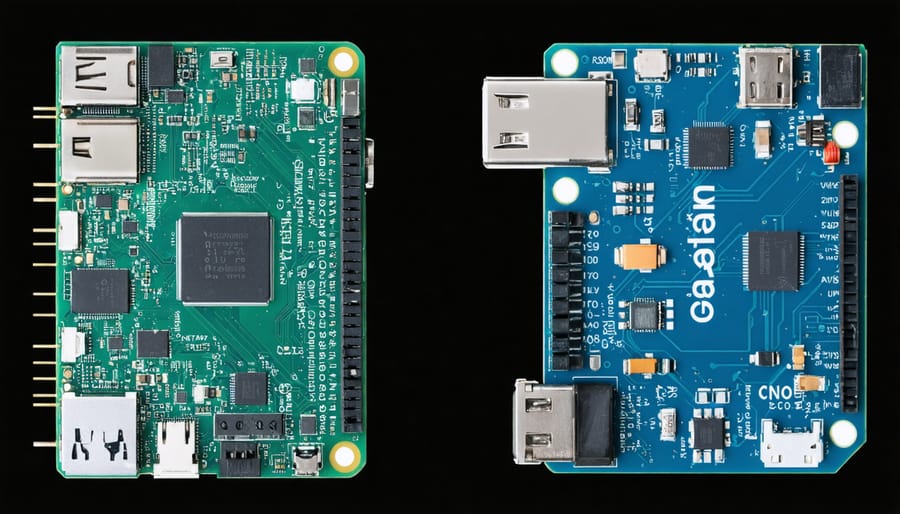
When it comes to processing power, the Raspberry Pi and Arduino operate in completely different leagues. The Raspberry Pi 4 specifications reveal a robust quad-core processor running at 1.5GHz with up to 8GB of RAM, making it capable of running a full Linux operating system and handling multiple tasks simultaneously. This means you can run desktop applications, browse the web, and process complex calculations all at once.
In contrast, Arduino boards typically feature simple microcontrollers running at 16MHz with just a few kilobytes of RAM. While this might seem like a significant disadvantage, it’s actually perfect for their intended use: dedicated, single-purpose tasks that require precise timing and direct hardware control.
The Raspberry Pi functions as a complete computer, capable of running various operating systems like Raspberry Pi OS, Ubuntu, or even Windows IoT Core. This versatility allows for sophisticated programming environments, graphical interfaces, and the ability to handle complex tasks like machine learning or video processing.
Arduino, meanwhile, runs bare-metal code without an operating system, which results in faster response times for specific tasks and lower power consumption. This makes it ideal for projects requiring real-time operations, such as robotics controls or sensor monitoring.
Real-Time Operations vs. Multitasking
When it comes to handling operations, Raspberry Pi and Arduino take fundamentally different approaches. The Arduino excels at real-time operations, making it ideal for projects that require precise timing and immediate responses. Its dedicated microcontroller can execute simple tasks with extremely low latency, perfect for controlling motors, reading sensors, or responding to button presses instantly.
The Raspberry Pi, running a full operating system, operates on a multitasking principle. While this means it can handle multiple complex operations simultaneously – like running a web server while processing camera input – it doesn’t guarantee the same precise timing as an Arduino. The Pi might experience slight delays or interruptions as the operating system manages various tasks and processes.
Think of it this way: an Arduino is like a skilled worker focused on one specific task, performing it perfectly and consistently. The Raspberry Pi is more like a manager coordinating multiple projects simultaneously – more versatile but with divided attention.
For projects requiring microsecond-level precision, such as generating PWM signals or implementing timing-critical protocols, the Arduino is often the better choice. However, if your project needs to handle multiple complex tasks, like processing data while maintaining a user interface and network connection, the Raspberry Pi’s multitasking capabilities make it the superior option.
Project-Based Decision Making
When Raspberry Pi Shines
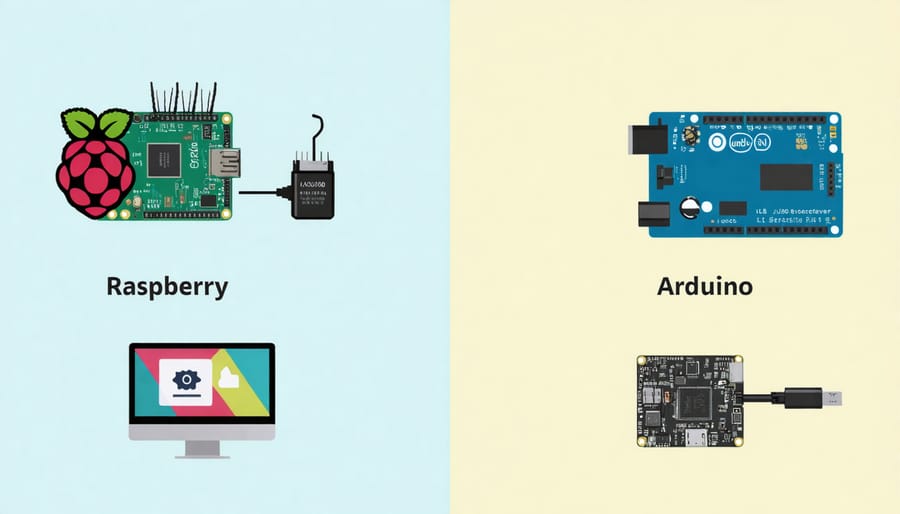
When it comes to multimedia projects, web servers, or advanced computing tasks, the Raspberry Pi truly excels. Its Linux-based operating system and powerful processor make it the ideal choice for projects that require significant processing power or multitasking capabilities.
The Pi shines particularly bright in projects involving computer vision, such as security cameras or motion detection systems. Its ability to run Python scripts and handle complex image processing libraries like OpenCV makes it perfect for these applications. Additionally, the Pi’s GPIO pin capabilities combined with its processing power enable sophisticated home automation systems that can handle multiple sensors and actuators simultaneously.
For educational environments, the Raspberry Pi serves as an excellent platform for learning programming, operating systems, and networking concepts. Students can use it as a complete desktop computer, write code in various programming languages, and even host their own websites. The ability to run multiple programs simultaneously makes it ideal for teaching environments where students need to use different applications and tools.
Media centers and retro gaming consoles are another sweet spot for the Pi. With its HDMI output and ability to run entertainment software like Kodi or RetroPie, it’s perfect for creating your own streaming device or gaming station. The Pi 4’s capability to output 4K video makes it particularly suitable for modern media applications.
Network-related projects also benefit from the Pi’s capabilities. Whether you’re setting up a network-attached storage (NAS) system, a VPN server, or a network monitoring tool, the Pi’s ethernet port and processing power make it an excellent choice. Its ability to run Docker containers and handle database operations makes it suitable for small-scale web hosting and development environments.
Remember that the Pi excels in projects requiring a full operating system, graphical interface, or significant computational power. If your project involves these elements, the Raspberry Pi is likely your better choice.
When Arduino Takes the Lead
While the Raspberry Pi is incredibly versatile, Arduino often emerges as the superior choice for specific types of projects, particularly those involving real-time operations and direct hardware control. Arduino’s simplified architecture and dedicated microcontroller make it perfect for projects that require precise timing and immediate response to sensor inputs.
Arduino excels in projects that need to run a single task repeatedly and reliably. For instance, automated plant watering systems, motion-triggered security devices, and LED light controllers benefit from Arduino’s ability to execute commands without the overhead of an operating system. Its real-time processing capabilities make it ideal for robotics projects where split-second timing is crucial, such as line-following robots or servo motor control systems.
The Arduino platform also shines in portable projects that need to operate on battery power for extended periods. Its low power consumption and ability to enter sleep modes make it perfect for environmental monitoring stations, wearable electronics, and remote sensors that need to run for weeks or months on a single battery.
When it comes to rapid prototyping and testing simple electronic circuits, Arduino’s straightforward nature is a significant advantage. Its analog input capabilities make it easier to work with various sensors without additional components, and its PWM outputs are perfect for motor control and LED dimming applications.
Arduino is also the better choice for projects that need to operate independently without user intervention. Unlike the Raspberry Pi, which requires proper shutdown procedures, an Arduino can be safely powered off at any time without risking data corruption. This makes it ideal for installations in remote locations or projects that might experience unexpected power interruptions.
For beginners learning electronics and programming, Arduino’s simpler architecture can provide a more focused learning experience, especially when working with basic concepts like digital inputs/outputs, analog sensing, and basic automation tasks.
Cost and Learning Curve Analysis
When considering the investment in either platform, both initial costs and long-term expenses play crucial roles in decision-making. The Arduino platform typically offers a lower entry point, with basic boards starting around $25, while genuine Raspberry Pi boards generally start at $35-45 for the latest models. However, these base prices don’t tell the complete story.
Arduino’s simplicity means fewer additional components are needed for basic projects. Most Arduino boards come ready to use with just a USB cable and your code. The power requirements are minimal, and you can often run projects on batteries or simple power supplies.
Raspberry Pi, while more expensive upfront, comes as a complete computer system. You’ll need additional items like a microSD card, power supply, and potentially a case, monitor, keyboard, and mouse. These extras can push initial costs to $100 or more. However, this higher investment brings significantly more functionality and computing power.
The learning curve also factors into the total cost of ownership. Arduino’s straightforward nature makes it ideal for beginners in electronics and programming. The Arduino IDE is user-friendly, and the C/C++ programming environment is relatively easy to grasp for basic projects. You can start creating simple projects within hours of unboxing.
Raspberry Pi presents a steeper learning curve, requiring understanding of Linux operating systems, Python programming (though other languages are supported), and basic system administration. While this might take longer to master, the skills gained are more transferable to professional computing environments.
Long-term investment considerations favor Raspberry Pi for those interested in expanding their computing knowledge. The platform’s versatility means one board can serve multiple purposes, from learning programming to hosting servers or running media centers. Arduino, while excellent for specific tasks, generally remains focused on single-purpose applications.
For budget-conscious beginners focusing on electronics and basic automation, Arduino provides the most cost-effective entry point. However, if your goals include broader computing applications and professional skill development, Raspberry Pi’s higher initial investment often proves more economical in the long run.
Using Both Together
While it might seem like you need to choose between a Raspberry Pi and Arduino, many makers find that using both platforms together creates powerful project possibilities. Each device’s strengths can complement the other’s limitations, leading to more sophisticated and capable solutions.
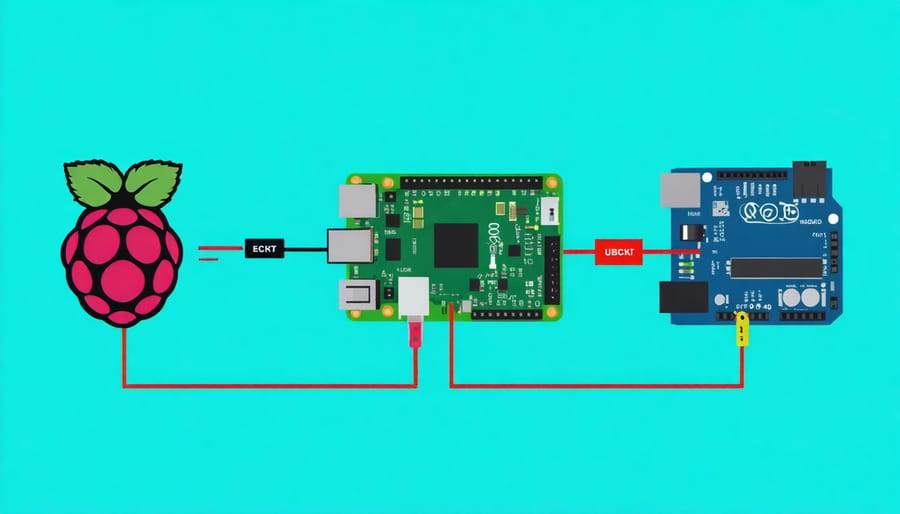
Consider a scenario where you’re building advanced robotics projects. The Arduino can handle real-time sensor readings and motor control with precise timing, while the Raspberry Pi manages high-level tasks like computer vision, wireless communication, and complex data processing. This combination creates a more robust and versatile system than either platform could achieve alone.
The communication between these devices is straightforward, typically using serial communication or I2C protocol. For example, you might use an Arduino to collect environmental sensor data and control actuators, while the Raspberry Pi stores this information in a database and provides a web interface for remote monitoring and control.
Here’s a practical approach to combining both platforms:
– Use Arduino for time-sensitive operations, analog input processing, and direct hardware control
– Let Raspberry Pi handle user interfaces, network connectivity, and complex computational tasks
– Connect them via USB or GPIO pins for seamless data exchange
– Leverage Arduino’s real-time capabilities while benefiting from Pi’s processing power
This dual-platform approach is particularly effective for projects requiring both precise hardware control and sophisticated processing. Home automation systems, weather stations, and autonomous vehicles often benefit from this combination, where Arduino handles the immediate physical interactions while Raspberry Pi manages the overall system intelligence and user interface.
Remember that while this approach offers great flexibility, it also requires understanding both platforms’ programming environments and communication protocols. However, the learning curve is worth the expanded capabilities you’ll gain for your projects.
When choosing between a Raspberry Pi and Arduino, the best option ultimately depends on your specific project needs and goals. The Raspberry Pi excels in projects requiring complex computing, multimedia capabilities, or internet connectivity, making it ideal for home automation hubs, media centers, or advanced robotics projects. Its Linux-based operating system and programming versatility offer endless possibilities for software development and integration.
Arduino, on the other hand, shines in projects focused on real-time hardware control, sensor interaction, and simple, dedicated tasks. Its simplicity, reliability, and low power consumption make it perfect for embedded systems, basic robotics, and environmental monitoring projects.
For beginners interested in learning programming and general computing, the Raspberry Pi provides a more comprehensive educational platform. However, those wanting to learn electronics and hardware interaction might find Arduino’s straightforward approach more accessible.
Consider using both platforms together for more complex projects – Arduino handling real-time sensor data and hardware control while Raspberry Pi manages high-level processing and user interface. This combination leverages the strengths of both platforms for optimal results.
Remember that neither platform is universally “better” – they’re different tools designed for different purposes. Choose based on your project requirements, budget constraints, and personal learning goals rather than perceived superiority of one over the other.