


The Raspberry Pi revolutionized accessible computing by offering a credit card-sized computer that packs surprising power into an affordable package. This versatile single-board computer serves as both an educational platform and a practical tool for everything from home automation to enterprise solutions. Whether you’re a student learning to code, a maker building IoT projects, or an IT professional seeking cost-effective computing solutions, the Raspberry Pi provides the perfect balance of functionality, flexibility, and affordability.
At its core, the Raspberry Pi is a complete Linux computer featuring a processor, RAM, and various connectivity options, all for under $50. Its low power consumption, compact size, and robust community support make it ideal for projects ranging from simple LED controllers to sophisticated network servers. Organizations increasingly deploy Raspberry Pi devices for digital signage, monitoring systems, and edge computing applications, demonstrating its evolution from an educational tool to a serious business solution.
Understanding this powerful platform opens doors to endless possibilities in computing, programming, and automation. Let’s explore what makes the Raspberry Pi unique and discover how it can serve your specific needs, whether personal or professional.
What Makes Raspberry Pi Unique in Enterprise
Hardware Specifications
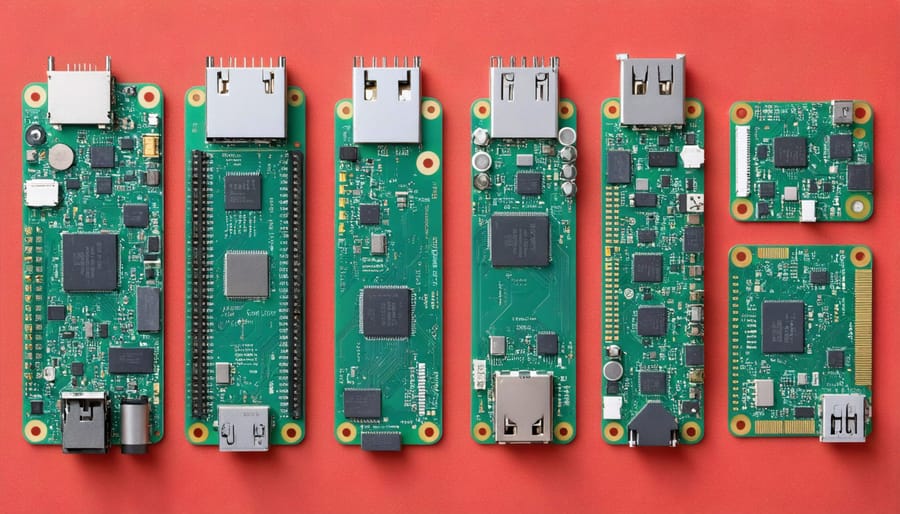
The Raspberry Pi 4 Model B, the latest flagship model, offers impressive specifications with options for 2GB, 4GB, or 8GB of RAM, making it suitable for various enterprise applications. Its 1.5GHz quad-core ARM Cortex-A72 processor provides robust processing power for demanding tasks. The device features dual-monitor support through two micro HDMI ports, capable of 4K resolution output.
For connectivity, it includes Gigabit Ethernet, dual-band Wi-Fi (2.4GHz and 5GHz), Bluetooth 5.0, and two USB 3.0 ports alongside two USB 2.0 ports. The board also provides 40 GPIO pins for connecting various enterprise-grade expansion options, sensors, and peripherals.
For organizations requiring more compact solutions, the Raspberry Pi Zero 2 W offers a smaller form factor with a 1GHz quad-core processor and 512MB RAM. This model maintains essential connectivity features like Wi-Fi and Bluetooth while consuming minimal power, making it ideal for embedded systems and IoT deployments.
Both models use microSD cards for storage and feature the standard Raspberry Pi camera and display interfaces, enabling versatile implementation in business environments.
Enterprise-Ready Features
The Raspberry Pi has evolved beyond its educational roots to become a viable solution for various enterprise automation applications. Its robust Linux-based operating system supports industry-standard protocols and security features essential for business deployments. Organizations can leverage built-in features like remote management capabilities, network monitoring tools, and compatibility with standard enterprise software stacks.
Key enterprise features include support for Active Directory integration, VPN connectivity, and centralized device management. The platform’s ability to run Docker containers makes it ideal for edge computing and IoT implementations, while its hardware interfaces support industrial sensors and control systems. Companies can deploy multiple Raspberry Pi devices at a fraction of the cost of traditional enterprise hardware.
The device’s extensive GPIO capabilities enable custom hardware integration, making it suitable for specialized industrial applications. With proper configuration, Raspberry Pis can handle mission-critical tasks while maintaining enterprise-grade security standards. This versatility, combined with its low cost and energy efficiency, makes it an attractive option for businesses looking to implement scalable IoT solutions or modernize their infrastructure.
Common Enterprise Applications

IoT and Monitoring Solutions
The Raspberry Pi has become a cornerstone in modern IoT and monitoring solutions, offering businesses a cost-effective way to implement smart technology systems. Companies are increasingly turning to these compact computers for their IoT implementation solutions, from environmental monitoring to industrial automation.
In warehouses, Raspberry Pis serve as sensor hubs, tracking temperature, humidity, and inventory movements in real-time. Manufacturing facilities use them to monitor equipment performance and predict maintenance needs, significantly reducing downtime and operational costs. Retail businesses leverage these devices for customer tracking, inventory management, and digital signage systems.
The versatility of Raspberry Pi in IoT applications extends to smart agriculture, where farmers use them to control irrigation systems and monitor crop health. Office buildings integrate these devices into their security systems, managing access control and surveillance cameras while collecting occupancy data for better space utilization.
What makes Raspberry Pi particularly attractive for business IoT applications is its combination of affordability, reliability, and extensive support community. Companies can start small with pilot projects and scale up as needed, without significant initial investment. The ability to run various operating systems and support multiple programming languages also makes it easier for businesses to integrate Raspberry Pi devices into their existing infrastructure.
Edge Computing Applications
Raspberry Pi’s compact size and processing capabilities make it an excellent choice for edge computing applications, where data processing needs to occur closer to the source. In industrial settings, Raspberry Pi devices can be deployed as smart sensors to collect and process data from manufacturing equipment in real-time, reducing latency and bandwidth usage.
One popular application is using Raspberry Pi as an IoT gateway, where it acts as an intermediary between local sensors and cloud services. For example, in agricultural settings, Raspberry Pi devices can monitor soil conditions, temperature, and humidity, processing this data locally before sending only relevant information to central servers.
Security systems benefit from edge computing with Raspberry Pi through local video processing and motion detection. Instead of streaming all footage to a central server, the Raspberry Pi can analyze video feeds on-site and only transmit alerts when specific events are detected, significantly reducing network traffic and storage requirements.
Smart home automation represents another key edge computing application. Raspberry Pi can process voice commands, control connected devices, and manage home security systems locally, ensuring faster response times and continued functionality even during internet outages.
In retail environments, Raspberry Pi devices serve as point-of-sale systems and inventory trackers, processing transactions and managing stock levels at the edge while synchronizing with central databases when needed.
Network Management Tools
La Raspberry Pi se destaca como una herramienta versátil para la gestión y monitorización de redes. Con el software adecuado, puede transformarse en un potente sistema de supervisión de red que analiza el tráfico, detecta problemas y proporciona información valiosa sobre el rendimiento de tu infraestructura.
Algunas de las aplicaciones más populares incluyen Pi-hole, un bloqueador de anuncios a nivel de red que también funciona como servidor DNS, y Nagios, una solución de monitorización que permite supervisar dispositivos y servicios en tu red. También puedes configurar Wireshark para análisis de paquetes o instalar Cacti para generar gráficos detallados del tráfico de red.
La ventaja de usar Raspberry Pi para estas tareas es su bajo consumo energético y su capacidad para funcionar 24/7 sin necesidad de mantenimiento constante. Además, su tamaño compacto permite ubicarla estratégicamente en cualquier punto de la red donde sea necesaria la monitorización.
Para comenzar, solo necesitas una Raspberry Pi con Raspberry Pi OS, conexión a red mediante cable Ethernet para mayor estabilidad, y conocimientos básicos de Linux. La comunidad activa de usuarios proporciona abundante documentación y soporte para implementar estas soluciones, haciendo que la curva de aprendizaje sea más accesible para principiantes en administración de redes.
Implementation Considerations
Security Requirements
When implementing Raspberry Pi in an enterprise environment, proper security measures are essential to protect sensitive data and systems. Start by changing the default password and creating unique user accounts with appropriate permissions for each team member. Enable SSH key-based authentication instead of password login, and consider implementing two-factor authentication for additional security.
Regularly update your Raspberry Pi’s operating system and installed packages to patch security vulnerabilities. Install and configure a firewall like UFW (Uncomplicated Firewall) to control incoming and outgoing network traffic. Consider implementing network segmentation to isolate Raspberry Pi devices from critical infrastructure.
For data protection, encrypt sensitive information stored on the SD card using LUKS (Linux Unified Key Setup) or similar encryption tools. If your Raspberry Pi serves as an IoT device, ensure all communications are encrypted using SSL/TLS protocols. Implement secure boot mechanisms to prevent unauthorized modifications to the boot sequence.
Monitor system logs regularly for suspicious activities and consider setting up automated alerts for security events. Install and maintain antivirus software specifically designed for ARM architecture. Create regular backups of critical data and system configurations, storing them securely off-site.
For enterprise deployments, consider implementing a mobile device management (MDM) solution to centrally manage multiple Raspberry Pi devices. Establish clear security policies and procedures for device maintenance, updates, and access control. Regular security audits and penetration testing can help identify potential vulnerabilities before they can be exploited.
Scalability and Management
When deploying multiple Raspberry Pi devices in an organization or educational setting, proper management and scalability become crucial factors for success. The versatility of these devices allows for various deployment strategies, from single-unit implementations to advanced Raspberry Pi clustering capabilities that can handle more demanding workloads.
For effective management of multiple units, consider implementing configuration management tools like Ansible or Puppet, which allow for centralized control and automated updates across your Raspberry Pi fleet. Docker containers can also streamline application deployment and ensure consistency across devices.
Remote management capabilities can be enhanced through SSH access and web-based management interfaces. Tools like Pi-hole for network management or Portainer for container orchestration make it easier to monitor and maintain multiple devices from a central location.
To ensure scalability, implement proper networking infrastructure with DHCP reservations and organized IP addressing schemes. Using network boot configurations can simplify the deployment of new devices, while maintaining a master image ensures consistency across all units.
Documentation is essential – maintain detailed records of hardware configurations, installed software, and network settings. This becomes particularly important as your deployment grows. Consider implementing monitoring solutions like Prometheus and Grafana to track system performance and resource utilization across your Raspberry Pi network.
For larger deployments, establish clear update procedures and maintenance schedules to minimize downtime and ensure all devices remain secure and up-to-date. Regular backups of critical configurations and data should be part of your management strategy.
Getting Started with Enterprise Deployment
Implementing Raspberry Pi in a business environment requires careful planning and execution. Start by assessing your organization’s needs and identifying specific use cases where Raspberry Pi can add value, such as digital signage, network monitoring, or IoT data collection.
Begin with a pilot project using 2-3 Raspberry Pi units. Set up a dedicated workspace with proper power supply, cooling, and network connectivity. Install Raspberry Pi OS or your preferred enterprise-ready operating system, ensuring it’s the latest stable version for optimal security and performance.
Security is paramount in enterprise deployment. Configure each device with strong passwords, enable SSH key authentication, and disable unnecessary services. Implement network segmentation to isolate Raspberry Pi devices from critical business systems. Regular security updates and monitoring should be part of your maintenance routine.
For scalability, establish a standardized configuration process. Create disk images of your base setup to streamline deployment of multiple units. Consider using configuration management tools like Ansible or Puppet to maintain consistency across devices.
Document everything thoroughly: hardware specifications, network configurations, installed software, and maintenance procedures. Develop clear protocols for troubleshooting and support. Train your IT team on Raspberry Pi management and establish backup procedures for critical data and configurations.
Consider implementing remote management solutions for efficient oversight of multiple devices. Monitor system health, network performance, and resource utilization through centralized dashboards. Set up automated alerts for potential issues like high temperature or storage capacity warnings.
For reliability, invest in quality power supplies and cases designed for enterprise use. Consider redundancy for critical applications and have spare units ready for quick replacement if needed. Regular testing of backup and recovery procedures ensures business continuity.
Remember to factor in total cost of ownership, including hardware, maintenance, and support requirements. While Raspberry Pi is cost-effective, enterprise deployment requires additional investment in infrastructure and security measures to ensure robust operation.
Raspberry Pi has proven itself as a versatile and cost-effective solution for enterprise environments, offering significant value through its compact size, low power consumption, and remarkable adaptability. As businesses continue to embrace digital transformation, Raspberry Pi’s role in powering IoT solutions, edge computing, and custom enterprise applications is expected to grow substantially. The platform’s strong community support, regular updates, and expanding ecosystem make it an increasingly attractive option for companies looking to innovate while maintaining budget efficiency. With the continuous development of more powerful models and enterprise-focused solutions, Raspberry Pi is positioned to become an even more integral part of business technology infrastructure in the coming years, enabling organizations to create tailored solutions for their specific needs while maintaining a competitive edge in the digital marketplace.