
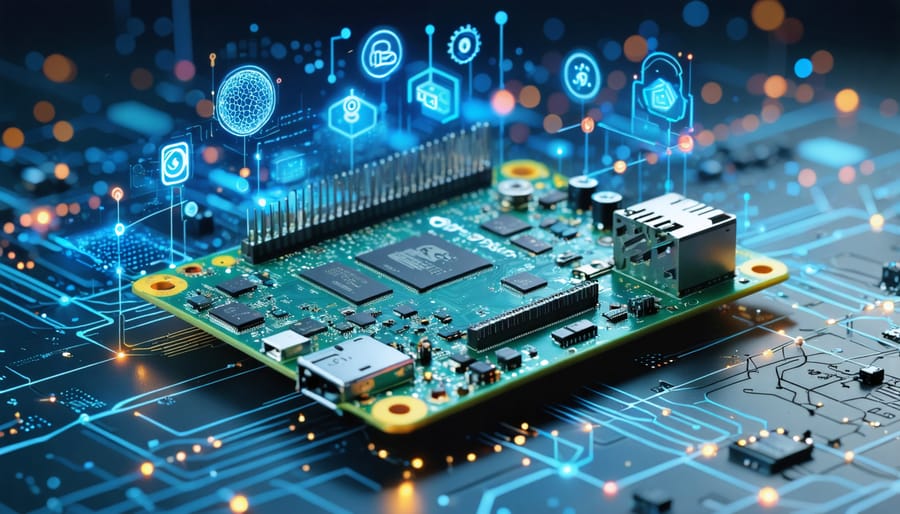
Transform your Raspberry Pi into a powerful edge computing node by deploying containerized applications, implementing local data processing algorithms, and utilizing GPIO pins for real-time sensor interactions. Modern edge computing techniques enable Raspberry Pi devices to process data directly at the source, reducing latency and bandwidth consumption while enhancing privacy and operational efficiency.
The Pi’s compact form factor, low power consumption, and robust Linux ecosystem make it an ideal platform for edge computing applications – from smart home automation to industrial IoT deployments. With tools like Docker, TensorFlow Lite, and Node-RED, developers can build sophisticated edge solutions that rival commercial alternatives at a fraction of the cost.
Whether you’re processing sensor data, running machine learning models, or managing local network traffic, the Raspberry Pi provides enterprise-grade edge computing capabilities in an accessible, affordable package. By following industry best practices for optimization and security, your Pi-based edge computing solution can deliver reliable, real-time performance for demanding applications.
Why Edge Computing Matters for Real-Time Applications
The Problem with Cloud Latency
While cloud computing has revolutionized how we process and store data, it comes with a significant drawback: latency. When devices need to send data to distant servers for processing, the round-trip time can range from tens to hundreds of milliseconds. For time-sensitive applications like autonomous vehicles, industrial automation, or real-time video processing, this delay is simply unacceptable.
Consider a smart security camera that needs to detect and respond to suspicious activity. If it relies on cloud processing, the time taken to send video feeds to remote servers, analyze them, and receive instructions back could mean the difference between preventing an incident and merely recording it. Network congestion, bandwidth limitations, and geographical distance all contribute to these delays.
Additionally, cloud-dependent systems can face reliability issues when internet connectivity is unstable or unavailable. In remote locations or during network outages, cloud-based solutions might fail completely, leaving critical systems vulnerable. This is where edge computing with Raspberry Pi offers a compelling solution, bringing processing power closer to where data is generated and enabling near-instantaneous response times.
Edge Computing: Processing Where It Matters
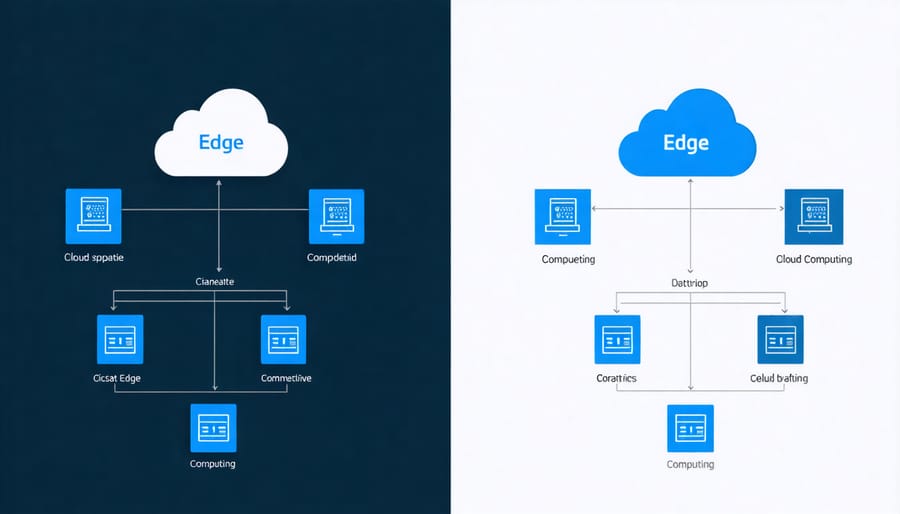
Edge computing brings data processing closer to where it’s actually needed, and the Raspberry Pi excels at this task. Instead of sending data to distant cloud servers and waiting for responses, edge computing processes information right at the source, dramatically reducing latency and improving response times.
Think of it like having a mini data center right where you need it. When you’re running sensors in a smart home or monitoring industrial equipment, every millisecond counts. By processing data on a Raspberry Pi at the edge, you can get near-instantaneous results without the delay of internet transmission.
This local processing approach offers several key benefits. First, it reduces bandwidth usage since only relevant data needs to be sent to the cloud. Second, it enhances privacy by keeping sensitive data local. Third, it ensures your applications continue working even when internet connectivity is unstable.
For time-critical applications like automated manufacturing or security systems, this reduction in latency from seconds to milliseconds can make a crucial difference. The Raspberry Pi’s combination of low cost, modest power consumption, and sufficient processing power makes it an ideal platform for edge computing solutions.
Optimizing Your Raspberry Pi for Edge Computing
Hardware Requirements and Recommendations
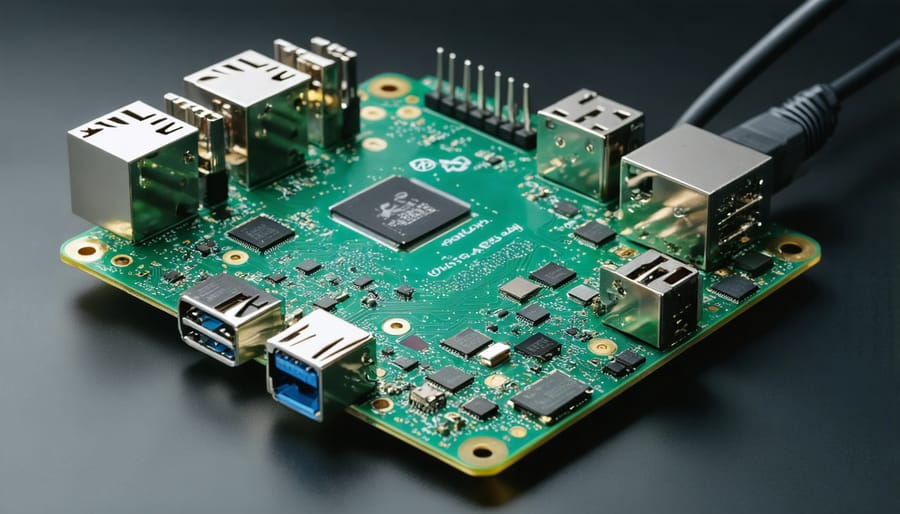
For edge computing applications, the Raspberry Pi 4 Model B with at least 4GB RAM is highly recommended as the minimum baseline. The 8GB variant offers better performance for more demanding edge computing tasks, especially when running multiple containers or AI inference workloads. Choose a high-quality microSD card (Class 10 or UHS-I) with at least 32GB storage for reliable operation.
Essential accessories include a reliable 5V/3A USB-C power supply to ensure stable power delivery, and a proper heat sink or cooling solution to maintain optimal performance during intensive processing tasks. For outdoor or industrial deployments, consider a weatherproof case with adequate ventilation.
Network connectivity is crucial for edge computing. While the Pi 4’s built-in Gigabit Ethernet port works well for most applications, you might want to add a USB Wi-Fi adapter for wireless deployments or redundancy. For projects requiring additional sensors or actuators, the GPIO header pins allow easy integration of I2C, SPI, or UART devices.
Optional but recommended components include:
– Real-time clock module for time-sensitive applications
– UPS HAT for power backup
– External SSD via USB 3.0 for faster storage
– PoE HAT for single-cable power and network deployment
Remember to factor in future expansion when choosing your initial hardware configuration, as edge computing requirements often grow over time.
Software Stack Configuration
A well-configured software stack is crucial to optimize your edge computing setup. Start with a lightweight operating system like Raspberry Pi OS Lite, which provides essential functionality without unnecessary GUI overhead. For enhanced performance, disable unused services and configure boot options to minimize startup time.
Install Docker to containerize your applications, making them more portable and easier to manage. This approach allows you to run multiple isolated services while maintaining system stability. Consider implementing container orchestration tools like K3s, a lightweight Kubernetes distribution specifically designed for edge devices.
For real-time data processing, Python proves invaluable with libraries such as NumPy and Pandas. Install these dependencies using pip, and ensure you’re using Python 3.x for better performance and security. Enable caching mechanisms where appropriate to reduce processing latency.
Configure your network stack by optimizing TCP/IP settings and implementing quality of service (QoS) rules to prioritize critical traffic. Use systemd-networkd for efficient network management and consider enabling IPv6 for future-proofing your setup.
Set up proper logging with rsyslog or journald, but configure log rotation to prevent storage issues. Implement monitoring tools like Prometheus with Node Exporter to track system performance and resource usage, enabling proactive maintenance of your edge computing node.
Network Setup for Minimal Latency
Optimizing network configuration is crucial for edge computing applications where every millisecond counts. Start by enabling jumbo frames on your Raspberry Pi’s network interface to increase throughput for larger data packets. Edit the /etc/network/interfaces file to set MTU to 9000, but ensure your entire network infrastructure supports this setting.
For Wi-Fi connections, use the 5GHz band whenever possible, as it typically offers lower latency than 2.4GHz. Configure your Pi to prefer 5GHz networks by modifying the wpa_supplicant.conf file with the appropriate frequency band settings.
Consider implementing Quality of Service (QoS) rules to prioritize edge computing traffic over other network activities. This can be achieved using tc (traffic control) commands in Linux. For example, prioritize sensor data or real-time processing packets over regular web traffic.
Static IP assignment is essential for consistent performance. Avoid DHCP to eliminate address resolution delays. Configure your Pi with a static IP through the dhcpcd.conf file, and ensure it’s within the same subnet as your edge devices to minimize routing hops.
For critical applications, set up a direct ethernet connection between your Pi and edge devices. This eliminates wireless interference and reduces network complexity. Use Cat 6 or better cables for optimal performance, and consider implementing link aggregation for increased bandwidth if your application demands it.
Monitor network performance using tools like iperf3 to identify and resolve bottlenecks promptly.
Real-World Implementation Examples
IoT Sensor Processing
Real-time sensor processing is one of the most common applications for Raspberry Pi edge computing, allowing you to collect and analyze data directly at the source. A typical IoT sensor setup might include temperature, humidity, and motion sensors connected to your Raspberry Pi through GPIO pins.
For example, imagine a smart greenhouse monitoring system. Instead of sending raw temperature readings to the cloud every second, your Raspberry Pi can process this data locally. Using Python and libraries like NumPy, you can calculate rolling averages, detect anomalies, and trigger actions only when necessary.
Here’s what this looks like in practice: Your temperature sensor readings are collected every 5 seconds. The Raspberry Pi processes these readings in real-time, comparing them against predefined thresholds. If temperatures exceed safe levels, it can immediately activate cooling systems without waiting for cloud server responses. This immediate action is crucial for protecting sensitive plants.
The code implementation typically involves:
– Reading sensor data using GPIO libraries
– Processing data streams with NumPy or Pandas
– Implementing simple machine learning algorithms for anomaly detection
– Triggering local actuators based on processed results
This edge processing approach significantly reduces bandwidth usage and response times. Instead of sending 17,280 temperature readings per day to the cloud, your Pi might only transmit 50-100 meaningful events, such as significant temperature changes or system alerts.
The beauty of this setup lies in its reliability – even if internet connectivity fails, your local processing and control systems continue to function, ensuring your greenhouse remains protected.
Computer Vision Applications
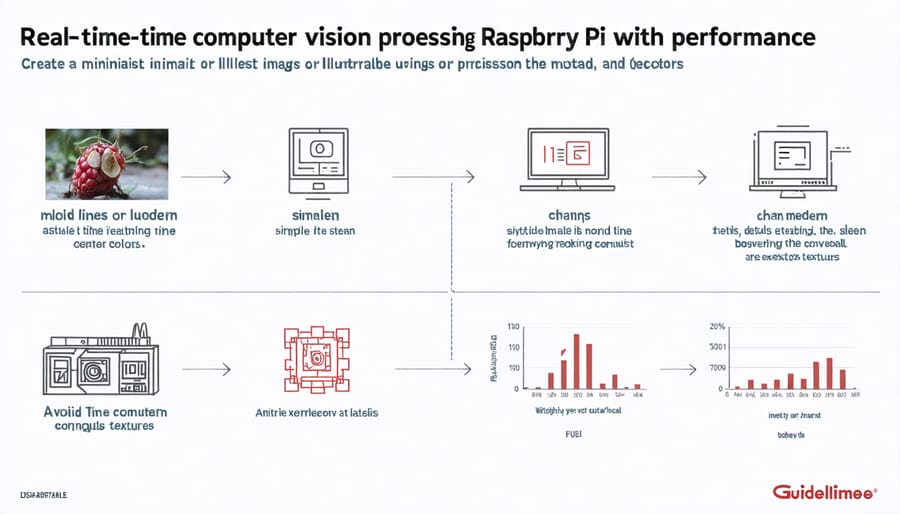
Computer vision applications represent one of the most exciting implementations of edge computing on the Raspberry Pi. By performing real-time image processing directly on the device, you can create responsive systems without relying on cloud services.
The Raspberry Pi’s GPU, combined with libraries like OpenCV and TensorFlow Lite, enables various computer vision tasks right at the edge. Common applications include motion detection for smart security systems, object recognition for automated inventory management, and facial recognition for personalized interactions.
To implement these features, you’ll typically use the Raspberry Pi Camera Module or a USB webcam as your input device. The Pi processes incoming video frames locally, applying algorithms for tasks like edge detection, color tracking, or pattern recognition. This approach significantly reduces latency compared to cloud-based solutions.
For example, a simple motion detection system can capture frames at 30 FPS, compare consecutive images for changes, and trigger alerts within milliseconds. More advanced projects might involve machine learning models for object classification, running efficiently through TensorFlow Lite’s edge-optimized framework.
Key considerations for successful implementation include:
– Optimizing image resolution and processing algorithms for the Pi’s capabilities
– Managing memory usage effectively
– Implementing proper error handling for camera operations
– Using multithreading to maintain smooth performance
– Considering power consumption for battery-operated projects
With careful optimization, your Raspberry Pi can handle sophisticated computer vision tasks while maintaining responsive performance and reliable operation.
Industrial Monitoring Systems
The Raspberry Pi has revolutionized industrial automation applications by providing an affordable and flexible platform for monitoring systems. In manufacturing environments, these compact computers excel at collecting and processing real-time data from various sensors, enabling predictive maintenance and quality control.
A typical industrial monitoring setup involves connecting sensors for temperature, vibration, and power consumption to a Raspberry Pi. The device processes this data locally, reducing latency and bandwidth usage while enabling immediate responses to critical events. For instance, if a machine’s vibration patterns indicate potential failure, the system can trigger alerts or automated shutdown procedures without waiting for cloud server responses.
Many factories implement multiple Raspberry Pis across their production lines, creating a distributed network of edge devices. Each unit handles local monitoring tasks while sharing relevant data with a central management system. This approach has proven particularly effective in environments where network connectivity may be unreliable or when millisecond-level response times are crucial.
The cost-effectiveness of Raspberry Pi-based monitoring systems makes them especially attractive for small and medium-sized manufacturers looking to modernize their operations. With basic programming knowledge and appropriate sensors, businesses can build custom monitoring solutions that rival expensive commercial systems, all while maintaining complete control over their data and processes.
The Raspberry Pi has proven itself to be a versatile and cost-effective solution for edge computing applications, offering a perfect balance between affordability and computational capability. Throughout this exploration, we’ve seen how these compact devices can transform the way we process data at the network edge, reducing latency and bandwidth requirements while enabling real-time decision making.
The combination of Raspberry Pi’s robust hardware capabilities, extensive community support, and growing ecosystem of sensors and add-ons makes it an ideal platform for both educational and professional edge computing projects. From smart home automation to industrial IoT applications, the possibilities are nearly endless.
Looking ahead, the future of Raspberry Pi in edge computing appears increasingly promising. As new models continue to offer improved processing power and connectivity options, we can expect to see even more innovative applications emerge. The integration of machine learning capabilities and the growing adoption of containerization technologies on Raspberry Pi devices further expand their potential in edge computing scenarios.
For hobbyists and professionals alike, getting started with Raspberry Pi edge computing has never been more accessible. Whether you’re building a simple sensor network or developing a complex distributed computing system, the Raspberry Pi provides a reliable and flexible foundation for your edge computing journey.
Remember, the key to success lies in careful planning, proper optimization, and staying up-to-date with the latest developments in both Raspberry Pi hardware and edge computing practices.