

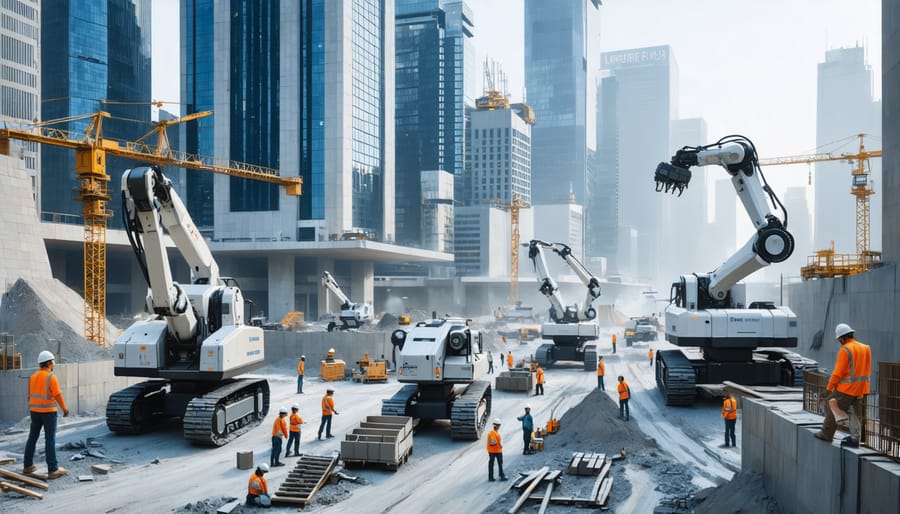
Construction automation and robotics are revolutionizing the building industry, transforming traditional construction sites into high-tech workspaces where automation engineers deploy sophisticated machines to handle everything from bricklaying to structural analysis. This technological evolution promises to address critical industry challenges: labor shortages, workplace safety, and project efficiency. Advanced robots now autonomously perform precise tasks like welding, concrete printing, and material handling, while AI-powered systems optimize construction schedules and monitor quality control in real-time. The integration of these smart technologies isn’t just changing how we build—it’s reshaping the entire construction landscape, promising faster project completion times, reduced costs, and unprecedented levels of precision. For tech enthusiasts and industry professionals alike, the convergence of robotics and construction represents an exciting frontier where digital innovation meets physical infrastructure, creating opportunities for groundbreaking developments in how we design, build, and maintain our built environment.
How Raspberry Pi Powers Modern Construction Robots
Smart Control Systems
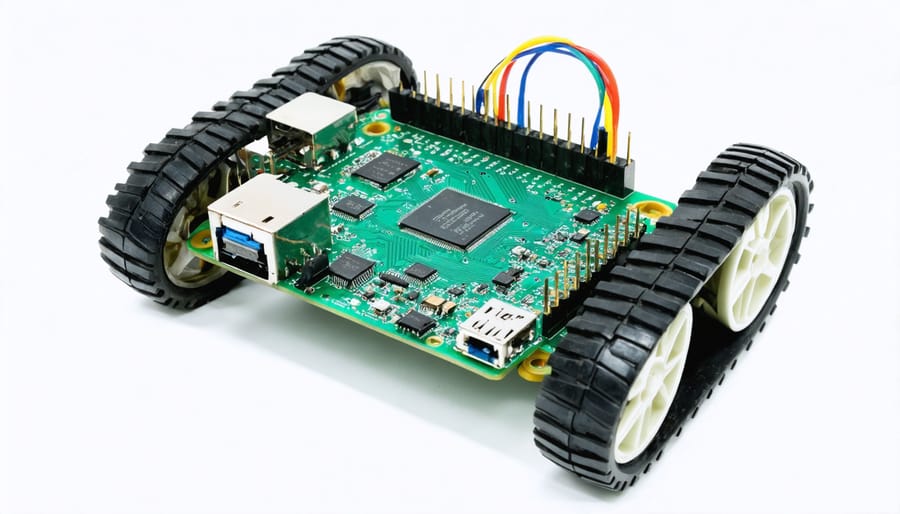
The Raspberry Pi has revolutionized smart control systems in construction automation by providing an affordable yet powerful platform for robot control. This single-board computer serves as the central processing unit for various construction robots, handling everything from motion planning to sensor data processing.
What makes the Raspberry Pi particularly suitable for construction automation is its versatility and robust GPIO capabilities. These features allow it to interface with multiple sensors, actuators, and motor controllers simultaneously, while its processing power enables real-time decision making and precise movement control.
The Pi’s ability to run Linux-based operating systems means developers can implement complex algorithms using popular programming languages like Python and C++. This accessibility has led to the development of numerous open-source control frameworks specifically designed for construction robotics.
Common applications include automated brick-laying systems, where the Pi processes spatial data and coordinates robotic arm movements, and autonomous construction vehicles, where it handles navigation and obstacle avoidance. The Pi’s network capabilities also enable remote monitoring and control of construction robots, making it easier to manage multiple units on large construction sites.
Sensor Integration
Sensor integration plays a crucial role in modern construction automation, creating intelligent systems that can monitor, analyze, and respond to various environmental conditions in real-time. Construction sites now employ sophisticated sensor networks that combine multiple types of sensors, including motion detectors, environmental sensors, and safety monitoring devices.
These sensor systems typically incorporate LiDAR for precise distance measurement, accelerometers for movement tracking, and environmental sensors that monitor temperature, humidity, and air quality. When connected to a central control system, these sensors create a comprehensive data collection network that enables automated decision-making and improved safety protocols.
Real-world applications include automated material tracking systems that use RFID sensors to monitor inventory and equipment location, structural health monitoring through strain gauges and vibration sensors, and worker safety systems utilizing wearable devices with integrated biometric sensors.
The data collected from these sensor networks feeds into machine learning algorithms that can predict maintenance needs, optimize resource allocation, and identify potential safety hazards before they become critical. This integration of sensors with automation systems represents a significant step forward in creating more efficient, safer, and more productive construction environments.
Key Construction Automation Technologies
3D Printing Robots
3D printing technology has revolutionized construction automation by enabling the creation of complex structures with minimal human intervention. These specialized robots use large-scale additive manufacturing techniques to extrude concrete, polymers, or other construction materials layer by layer, following precise digital blueprints.
The most common type of construction 3D printing robot uses a gantry or crane-mounted system with a specialized extruder head. These machines can print walls, foundations, and entire building structures in a fraction of the time required by traditional construction methods. Some advanced systems even incorporate multiple printing heads working simultaneously to further accelerate the process.
Recent innovations have introduced mobile 3D printing robots that can move autonomously around construction sites. These robots use sophisticated positioning systems and sensors to maintain precise printing accuracy while navigating uneven terrain. Many of these systems can be controlled using single-board computers like the Raspberry Pi, making them accessible to DIY enthusiasts and smaller construction firms.
The benefits of 3D printing in construction include reduced material waste, lower labor costs, and the ability to create complex geometries that would be difficult or impossible with traditional methods. Some systems can even incorporate internal features like conduits for electrical wiring and plumbing during the printing process.
For makers interested in experimenting with construction-scale 3D printing, several open-source projects provide designs for smaller concrete printers that can be built using readily available components and controlled with basic microcontrollers.
Demolition and Material Handling
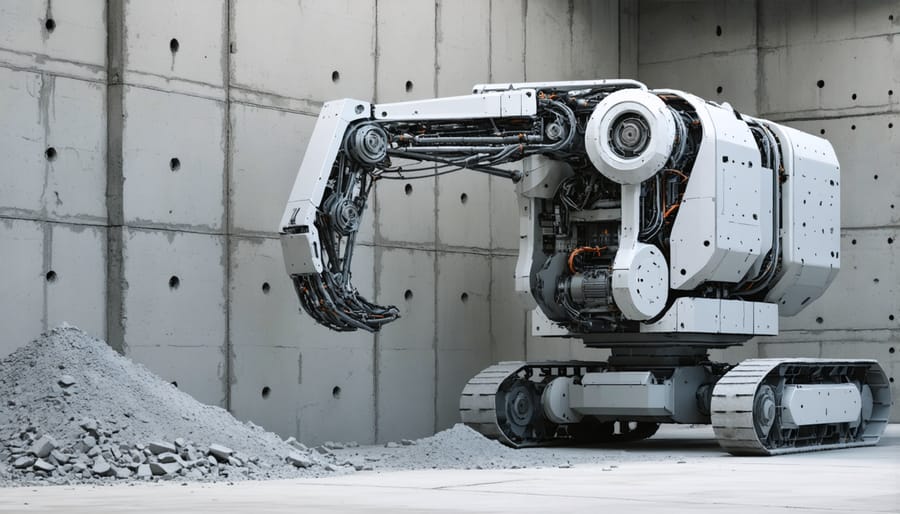
The demolition and material handling sector of construction has seen significant advancements through automation and robotics. Remote-controlled demolition robots equipped with various attachments can safely tackle hazardous demolition tasks while keeping human operators at a safe distance. These machines, ranging from compact units for indoor work to larger models for heavy-duty applications, feature articulated arms that can precisely control demolition tools.
In material handling, collaborative robots and autonomous mobile robots (AMRs) are transforming how construction materials are transported around job sites. These systems use advanced sensors and mapping technology to navigate complex environments while carrying loads ranging from small tools to heavy pallets of materials.
Many of these robots can be customized using microcontrollers like Raspberry Pi for specific tasks. For instance, makers have developed simple material transport robots using Pi-powered motor controllers and distance sensors. Some enthusiasts have even created scaled-down versions of demolition robots for educational purposes, demonstrating the principles behind their commercial counterparts.
Recent innovations include swarm robotics for coordinated material delivery and AI-powered waste sorting systems that automatically separate and process demolition debris. These technologies not only improve efficiency but also contribute to safer, more sustainable construction practices.
Quality Control and Inspection
Quality control in construction has been revolutionized by automated inspection systems and robots, making the process more accurate and efficient than ever before. Modern construction sites now employ sophisticated scanning devices that can detect structural defects, measure dimensions, and verify material properties with remarkable precision.
Drones equipped with high-resolution cameras and LiDAR sensors perform aerial inspections of buildings and infrastructure, creating detailed 3D models that can be analyzed for potential issues. These autonomous systems can access hard-to-reach areas safely, reducing risks to human inspectors while providing comprehensive documentation of construction progress.
Ground-based robots utilizing computer vision and AI algorithms navigate construction sites to perform regular quality checks. These robots can detect issues like concrete cracks, misaligned components, or improper installations in real-time. Some advanced models even incorporate thermal imaging to identify potential insulation problems or moisture infiltration.
Construction teams are increasingly using automated measurement systems that can verify dimensions and positioning with millimeter-level accuracy. These systems often integrate with Building Information Modeling (BIM) software to compare as-built conditions with design specifications automatically.
Quality assurance robots are particularly valuable for repetitive inspection tasks, such as checking welding quality or measuring paint thickness. They maintain consistent standards throughout the project while generating detailed digital reports that can be easily shared among stakeholders and archived for future reference.
DIY Construction Automation Projects
Building a Basic Robot Arm Controller
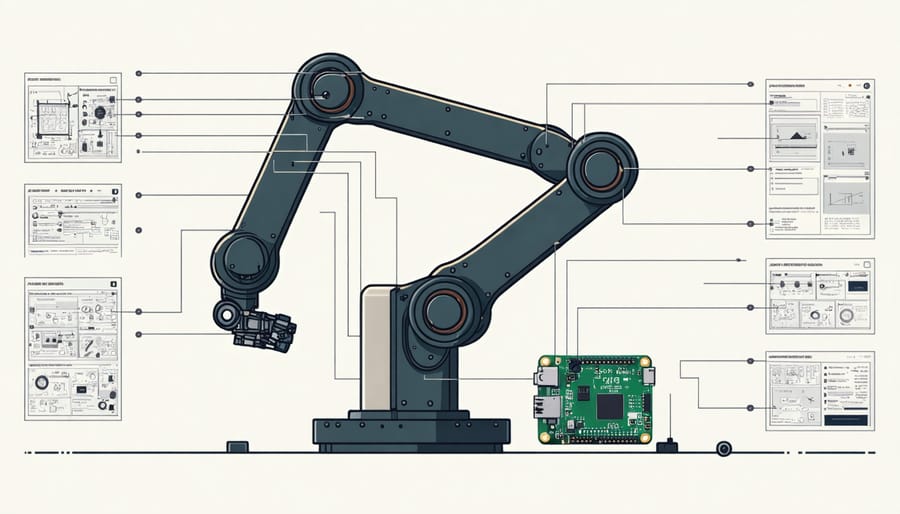
Creating your own robotic arm control systems is an excellent way to understand the fundamentals of construction automation. Let’s build a basic controller using readily available components and a Raspberry Pi.
First, gather your materials: a Raspberry Pi (3B+ or newer recommended), servo motors (typically 4-6 for basic movement), a servo driver board (PCA9685 works well), jumper wires, and a power supply rated for your servos. You’ll also need a breadboard for initial testing.
Start by connecting the servo driver to your Raspberry Pi using I2C pins. Connect SCL to GPIO 3 (SCL), SDA to GPIO 2 (SDA), VCC to 3.3V, and GND to ground. Next, attach your servo motors to the driver board’s channels, ensuring proper power distribution.
For the software setup, install the required libraries using:
“`
sudo pip3 install adafruit-circuitpython-servokit
“`
Create a basic Python script to control individual servo movements. Here’s a simple example:
“`python
from adafruit_servokit import ServoKit
kit = ServoKit(channels=16)
kit.servo[0].angle = 90 # Moves first servo to 90 degrees
“`
Test each servo individually before attempting coordinated movements. Start with small angle changes (15-degree increments) to ensure safe operation. Once basic movements are working, implement more complex sequences by combining multiple servo actions.
For manual control, add a simple GUI using tkinter or create a web interface using Flask. This allows for intuitive control through sliders or buttons. Consider adding position limits in your code to prevent mechanical stress on your arm’s joints.
Remember to calibrate your servos carefully and maintain proper power management – servos can draw significant current when moving simultaneously. As you gain confidence, expand the system by adding sensors for position feedback or implementing inverse kinematics for more precise control.
This basic setup serves as a foundation for more advanced automation projects and helps understand the core principles of robotic control systems.
Automated Site Monitoring System
A Raspberry Pi-based site monitoring system offers an affordable yet powerful solution for construction site surveillance and automation. This DIY project combines hardware sensors with custom software to create a comprehensive monitoring solution that can track environmental conditions, movement, and site activity.
To build the system, you’ll need a Raspberry Pi 4 (recommended for its processing power), a weatherproof case, a camera module, various environmental sensors, and a reliable power supply. Start by installing Raspberry Pi OS and configuring your Pi for headless operation, which allows remote access without a display.
Connect the camera module to the CSI port and attach environmental sensors (temperature, humidity, and dust) to the GPIO pins. For motion detection, add a PIR sensor. The system can be powered using a solar panel and battery combination for sustainable operation.
The software stack consists of Python scripts for sensor data collection and a web interface for remote monitoring. Use libraries like OpenCV for image processing and Flask for creating the web dashboard. Configure the system to capture images at regular intervals and when motion is detected.
Key monitoring features include:
– Real-time camera feed with motion detection alerts
– Environmental condition logging
– Unauthorized access detection
– Data visualization through graphs and charts
– SMS or email notifications for critical events
For deployment, mount the weatherproof enclosure at a strategic location with clear sight lines. Ensure stable internet connectivity through ethernet or a 4G modem. The system can be expanded by adding multiple Raspberry Pis across the site, creating a network of monitoring nodes.
Regular maintenance includes checking sensor calibration, cleaning camera lenses, and backing up collected data. Consider implementing redundancy measures like backup power supplies and local storage for critical data.
This automated monitoring system significantly enhances site security and provides valuable data for project management, while being cost-effective compared to commercial solutions. The modular nature allows for easy upgrades and customization based on specific site requirements.
Construction automation and robotics are revolutionizing the building industry, transforming traditional construction methods into efficient, precise, and safer processes. As we’ve explored throughout this article, the integration of automated systems and robotic solutions has already demonstrated significant improvements in productivity, cost reduction, and worker safety.
The future of construction automation looks particularly promising, with emerging technologies like AI-powered robots, autonomous vehicles, and advanced 3D printing systems continuing to push the boundaries of what’s possible. These innovations are not just changing how we build; they’re reshaping the entire construction landscape, from project planning to final inspection.
For tech enthusiasts and hobbyists, the accessibility of tools like Raspberry Pi has opened up exciting possibilities to experiment with and contribute to this field. Whether it’s creating automated monitoring systems, developing small-scale robotic helpers, or designing smart construction site solutions, the barrier to entry has never been lower.
Looking ahead, we can expect to see even greater integration of IoT devices, machine learning algorithms, and collaborative robots in construction projects. The industry is moving towards a future where human workers and robots work seamlessly together, combining human creativity and problem-solving skills with robotic precision and endurance.
As these technologies continue to evolve and become more accessible, the construction industry will become increasingly efficient, sustainable, and innovative. The journey towards fully automated construction sites may be gradual, but the foundation has been laid for a transformative future in building and infrastructure development.