

In the rapidly evolving world of technology, artificial intelligence (AI) and machine learning (ML) often get used interchangeably, but they’re distinctly different technologies with unique applications in microcontroller projects. Think of AI as the broader universe where machines simulate human intelligence, while machine learning is a specific subset that enables systems to learn and improve from experience without explicit programming. For makers and hobbyists working with microcontrollers, understanding this distinction is crucial for choosing the right approach for their projects.
Machine learning focuses on creating algorithms that can analyze data patterns and make decisions, like a temperature sensor that learns to predict equipment failures. AI, meanwhile, encompasses broader capabilities including natural language processing, computer vision, and decision-making systems that could help a robot navigate complex environments. This distinction becomes particularly important when working with resource-constrained microcontrollers, where choosing between AI and ML can significantly impact project complexity and performance.
The Core Differences Between AI and Machine Learning
AI: The Broader Picture
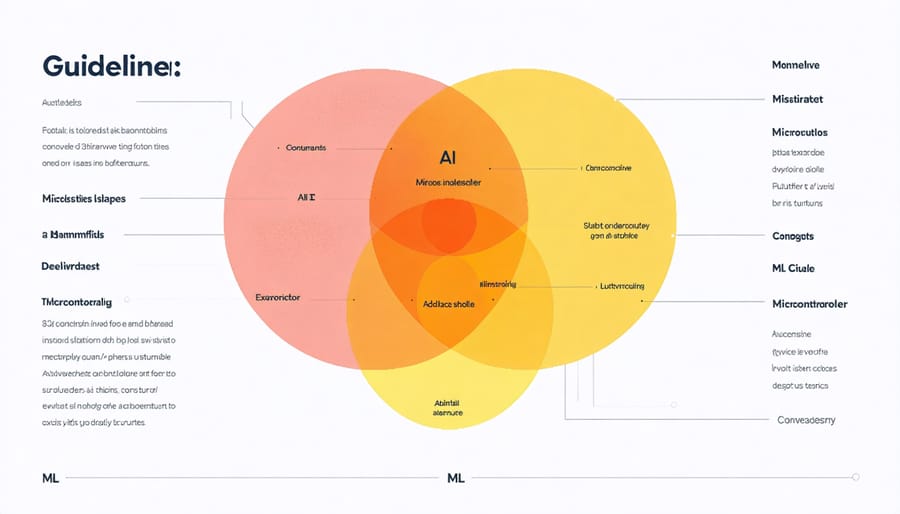
Artificial Intelligence represents a vast field that encompasses various technologies and approaches aimed at creating systems that can simulate human intelligence. Think of AI as a grand tree, with Machine Learning being one of its most prominent branches. While working with microcontrollers like Arduino or Raspberry Pi, you’ll encounter AI applications ranging from simple rule-based systems to complex neural networks.
For instance, a basic motion-activated security system using PIR sensors follows predetermined rules – this is AI, but not necessarily ML. On the other hand, a smart thermostat that learns from your temperature preferences over time uses ML techniques. What makes AI broader is its inclusion of other approaches like expert systems, fuzzy logic, and natural language processing.
In microcontroller projects, you might use AI without ML when implementing fixed decision trees or simple if-then rules. However, when your project needs to adapt and improve based on data – like a robot that learns to navigate better over time – that’s where ML comes into play. Understanding this distinction helps you choose the right approach for your specific project needs.
Machine Learning: A Powerful AI Tool
Machine Learning represents a specialized subset of AI that focuses on teaching computers to learn from data and improve their performance without explicit programming. In microcontroller projects, ML serves as a powerful tool that enables devices to recognize patterns, make predictions, and adapt to new situations based on training data.
Think of ML as the engine that powers many AI applications. While AI provides the broader framework for creating intelligent systems, ML handles the specific task of learning from experience. For instance, in a Raspberry Pi-based smart security camera, ML algorithms can learn to distinguish between regular household members and unknown visitors by analyzing facial features from collected images.
What makes ML particularly valuable in microcontroller projects is its ability to handle specific, well-defined tasks efficiently. Whether it’s detecting objects, recognizing speech patterns, or predicting sensor readings, ML algorithms can be optimized to run on devices with limited resources. This makes them ideal for projects where you need intelligent decision-making capabilities without the complexity of full-scale AI systems.
By focusing on data-driven learning, ML provides a practical approach to implementing intelligent features in your microcontroller projects, making it an essential tool in the modern maker’s toolkit.
Real-World Applications on Microcontrollers
AI Features for Microcontrollers
Not all AI implementations on microcontrollers require machine learning. Simple rule-based AI systems can run effectively even on 8-bit microcontrollers, making them perfect for resource-constrained projects. These systems use predefined rules and decision trees to make intelligent choices without the need for training data or complex neural networks.
For example, a smart garden controller can use fuzzy logic to decide when to water plants based on moisture, temperature, and time of day readings. This type of AI responds to sensor inputs using human-programmed logic rather than learned patterns. Similarly, expert systems can guide robot navigation through simple if-then rules, allowing basic obstacle avoidance without machine learning algorithms.
Other examples include:
– Finite state machines for intelligent home automation
– Pattern matching for gesture recognition
– Basic natural language processing using keyword detection
– Simple computer vision using threshold-based object detection
– Behavior trees for autonomous robot control
These traditional AI approaches often require less processing power and memory than machine learning solutions, making them ideal for microcontroller projects where resources are limited. They’re also more predictable and easier to debug since their decision-making process follows clear, predetermined paths. For hobbyists and makers just starting with AI, these simpler implementations can serve as excellent stepping stones before diving into more complex machine learning projects.
ML Projects for Microcontrollers
Machine learning projects on microcontrollers require careful consideration of hardware limitations and optimization techniques. Unlike traditional AI implementations, ML on microcontrollers focuses on efficient, lightweight models that can run with limited processing power and memory.
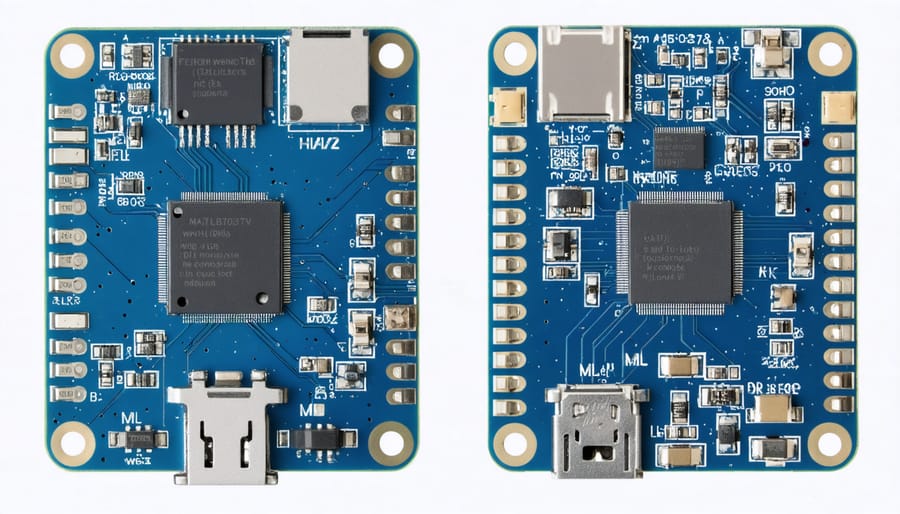
Popular microcontroller ML projects include gesture recognition, voice commands, and sensor data analysis. For example, you can implement a simple gesture recognition system using an Arduino Nano 33 BLE Sense, which comes with built-in accelerometer and gyroscope sensors. This project might use a basic decision tree or k-nearest neighbors algorithm rather than complex neural networks.
When developing ML projects for microcontrollers, it’s essential to understand microcontroller communication protocols and data handling capabilities. TinyML frameworks like TensorFlow Lite for Microcontrollers help optimize models for these resource-constrained environments.
Common implementations include:
– Motion detection using accelerometer data
– Simple keyword spotting for voice commands
– Anomaly detection in sensor readings
– Basic image classification using small cameras
The key to successful microcontroller ML projects lies in model optimization and quantization. These techniques reduce model size and computational requirements while maintaining acceptable accuracy levels. Start with simple projects and gradually increase complexity as you become more familiar with the limitations and capabilities of your chosen microcontroller platform.
Choosing the Right Approach for Your Project
When to Use AI
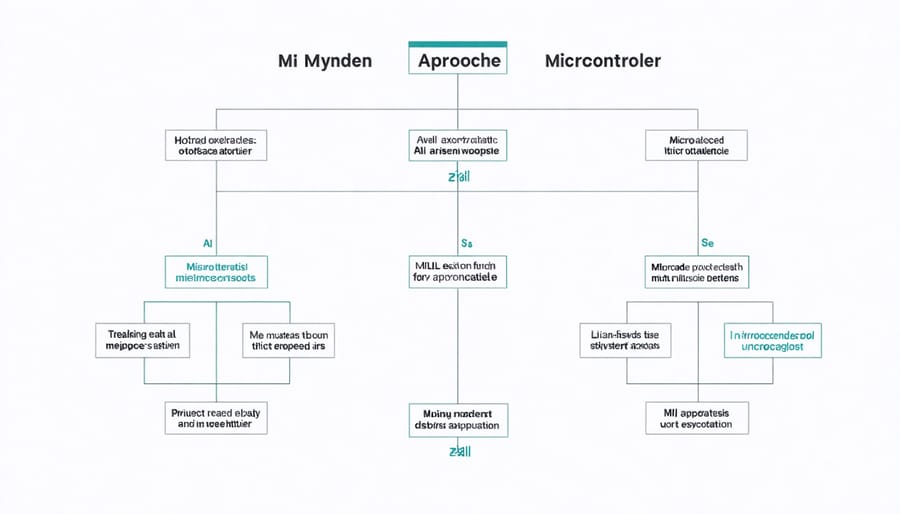
AI is particularly suited for projects that require high-level decision making, pattern recognition across multiple domains, or complex problem-solving capabilities. You’ll want to use AI when your project needs to understand and process natural language, recognize images or objects without specific pre-programming, or make autonomous decisions based on multiple inputs.
For example, if you’re building a smart home assistant that needs to understand various voice commands, interpret context, and learn from user interactions, a general AI approach would be more appropriate than pure machine learning. Similarly, AI is ideal for projects that require adaptability to new situations without explicit programming, like a robot that needs to navigate through unpredictable environments.
AI also shines in scenarios where you need to combine multiple types of intelligence, such as mixing visual recognition with decision-making and natural language processing. This could be useful in projects like interactive educational tools or advanced monitoring systems that need to understand and respond to complex situations in real-time.
Remember that AI typically requires more computational resources and might be overkill for simpler tasks that can be handled effectively with basic programming or specific machine learning algorithms.
When to Use Machine Learning
Machine learning shines when dealing with complex patterns and data-driven decisions that would be impractical to program using traditional rule-based methods. It’s particularly useful when working with sensor data, image recognition, or predictive maintenance tasks on your microcontroller projects.
Consider using machine learning when you need your project to adapt and improve over time based on new data. For example, if you’re building a smart garden system, ML can help optimize watering schedules by learning from historical temperature, humidity, and soil moisture data. Similarly, ML is ideal for projects involving pattern recognition, like identifying different types of birds visiting your garden or detecting unusual sounds in your home security system.
Another compelling use case is when you need to handle variations in input data. While traditional programming requires explicit rules for every scenario, ML can generalize from examples and handle new, slightly different situations effectively. This makes it perfect for projects like gesture recognition or voice-controlled devices, where user inputs naturally vary.
However, remember that ML requires significant data to train effectively and more computational resources than simple if-then logic. Choose ML when the benefits of adaptability and pattern recognition outweigh these requirements.
Getting Started with AI and ML on Your Microcontroller
Getting started with AI and ML on your microcontroller doesn’t have to be overwhelming. Despite working with resource-constrained systems, you can implement effective machine learning solutions with the right approach and tools.
Begin with TensorFlow Lite for Microcontrollers, a lightweight framework specifically designed for small devices. It’s perfect for running basic neural networks on platforms like Arduino Nano 33 BLE Sense or Raspberry Pi Pico. Start with simple projects like gesture recognition or voice commands to build your confidence.
For your first project, consider these essential steps:
1. Choose a beginner-friendly development board with built-in sensors
2. Install the necessary libraries and development environment
3. Start with pre-trained models before creating your own
4. Focus on small datasets and simple classifications initially
Popular starter projects include:
– LED control through gesture recognition
– Simple voice command detection
– Temperature prediction
– Motion detection
Take advantage of Edge Impulse or Arduino’s ML tools, which provide user-friendly interfaces for model training and deployment. These platforms handle much of the complex work, letting you focus on understanding the basics and implementing your ideas.
Remember to optimize your models for microcontroller use. This means working with quantized models, reducing model size, and carefully managing memory usage. Start small, experiment often, and gradually increase complexity as you become more comfortable with the basics.
Join online communities and forums dedicated to microcontroller AI projects – they’re invaluable resources for troubleshooting and inspiration. The key is to maintain a steady learning curve while building practical skills through hands-on experience.
While AI and machine learning are closely related, they serve distinct purposes in the world of technology. AI represents the broader vision of creating intelligent systems, while machine learning is a specific approach to achieving that vision through data-driven algorithms. Understanding these differences is crucial for anyone looking to implement smart features in their projects.
For those ready to explore further, consider starting with simple machine learning projects like image recognition or sensor data analysis. These practical experiments will help you grasp the fundamentals before moving on to more complex AI implementations. Remember that both technologies have their place in modern computing – machine learning excels at pattern recognition and prediction, while AI can handle more complex decision-making and reasoning tasks.
Whether you choose AI or machine learning for your next project will depend on your specific goals, available resources, and the complexity of the problem you’re trying to solve. The key is to start small, experiment often, and gradually build your expertise in both fields.