
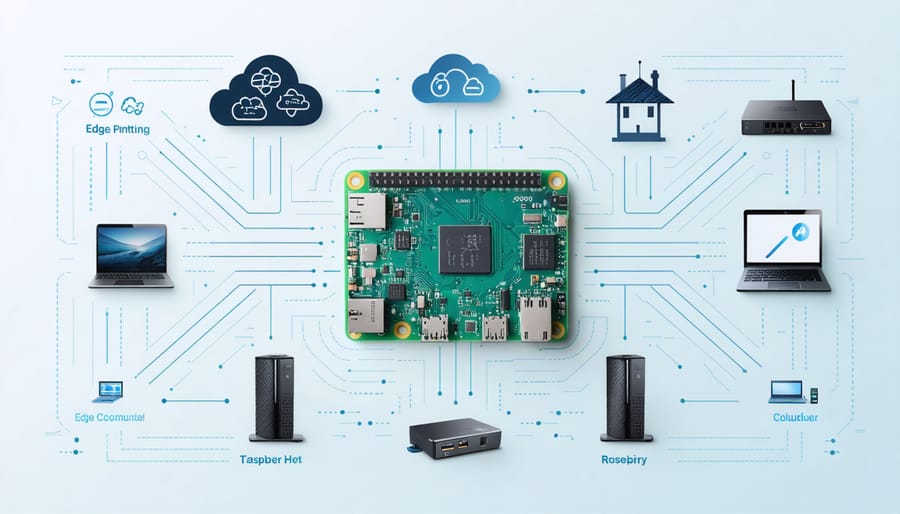
Edge computing revolutionizes data processing by bringing computational power closer to where data originates, fundamentally transforming how modern applications perform. Instead of sending all data to distant cloud servers, edge computing processes information directly on local devices – from smart sensors and getting started with Raspberry Pi to industrial IoT gateways. This distributed architecture slashes latency, reduces bandwidth consumption, and enhances data privacy by keeping sensitive information local.
Think of edge computing as establishing mini data centers at the network’s periphery. When your smartphone processes facial recognition locally instead of uploading images to the cloud, or when a factory’s sensors analyze equipment performance in real-time, that’s edge computing in action. The technology works through a sophisticated orchestration of edge devices, edge nodes, and edge gateways that form a mesh of computational resources, each handling specific tasks based on proximity and processing requirements.
This shift from centralized to distributed computing isn’t just an architectural choice – it’s becoming essential for applications requiring real-time processing, from autonomous vehicles to smart cities. As devices become more powerful and 5G networks expand, edge computing continues to redefine what’s possible in our connected world.
Edge Computing Fundamentals on Raspberry Pi
What Makes Raspberry Pi Perfect for Edge Computing
The Raspberry Pi stands out as an ideal platform for edge computing thanks to its unique combination of affordability, versatility, and robust computing capabilities. This credit card-sized computer offers sufficient processing power to handle many edge computing tasks while consuming minimal energy, making it perfect for remote deployments and continuous operation.
What makes Raspberry Pi particularly suitable for edge computing is its extensive GPIO (General Purpose Input/Output) pins, which enable direct connection to sensors, actuators, and other hardware components. This feature allows for real-time data collection and processing at the edge, reducing the need for cloud communication and decreasing latency.
The device’s Linux-based operating system provides excellent compatibility with various programming languages and frameworks commonly used in edge computing applications. Additionally, the strong community support and abundance of available resources make it easier for developers to implement and troubleshoot edge computing solutions.
The Raspberry Pi’s compact form factor and passive cooling options make it ideal for deployment in space-constrained environments, while its built-in networking capabilities enable seamless integration with existing infrastructure. For organizations looking to experiment with or implement edge computing solutions, Raspberry Pi offers an accessible and cost-effective entry point without compromising on functionality.
Core Components of Edge Computing
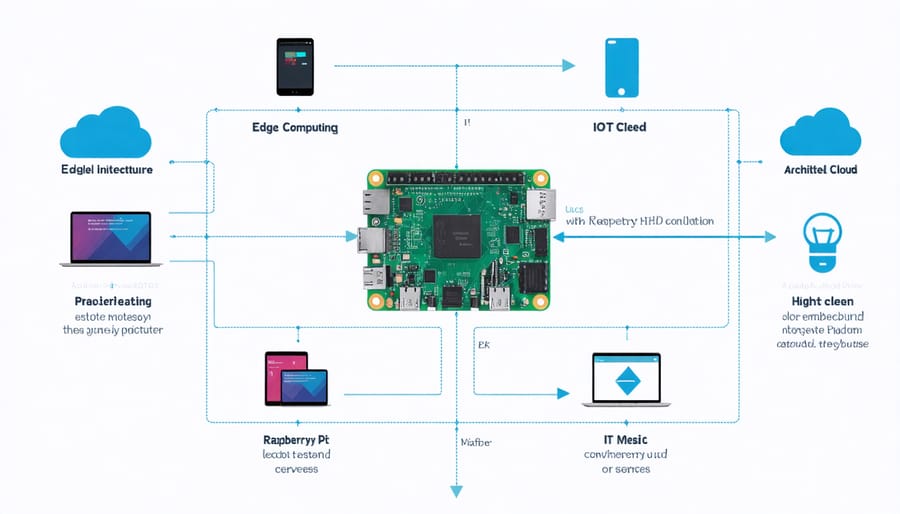
Edge computing systems rely on several key components working together seamlessly. At the hardware level, edge devices like Raspberry Pi serve as the primary computing units, equipped with processors, memory, and storage capabilities. These devices need reliable network interfaces, both wireless and wired, to communicate with other nodes and the cloud.
Sensors and actuators form the input/output layer, collecting real-world data and executing actions based on processed information. For instance, temperature sensors, cameras, or motion detectors feed data directly to the edge device for immediate processing.
On the software side, edge computing requires a robust operating system optimized for resource-constrained environments. Edge-specific applications and middleware handle data processing, device management, and security protocols. Container technologies like Docker are commonly used to package and deploy applications efficiently.
Security components are crucial, including encryption modules, authentication systems, and firewalls to protect both data and devices. Additionally, management software helps monitor device health, update firmware, and orchestrate workloads across multiple edge nodes.
These components must be carefully selected and integrated to create a reliable edge computing infrastructure that meets specific use case requirements while maintaining optimal performance and security.
Setting Up Your Edge Computing Environment
Required Hardware Configuration
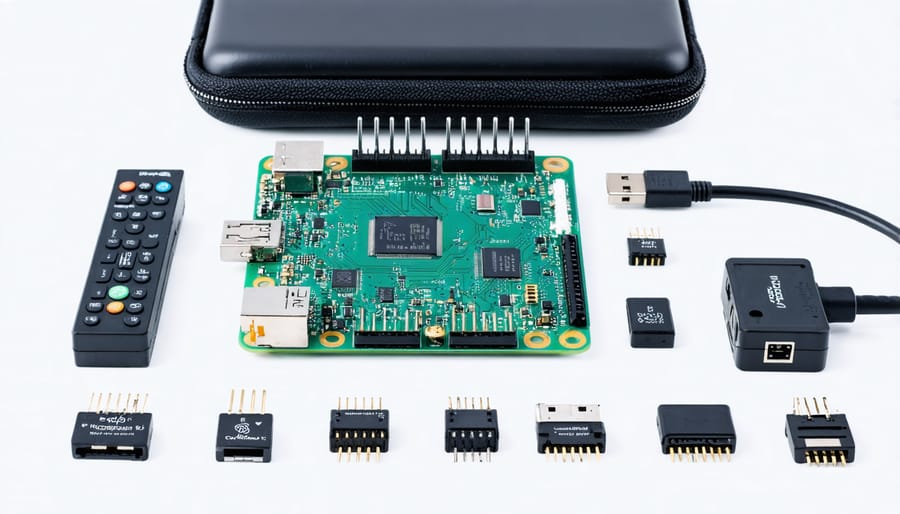
Edge computing requires specific hardware components to function effectively. At its core, you’ll need edge devices like Raspberry Pi, Arduino, or industrial IoT gateways that serve as local processing units. These devices should have adequate processing power (typically 1GHz or higher) and sufficient RAM (minimum 512MB, ideally 1GB or more) to handle data processing tasks.
Storage is crucial, with most edge setups requiring both local storage (minimum 16GB SD card or SSD) for temporary data handling and cached operations. Network connectivity components are essential, including Ethernet ports or Wi-Fi modules for data transmission, with 5G modules becoming increasingly common for mobile edge applications.
Sensors and actuators form the input/output layer, varying based on your specific use case. These might include temperature sensors, cameras, or motion detectors. Power management systems are vital, especially for remote deployments, often incorporating UPS (Uninterruptible Power Supply) units or solar power systems.
For enhanced reliability, consider redundant hardware components and fail-safe mechanisms, particularly in critical applications where continuous operation is essential.
Software Stack Installation
To get started with edge computing on your Raspberry Pi, you’ll need to install several key software components. Begin by downloading the latest version of Raspberry Pi OS (formerly Raspbian) from the official website. After flashing the OS to your microSD card using Raspberry Pi Imager, boot up your device and open the terminal.
First, update your system by running:
“`
sudo apt update
sudo apt upgrade
“`
Next, install Docker, which we’ll use to containerize our edge applications:
“`
curl -fsSL https://get.docker.com -o get-docker.sh
sudo sh get-docker.sh
“`
For edge AI capabilities, install TensorFlow Lite:
“`
sudo apt install python3-pip
pip3 install tensorflow-lite
“`
To enable real-time data processing, install Node-RED:
“`
bash <(curl -sL https://raw.githubusercontent.com/node-red/linux-installers/master/deb/update-nodejs-and-nodered)
```
Finally, install MongoDB for local data storage:
```
sudo apt install mongodb
sudo systemctl enable mongodb
```
Remember to test each installation by running basic commands or accessing the respective interfaces. For Node-RED, visit localhost:1880 in your browser, and for MongoDB, use the mongo command in the terminal to ensure everything is working correctly.
Network Configuration
Setting up networking for edge computing requires careful planning and configuration to ensure optimal performance and security. Start by establishing a reliable local network connection through either Ethernet or Wi-Fi, depending on your deployment environment. For Raspberry Pi implementations, understanding Raspberry Pi networking fundamentals is essential before proceeding with edge computing setup.
Configure your edge devices with static IP addresses to maintain consistent communication between nodes. This ensures reliable data transfer and prevents connection issues that could arise from dynamic IP assignments. Implement appropriate network segmentation using VLANs to isolate edge computing traffic from other network activities, enhancing both security and performance.
Enable secure communication protocols such as SSL/TLS for data encryption between edge devices and the central system. Set up firewalls and access control lists (ACLs) to restrict unauthorized access and protect sensitive data. Consider implementing load balancing if multiple edge nodes are deployed to distribute network traffic efficiently and prevent bottlenecks.
Remember to monitor network latency and bandwidth usage regularly, as these factors directly impact edge computing performance. Document all network configurations for future reference and troubleshooting.
Real-World Applications and Use Cases
IoT Data Processing
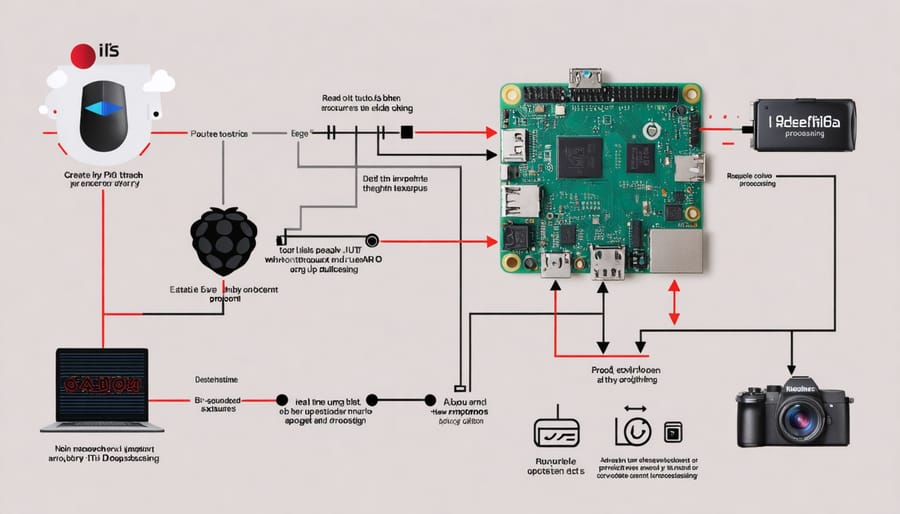
One of the most common applications of edge computing is processing IoT sensor data directly at the source. Let’s consider a practical example using a Raspberry Pi connected to temperature and humidity sensors in a smart greenhouse. Instead of sending raw sensor readings to a cloud server, the Raspberry Pi processes this data locally, making real-time decisions about ventilation and irrigation.
Following our IoT sensor setup guide, you can configure your sensors to collect data every few seconds. The Raspberry Pi then runs simple algorithms to calculate moving averages, detect anomalies, and trigger immediate actions when needed. For instance, if the temperature exceeds a threshold, the system can automatically activate cooling fans without waiting for a response from a distant server.
This local processing significantly reduces latency and bandwidth usage. Instead of sending thousands of raw data points to the cloud, the Raspberry Pi only transmits summarized reports or critical alerts. In our greenhouse example, the edge device might send hourly temperature averages to the cloud for long-term analysis while handling minute-by-minute adjustments locally.
The benefits are clear: faster response times, reduced network traffic, and continued operation even during internet outages. This approach is particularly valuable in applications where real-time decision-making is crucial, such as industrial monitoring, smart home automation, or agricultural systems.
Real-time Analytics
Real-time analytics at the edge represents one of the most powerful applications of edge computing, particularly when implemented with devices like the Raspberry Pi. Instead of sending raw data to distant cloud servers, edge devices can process and analyze information instantly where it’s generated, leading to faster insights and reduced bandwidth usage.
For example, a Raspberry Pi equipped with sensors can monitor temperature changes in a greenhouse and make immediate adjustments to ventilation systems without waiting for cloud-based analysis. This real-time processing happens in milliseconds, compared to the potential seconds or minutes required for cloud-based solutions.
The implementation typically involves three key components: data collection through sensors, local processing using lightweight analytics algorithms, and immediate action based on the results. Many edge devices run simplified versions of machine learning models that have been specifically optimized for limited computing resources while maintaining essential functionality.
To achieve effective real-time analytics, edge devices often use streaming analytics frameworks that process data in motion. These frameworks can handle continuous data flows, perform quick calculations, and trigger automated responses based on predefined thresholds or patterns. For instance, a security camera system might use edge analytics to detect motion, analyze the type of movement, and immediately alert security personnel if suspicious activity is detected.
This approach not only speeds up response times but also helps maintain data privacy since sensitive information can be processed locally without transmission to external servers.
Performance Optimization and Best Practices
Resource Management
Edge computing devices, including Raspberry Pi systems, often operate with limited resources compared to traditional cloud servers. Effective resource management is crucial for maintaining optimal performance and reliability. The key resources to monitor and manage include CPU usage, memory allocation, storage capacity, and network bandwidth.
To optimize CPU usage, implement task prioritization and scheduling mechanisms. Critical processes should receive higher priority, while background tasks can be scheduled during periods of lower activity. Memory management involves careful allocation and regular cleanup of unused resources. Consider using lightweight applications and implementing efficient data caching strategies to reduce memory pressure.
Storage management requires regular monitoring of available space and implementing data retention policies. Consider using compressed file formats where appropriate and implementing automated cleanup routines for temporary files and logs. For network resources, implement quality of service (QoS) policies to prioritize critical traffic and optimize bandwidth usage.
Power management is particularly important for edge devices deployed in remote locations. Implement power-saving modes during periods of low activity and ensure proper thermal management to prevent performance throttling. Consider using monitoring tools to track resource usage patterns and set up automated alerts for potential resource constraints.
Regular performance audits help identify resource bottlenecks and optimization opportunities. Keep your edge computing system’s software updated and properly configured to ensure efficient resource utilization while maintaining reliable operation.
Security Considerations
Edge computing brings data processing closer to the source, but this proximity also introduces unique security challenges. Implementing robust security measures is crucial for protecting both the edge devices and the data they process. When securing your Raspberry Pi or other edge devices, start with basic authentication by changing default passwords and implementing strong access controls.
Physical security is equally important since edge devices are often deployed in remote or accessible locations. Consider using tamper-evident cases, secure mounting solutions, and monitoring systems to protect against unauthorized physical access.
Data encryption should be implemented at three levels: data at rest (stored on the device), data in transit (being transferred), and data in use (during processing). Use industry-standard encryption protocols and regularly update encryption keys.
Network security requires special attention in edge computing. Implement firewalls, use Virtual Private Networks (VPNs) for remote access, and segment networks to isolate edge devices from other systems. Regular security audits and vulnerability assessments help identify potential weaknesses before they can be exploited.
Finally, maintain a robust update and patch management system. Edge devices should automatically receive security updates, and their firmware should be kept current to protect against known vulnerabilities. Consider implementing automated monitoring systems to detect and respond to potential security breaches quickly.
Edge computing represents a transformative approach to data processing that’s becoming increasingly vital in our connected world. As we’ve explored throughout this article, edge computing brings computation closer to data sources, reducing latency and enabling real-time processing capabilities that weren’t possible with traditional cloud computing alone.
By implementing edge computing solutions with Raspberry Pi, you can start building practical applications that leverage these advantages. Whether you’re developing IoT projects, setting up local processing nodes, or creating smart home applications, the fundamental concepts we’ve covered will serve as your foundation for success.
Remember the key benefits: reduced latency, improved privacy, lower bandwidth costs, and enhanced reliability. These advantages make edge computing an attractive solution for many modern applications, from industrial IoT to smart cities and beyond.
Ready to start your edge computing journey? Begin with a simple project using your Raspberry Pi, perhaps processing sensor data locally before sending summaries to the cloud. As you gain confidence, gradually expand your implementation to include more complex features and multiple edge nodes.
Stay current with edge computing developments, as this field continues to evolve rapidly. Whether you’re a hobbyist or professional developer, the skills you develop in edge computing will become increasingly valuable in our interconnected future. The possibilities are endless, and the time to start exploring is now.