
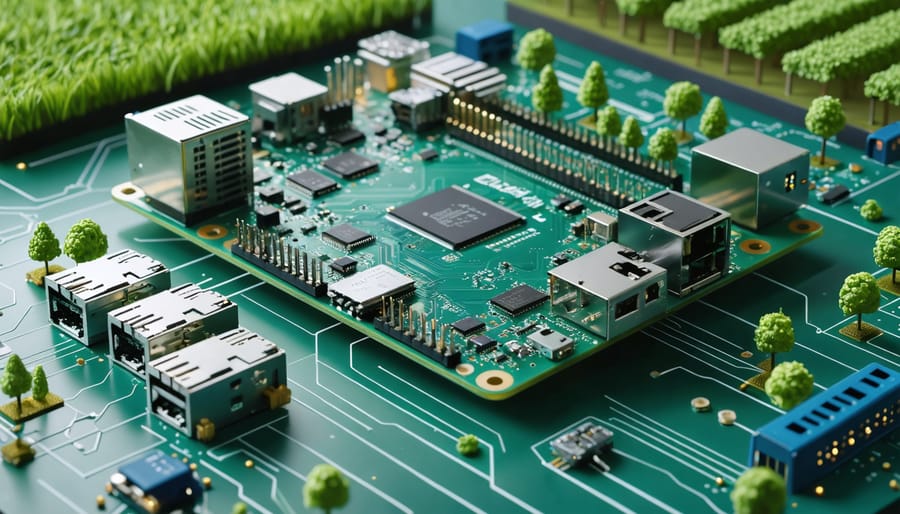
Transform your IoT infrastructure by leveraging edge computing basics with Raspberry Pi devices, bringing real-time processing and decision-making closer to your data sources. This revolutionary approach reduces latency from 100+ milliseconds to under 10ms, cuts bandwidth costs by up to 60%, and enhances data privacy through localized processing.
Edge computing represents the next evolution in IoT architecture, addressing the critical challenges of traditional cloud-centric systems. By processing data at the network edge – whether on factory floors, smart homes, or agricultural settings – organizations can achieve unprecedented response times while maintaining robust security protocols.
The convergence of edge computing and IoT isn’t just a technological trend; it’s a fundamental shift in how we architect intelligent systems. With 75% of enterprise-generated data expected to be created and processed outside traditional centralized data centers by 2025, mastering edge computing implementation has become essential for forward-thinking developers and organizations.
This guide explores practical implementations using Raspberry Pi as an edge computing platform, combining affordable hardware with powerful capabilities to create scalable IoT solutions that deliver immediate business value.
Why Raspberry Pi Excels at Edge Computing
Hardware Capabilities
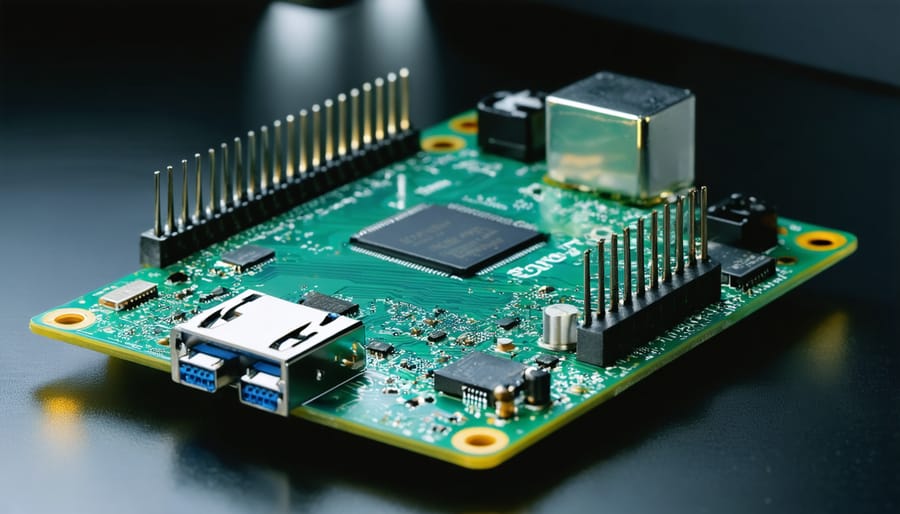
Edge computing devices need robust hardware capabilities to process data effectively at the network’s edge. Modern IoT devices typically feature ARM-based processors ranging from single-core to quad-core configurations, with clock speeds varying from 700MHz to 2GHz. RAM configurations commonly range from 512MB to 4GB, allowing for efficient local data processing and temporary storage.
Storage options include both volatile and non-volatile memory, with many devices featuring expandable storage through SD cards or eMMC modules. This flexibility enables developers to balance performance requirements with cost constraints.
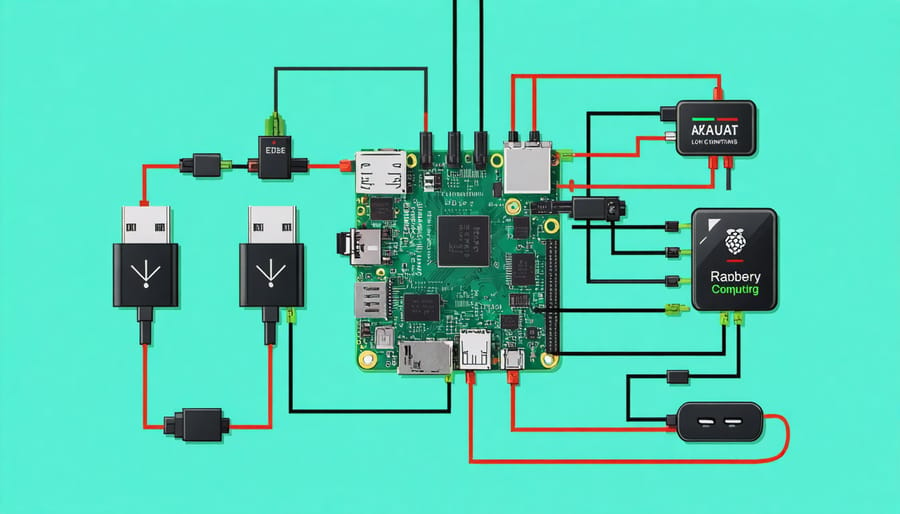
Connectivity is crucial for edge devices, with most supporting multiple communication protocols. Wi-Fi (802.11 b/g/n/ac) and Bluetooth (4.0/5.0) are standard features, while many devices also include Ethernet ports for reliable wired connections. Advanced models may incorporate cellular connectivity (4G/5G) or specialized IoT protocols like LoRaWAN for long-range communication.
Power consumption is another critical consideration, with most edge devices designed to operate efficiently on 5V power supplies, consuming between 2W to 15W depending on processing load. Many include power management features to optimize battery life in portable applications.
Cost-Effectiveness and Scalability
Edge computing and IoT solutions built on Raspberry Pi offer remarkable cost advantages compared to traditional cloud-based infrastructures. A typical Raspberry Pi setup costs between $35-75, making it an affordable entry point for both hobbyists and small businesses. When scaled across multiple devices, this represents significant savings over commercial IoT platforms that often charge monthly subscription fees.
The scalability aspect is equally impressive. You can start with a single Raspberry Pi handling local data processing and gradually expand your network as needs grow. This flexible approach allows for incremental investment and easier budget management. Adding new nodes to your edge computing network is as simple as configuring another Raspberry Pi and connecting it to your existing infrastructure.
Additionally, edge computing reduces ongoing operational costs by minimizing cloud data transfer and storage fees. By processing data locally, you can filter out unnecessary information and only send relevant data to the cloud, resulting in lower bandwidth usage and storage costs. This approach also provides better control over your infrastructure’s growth, allowing you to scale up or down based on actual needs rather than being locked into rigid cloud service tiers.
Setting Up Your Pi for Edge Computing

Essential Software and Tools
When implementing edge computing solutions for IoT projects, having the right software stack is crucial. Start by setting up Raspberry Pi with either Raspberry Pi OS (formerly Raspbian) or Ubuntu IoT Core, both of which provide excellent foundations for edge computing applications.
For IoT device management and data processing, several essential frameworks stand out. Node-RED offers an intuitive, flow-based programming environment perfect for IoT applications, while Docker enables containerization for better resource management and deployment flexibility. MongoDB or SQLite serve well as local databases for edge data storage.
Python developers should install key libraries like TensorFlow Lite for edge AI applications, OpenCV for computer vision projects, and Flask for creating lightweight web services. The Mosquitto MQTT broker is indispensable for IoT communication, facilitating efficient device-to-device and device-to-cloud messaging.
Development tools like Visual Studio Code with remote development extensions make coding and debugging more efficient. For monitoring and maintenance, consider installing Grafana for visualization and Prometheus for metrics collection.
Security tools are equally important. Install UFW (Uncomplicated Firewall) for network protection, and consider implementing fail2ban to prevent unauthorized access attempts. SSL/TLS certificates are essential for securing data transmission.
For seamless cloud integration, install AWS IoT Greengrass, Azure IoT Edge, or Google Cloud IoT Core SDK, depending on your preferred cloud provider. These tools enable local processing while maintaining cloud connectivity when needed.
Remember to regularly update these tools using apt-get or pip package managers to ensure security and performance improvements.
Network Configuration
Optimizing your network configuration is crucial for successful edge computing implementation. Start by ensuring your Raspberry Pi has a stable network connection, preferably through ethernet for more reliable performance. Configure your network settings to prioritize local processing and minimize latency between IoT devices and your edge computing node.
Begin by setting static IP addresses for your edge devices to maintain consistent communication. This can be done by editing the /etc/dhcpcd.conf file on your Raspberry Pi. Add the following configuration:
interface eth0
static ip_address=192.168.1.100/24
static routers=192.168.1.1
static domain_name_servers=192.168.1.1
Next, optimize your network buffer sizes to handle IoT data streams efficiently. Modify the /etc/sysctl.conf file to increase buffer sizes:
net.core.rmem_max=16777216
net.core.wmem_max=16777216
Enable Quality of Service (QoS) settings on your network router to prioritize edge computing traffic. This ensures critical IoT data receives preferential treatment over regular network traffic.
Consider implementing a local DNS server to reduce external dependencies and improve response times. You can use tools like Pi-hole or Dnsmasq for this purpose.
For security, configure your firewall to allow only necessary communications:
– Open required ports for IoT device communication
– Restrict access to specific IP ranges
– Enable logging for network activities
– Implement rate limiting to prevent DoS attacks
Finally, regularly monitor network performance using tools like iftop or nethogs to identify and address any bottlenecks in your edge computing setup.
Real-World IoT Applications
Data Processing at the Edge
Data processing at the edge revolutionizes how IoT devices handle information by performing crucial computations locally, before sending data to the cloud. A Raspberry Pi running edge analytics can process sensor readings in real-time, making quick decisions without depending on cloud connectivity.
For example, a smart security camera can use local image processing to detect motion and identify objects. Instead of streaming all footage to the cloud, it only uploads relevant events, saving bandwidth and reducing latency. Similarly, industrial sensors can analyze vibration patterns locally to detect equipment failures immediately, rather than waiting for cloud-based analysis.
Temperature monitoring systems demonstrate another practical application. Edge devices can process readings locally, triggering immediate cooling responses when necessary, while only sending aggregated data to the cloud for long-term analysis. This approach significantly reduces response time and ensures critical systems remain functional even during network outages.
Smart agriculture solutions also benefit from edge processing. Soil moisture sensors can analyze readings locally to control irrigation systems in real-time, optimizing water usage based on immediate conditions rather than waiting for cloud-based instructions.
The key advantage of edge processing is its ability to filter, aggregate, and analyze data where it’s generated. This not only reduces network traffic but also enhances privacy by keeping sensitive data local and enables faster response times for critical applications.
Sensor Integration
Edge computing thrives on effective sensor integration, which serves as the foundation for collecting real-world data. The process of connecting IoT sensors to your edge devices requires careful consideration of both hardware compatibility and processing requirements.
Common sensors in edge computing setups include temperature sensors, motion detectors, humidity sensors, and accelerometers. Each sensor type generates different data streams that need real-time processing. For example, a temperature sensor might only need readings every few seconds, while a motion sensor requires constant monitoring for immediate response.
The key to successful sensor integration lies in proper data preprocessing at the edge. This involves filtering raw sensor data, converting analog signals to digital format, and implementing basic error checking before transmission. Many modern sensors come with built-in preprocessing capabilities, reducing the computational load on your main edge device.
For optimal performance, consider implementing a sensor fusion approach, where data from multiple sensors is combined to provide more accurate and reliable measurements. This could involve using complementary sensors (like combining temperature and humidity readings) or redundant sensors for critical applications where accuracy is paramount.
Remember to account for power consumption when selecting sensors, as edge devices often operate on limited power sources. Many sensors offer low-power modes or sleep states that can significantly extend battery life while maintaining functionality.
Security Considerations
Securing edge devices is crucial in IoT deployments, as these endpoints often represent vulnerable access points to your network. Following IoT security best practices is essential to protect both your devices and data. Start by implementing strong authentication mechanisms, including unique passwords for each device and two-factor authentication where possible.
Regularly update firmware and software on all edge devices to patch security vulnerabilities. Enable encryption for both data at rest and in transit using industry-standard protocols like TLS/SSL. Consider implementing a secure boot process to ensure only authorized software runs on your edge devices.
Network segmentation is another vital security measure. Isolate IoT devices on separate network segments to limit potential damage if a breach occurs. Use firewalls and access control lists to restrict unnecessary communication between devices and monitor network traffic for suspicious activities.
Physical security shouldn’t be overlooked. Secure edge devices in locked enclosures when deployed in public or accessible areas. Disable unused physical ports and interfaces to prevent unauthorized access. Additionally, implement device authentication certificates and maintain an up-to-date inventory of all edge devices in your network.
Regular security audits and penetration testing can help identify vulnerabilities before they’re exploited. Document and maintain incident response procedures for quick action in case of security breaches.
Performance Optimization Tips
To maximize your Raspberry Pi’s edge computing performance for IoT applications, implementing these optimization techniques can significantly improve efficiency and response times.
Start by optimizing your operating system configuration. Remove unnecessary background services and disable unused ports to free up system resources. Configure your Pi to boot directly to the command line interface instead of the GUI when running headless applications, as this reduces memory usage and processing overhead.
Memory management is crucial for edge computing performance. Implement proper memory allocation in your applications and utilize swap space effectively. However, be cautious with swap usage on SD cards, as excessive writing can reduce their lifespan. Consider using a high-quality SSD for better durability and faster data access.
Network optimization plays a vital role in IoT applications. Enable hardware acceleration for network interfaces where available, and implement efficient data compression techniques before transmission. Consider using lightweight protocols like MQTT instead of HTTP for IoT communication, as they consume less bandwidth and processing power.
Cache management can dramatically improve response times. Implement local caching for frequently accessed data and edge analytics results. Use Redis or SQLite for efficient local data storage and retrieval, ensuring quick access to critical information without constant network requests.
For processing optimization, prioritize tasks effectively. Implement multi-threading where appropriate, but be mindful of the Pi’s processing limitations. Use efficient algorithms and consider implementing batch processing for non-time-critical operations to reduce overall system load.
Monitor your system’s performance regularly using tools like htop or iotop. This helps identify bottlenecks and resource-heavy processes that might need optimization. Set up automated alerts for when CPU usage, memory, or temperature exceeds acceptable thresholds.
Finally, ensure proper cooling for your Pi, as thermal throttling can significantly impact performance. Consider adding a heat sink or fan, especially for compute-intensive edge applications. Regular maintenance, including cleaning and updating software, helps maintain optimal performance over time.
Edge computing and IoT continue to revolutionize how we process and utilize data in our connected world. By bringing computation closer to data sources, we’ve seen remarkable improvements in response times, bandwidth efficiency, and overall system reliability. The integration of Raspberry Pi devices into this ecosystem has made edge computing more accessible and cost-effective for hobbyists and professionals alike.
Looking ahead, we can expect to see even more innovative applications combining edge computing and IoT, from smart agriculture to advanced home automation systems. The continued development of more powerful and energy-efficient devices, coupled with improvements in machine learning capabilities at the edge, will open up exciting new possibilities for real-time data processing and automation.
As you begin your journey into edge computing with IoT, remember that starting small and scaling gradually is key to success. Whether you’re building a simple sensor network or planning a complex industrial monitoring system, the foundations we’ve covered will serve as your stepping stones to more advanced implementations.