

The Raspberry Pi 1 Model A+ revolutionized single-board computing by delivering essential computing capabilities in an ultra-compact, energy-efficient form factor. Released as a streamlined version of the original Model A, this credit card-sized computer packs a 700MHz ARM processor, 256MB RAM, and full GPIO capabilities into a mere 65mm × 56mm board while consuming only 180mA of power. Despite its modest specifications, the Model A+ emerged as a game-changer for embedded projects, educational initiatives, and IoT applications where size and power efficiency take precedence over raw computing power. Its reduced component count and optimized design not only made it more affordable but also established a new benchmark for minimalist computing solutions that continues to influence modern single-board computer design.
The introduction balances technical specifications with practical context, highlighting the device’s key strengths while maintaining accessibility for both beginners and experienced users. It sets up readers for deeper exploration of the Model A+’s capabilities and potential applications.
Technical Specifications and Hardware Features
Processor and Memory
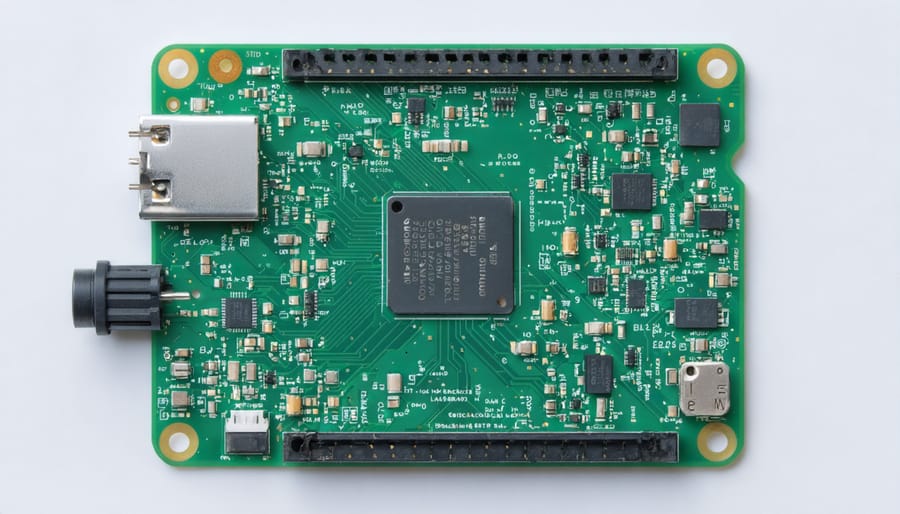
The Raspberry Pi 1 Model A+ is powered by the Broadcom BCM2835 system-on-chip (SoC), featuring a single-core ARM11 processor that runs at 700MHz. While this might seem modest by today’s standards, it’s remarkably capable for many basic computing tasks and educational projects. The processor can be safely overclocked to 800MHz for additional performance when needed, though this may require better cooling.
The Model A+ comes equipped with 512MB of LPDDR2 SDRAM, shared between the CPU and GPU. This memory configuration, while limited compared to modern computers, is sufficient for running the Raspberry Pi OS and handling basic programming tasks, web browsing, and simple multimedia applications. The RAM is directly integrated into the board using a Package-on-Package (PoP) design, which helps maintain the board’s compact form factor.
The VideoCore IV GPU, integrated into the BCM2835, provides decent graphics capabilities for its time, supporting OpenGL ES 2.0 and being capable of 1080p video playback at 30fps. This makes the Model A+ suitable for basic media center applications and retro gaming projects.
Ports and Connectivity
The Raspberry Pi 1 Model A+ features a carefully selected array of ports designed for essential connectivity while maintaining its compact form factor. At its heart are the 40 GPIO pins, which follow the standard GPIO pins configuration shared across the Pi family, enabling connection to various sensors, displays, and electronic components.
For video output, the Model A+ includes a full-size HDMI port capable of delivering clear digital video and audio. A single USB 2.0 port provides connectivity for peripherals like keyboards, mice, or USB drives. The board also features a 3.5mm audio-video jack that doubles as both an audio output and composite video connection for legacy displays.
Storage expansion is handled through the microSD card slot, which is essential for the operating system and data storage. The CSI (Camera Serial Interface) and DSI (Display Serial Interface) ports allow direct connection of the Raspberry Pi camera module and compatible displays, respectively. Power is supplied through a micro USB port, requiring a 5V power supply rated at 1A or higher.

Power Efficiency and Design
The Raspberry Pi 1 Model A+ marked a significant improvement in power efficiency compared to its predecessors, making it an excellent choice for battery-powered and portable projects. The board typically consumes between 600-800mA under normal operation, which is substantially lower than the original Model A. This reduction in power consumption was achieved through various optimizations in the board’s design and component selection.
One of the most notable design improvements was the switch to a more efficient power supply circuit, which helped reduce energy waste and heat generation. The board can operate on a 5V micro USB power supply, requiring a minimum of 500mA for stable operation, though a 1A power supply is recommended for most applications to ensure adequate power headroom.
The Model A+ also introduced a more compact form factor, measuring just 65mm x 56mm, making it the smallest Raspberry Pi board at the time of its release. This reduced size was achieved by optimizing the PCB layout and removing several larger components that were deemed non-essential for the target use cases. The board’s smaller footprint makes it particularly suitable for projects where space is at a premium, such as embedded systems, portable devices, and robotics applications.
The improved power efficiency and compact design come with practical benefits for makers and hobbyists. Projects can run longer on battery power, generate less heat, and fit into smaller enclosures. This makes the Model A+ an ideal choice for solar-powered projects, remote sensing applications, and other scenarios where power consumption and physical size are critical considerations.
Popular Use Cases and Projects
Media Centers and Retro Gaming
Despite its compact size and modest specifications, the Raspberry Pi 1 Model A+ can serve as an excellent platform for media center applications and retro gaming enthusiasts. Using lightweight media center software like OpenELEC or OSMC, users can transform their Model A+ into a capable streaming device for playing local media files and accessing online content.
The device’s HDMI output supports 1080p video playback, making it suitable for connecting to modern televisions and monitors. While the single USB port might seem limiting, users can expand connectivity using a powered USB hub for additional peripherals like keyboards, gamepads, or external storage devices.
For those interested in creating a retro gaming setup, the Model A+ can handle emulation of classic 8-bit and 16-bit gaming systems effectively. Popular emulation platforms like RetroPie and RecalBox run smoothly, though users should expect optimal performance with games from earlier console generations like the NES, SNES, and Sega Genesis.
To enhance the gaming experience, consider using a powered USB hub to connect multiple controllers, and opt for a lightweight OS distribution to maximize available resources. While the 256MB of RAM might limit some more demanding applications, the Model A+ remains a cost-effective solution for basic media center needs and classic gaming entertainment.
IoT and Automation Projects
The Raspberry Pi 1 Model A+ shines in IoT and automation projects, thanks to its compact size and low power consumption. Its single USB port and simplified design make it particularly suitable for standalone sensor projects and automated systems where space is at a premium.
For smart home enthusiasts, the Model A+ serves as an excellent controller for basic automation tasks. You can create a temperature and humidity monitoring system using a DHT22 sensor connected to the GPIO pins, with data logging capabilities to track environmental changes over time. The board’s low power requirements make it perfect for battery-powered weather stations or garden monitoring systems.
Security applications are another strong suit for the Model A+. By connecting a PIR motion sensor and a camera module, you can build a basic surveillance system that captures images or video when movement is detected. The system can be configured to send notifications to your smartphone or upload footage to cloud storage.
Light automation projects work particularly well with this model. Using relay modules, you can control household lights or appliances based on time schedules or sensor inputs. The GPIO pins provide sufficient connectivity for multiple relays, enabling control of several devices simultaneously.
For more advanced projects, the Model A+ can function as a simple home automation hub, controlling smart plugs and LED strips through custom Python scripts. While it may not handle complex multi-device systems as efficiently as newer models, it remains a capable choice for focused, single-purpose automation tasks.
Comparison with Other Pi Models
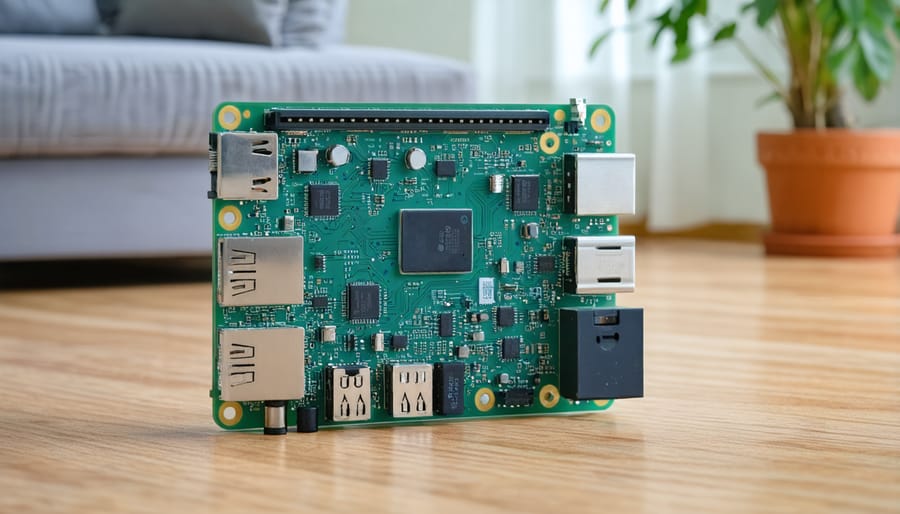
When comparing Pi models, the Model A+ stands as a unique entry in the Raspberry Pi family. While it shares the same 700MHz single-core processor and 512MB RAM as the Model B+, it offers distinct advantages and trade-offs that set it apart from its siblings.
Compared to the original Model A, the A+ brings significant improvements in form factor and power consumption. Its compact size (65mm vs. 86mm) and reduced power usage make it ideal for portable and battery-powered projects. However, it maintains just one USB port and lacks the ethernet port found on B-series models.
The Model A+ shows its age when compared to newer Pi variants like the Pi 3 or Pi 4, particularly in processing power and memory capabilities. While modern Pis feature quad-core processors and up to 8GB RAM, the A+ remains suitable for simpler applications and learning environments where raw performance isn’t critical.
One notable advantage of the A+ over newer models is its lower power consumption, drawing only about 600mA compared to the 1.2A or more required by recent models. This makes it particularly valuable for solar-powered or battery-operated projects where energy efficiency is paramount.
Despite its limitations, the A+ remains relevant for specific use cases, especially in embedded systems and educational environments where its simplicity and reliability are valuable assets. Its GPIO capabilities match those of the B+, making it equally capable for hardware interfacing projects, just in a more compact and energy-efficient package.
The Raspberry Pi 1 Model A+ stands as a testament to the Raspberry Pi Foundation’s commitment to making computing accessible and affordable. Despite its compact size and basic specifications, this model offers remarkable value for specific use cases, particularly in embedded projects and educational environments where power efficiency and small form factor are paramount. Its reduced power consumption, simplified design, and lower cost make it an excellent choice for battery-powered projects and installations where space is at a premium.
For beginners entering the world of single-board computers, the Model A+ serves as an affordable entry point to learn programming, electronics, and basic computing concepts. However, those requiring more processing power or planning to run resource-intensive applications should consider newer Raspberry Pi models. The A+ particularly shines in projects like digital signage, environmental monitoring stations, and simple robotics applications.
While not the most powerful Raspberry Pi variant, the Model A+ remains relevant today for specific applications and continues to demonstrate the platform’s core mission of democratizing computing education and innovation.