

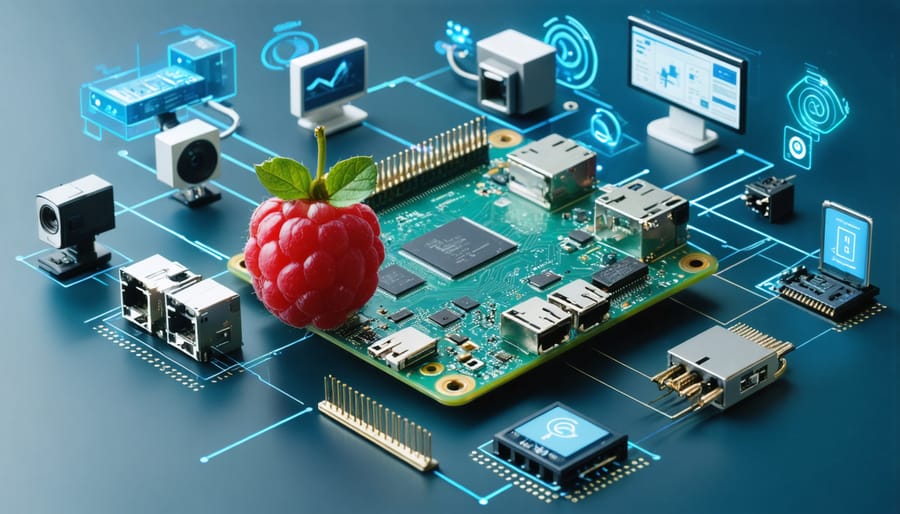
Transform your business operations with the Raspberry Pi, a versatile computing solution that extends far beyond hobby projects. From powering digital signage networks across retail chains to orchestrating industrial IoT sensor arrays, this pocket-sized computer revolutionizes enterprise applications at a fraction of traditional infrastructure costs. Fortune 500 companies now deploy Raspberry Pi clusters for edge computing and data processing, while startups leverage them as cost-effective development platforms for AI and machine learning prototypes. The device’s combination of low power consumption, robust processing capabilities, and extensive GPIO options makes it ideal for both proof-of-concept testing and production-ready implementations. Whether monitoring manufacturing equipment in real-time or serving as a secure VPN gateway, the Raspberry Pi’s enterprise use cases demonstrate its evolution from an educational tool to a serious business technology solution.
Industrial Monitoring and Control Systems
Environmental Monitoring Stations
The Raspberry Pi’s versatility shines in environmental monitoring applications, offering a cost-effective solution for tracking various atmospheric conditions. By connecting sensors to the Pi, you can create sophisticated monitoring stations that collect real-time data on temperature, humidity, air quality, and other environmental parameters.
A basic environmental monitoring station typically combines a DHT22 sensor for temperature and humidity readings with an MQ135 sensor for air quality measurements. These components connect directly to the Pi’s GPIO pins and can be programmed using Python to collect and log data at regular intervals. For more comprehensive monitoring, additional sensors can measure atmospheric pressure, UV levels, and particulate matter.
The real power of Pi-based monitoring stations lies in their connectivity options. Data can be transmitted to cloud services for remote monitoring, visualization, and analysis. Many enthusiasts use platforms like ThingSpeak or custom MQTT brokers to create dashboards that display real-time environmental metrics. This setup is particularly valuable for applications in greenhouse management, indoor air quality monitoring, and weather tracking.
The system can be enhanced with automated alerts when readings exceed predetermined thresholds, making it ideal for both home use and industrial applications. Solar panels and battery backup systems can be added for deployment in remote locations, creating truly autonomous monitoring solutions that operate continuously with minimal maintenance.
Production Line Automation
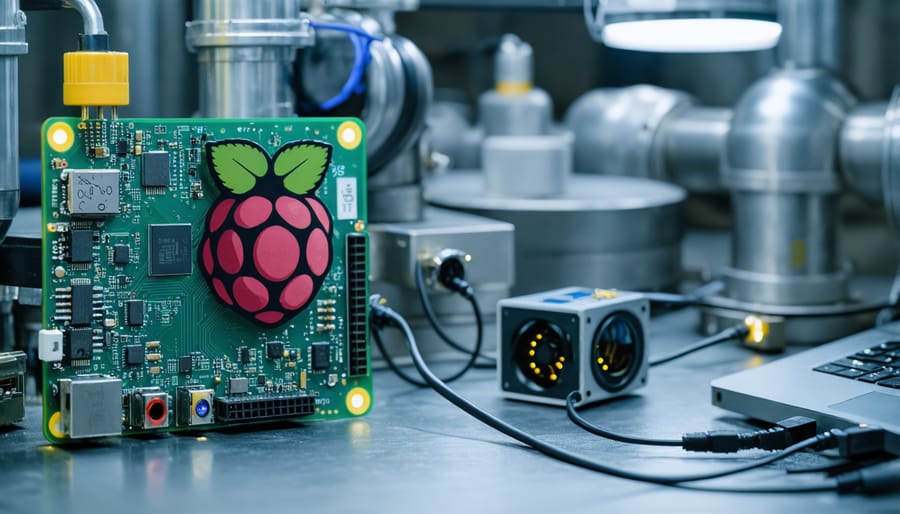
The Raspberry Pi’s versatility shines in manufacturing environments, where it serves as a cost-effective solution for production line automation. By integrating sensors, cameras, and custom software, these compact computers enable sophisticated automated production monitoring systems at a fraction of the cost of traditional industrial controllers.
Companies can implement quality control systems using Pi-powered computer vision to detect defects in products as they move along the conveyor belt. The Pi’s GPIO pins allow for easy connection to various sensors that monitor temperature, humidity, vibration, and other critical production parameters. When combined with machine learning algorithms, these systems can predict maintenance needs and prevent costly downtime.
One popular application involves using multiple Raspberry Pis to create a distributed monitoring network. Each unit can handle specific tasks like barcode scanning, weight measurement, or dimensional verification, while sending data to a central database for analysis. This modular approach allows manufacturers to scale their automation gradually and customize solutions to their specific needs.
The Pi’s ability to run Python scripts and communicate via industrial protocols like Modbus makes it particularly suitable for retrofitting older machinery with modern monitoring capabilities. This enables smaller manufacturers to embrace Industry 4.0 principles without significant capital investment.
Network Security Applications
Network Traffic Analysis
Transform your Raspberry Pi into a powerful network security monitoring tool by setting it up as a dedicated traffic analyzer. With its compact size and low power consumption, the Pi makes an ideal platform for continuous network surveillance and intrusion detection.
Using popular open-source tools like Wireshark and Snort, you can configure your Pi to monitor all incoming and outgoing traffic on your network. This setup allows you to detect suspicious activities, identify potential security threats, and analyze bandwidth usage patterns in real-time.
To get started, install Raspbian OS and configure your Pi with two network interfaces: one for monitoring and another for management. Popular monitoring tools can be easily installed through the package manager. For instance, installing Wireshark is as simple as running ‘sudo apt-get install wireshark’ in the terminal.
The Pi can capture and analyze packets, generate detailed traffic reports, and even send automated alerts when it detects unusual network behavior. This makes it particularly valuable for small businesses and home offices looking to enhance their network security without investing in expensive commercial solutions.
For advanced users, implementing tools like PI-HOLE alongside traffic monitoring can provide additional benefits such as network-wide ad blocking and DNS-level threat protection. You can also create custom scripts to log specific types of traffic or automatically block suspicious IP addresses.
Remember to position your Pi at a network chokepoint, such as between your router and switch, to ensure comprehensive traffic monitoring. Regular monitoring and analysis of the collected data will help you maintain a secure and efficient network environment.
VPN Gateway Solutions
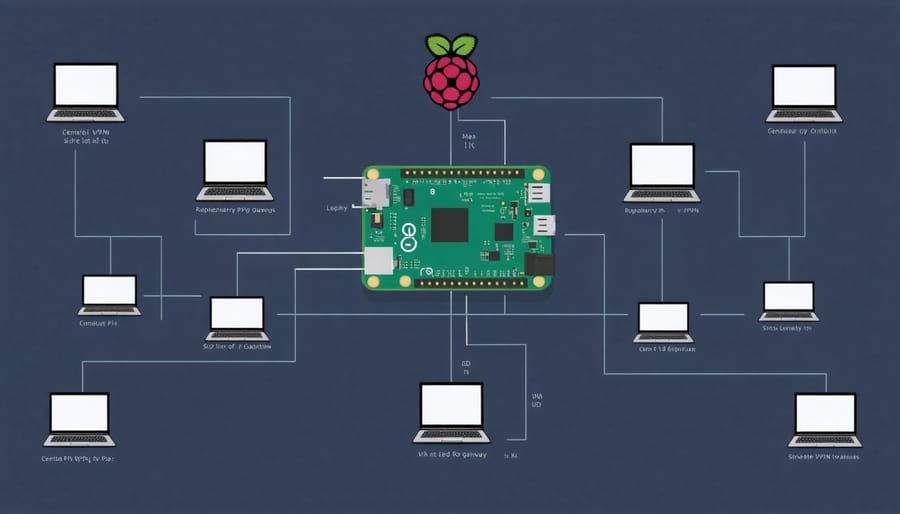
A Raspberry Pi can serve as a cost-effective and powerful VPN gateway, allowing secure remote access to your home or small business network. By setting up your Pi as a VPN endpoint, you can create an encrypted tunnel between your devices and your network, ensuring safe access to your files and services from anywhere in the world.
Setting up a VPN gateway on your Raspberry Pi is surprisingly straightforward. Popular solutions like OpenVPN and WireGuard can be installed directly on Raspberry Pi OS, with WireGuard offering excellent performance even on the Pi’s modest hardware. The Pi 4’s improved processing power makes it particularly suitable for handling multiple concurrent VPN connections without significant speed degradation.
To enhance security, you can configure your Pi-based VPN gateway with two-factor authentication, custom encryption settings, and detailed access logs. This setup is ideal for remote workers needing secure access to office resources or for home users wanting to access their media servers and smart home devices while traveling.
The low power consumption of the Raspberry Pi makes it perfect for running 24/7 as a VPN endpoint, typically drawing less than 5 watts under normal use. Combined with its small form factor, the Pi can be tucked away in a network closet or mounted directly to your router.
For additional functionality, you can integrate Pi-hole for network-wide ad blocking or set up split tunneling to route only specific traffic through the VPN. This versatility, combined with the Pi’s reliability and active community support, makes it an excellent choice for both personal and small business VPN gateway implementations.
Edge Computing Solutions
Data Processing at the Source
In today’s data-driven world, sending every piece of information directly to the cloud isn’t always efficient or practical. The Raspberry Pi excels at processing data locally before transmission, making it perfect for edge computing applications where immediate analysis is crucial.
By implementing local data processing on your Pi, you can filter out unnecessary information, reduce bandwidth usage, and respond to critical events in real-time. For example, a Pi-powered security camera can analyze motion detection locally, only uploading relevant footage when actual movement is detected rather than streaming constantly.
This approach is particularly valuable in industrial IoT scenarios. Consider a manufacturing facility where multiple sensors monitor equipment performance. The Pi can process this data on-site, sending only actionable insights to the cloud while handling immediate responses locally. This reduces latency and ensures critical operations continue even during network outages.
Setting up local processing is straightforward with popular Python libraries like NumPy and Pandas. You can create simple scripts to aggregate sensor data, perform basic statistical analysis, or implement machine learning models using TensorFlow Lite. This local processing capability transforms the Pi from a simple data collector into an intelligent edge device that can make autonomous decisions while optimizing network resources.
IoT Gateway Implementation
The Raspberry Pi’s versatility shines when configured as an IoT gateway, serving as a central hub for managing multiple connected devices and processing their data streams. This implementation allows businesses and tech enthusiasts to create a cost-effective bridge between local IoT devices and cloud services.
To set up a Pi as an IoT gateway, you’ll need to install a compatible operating system (Raspberry Pi OS is recommended) and configure essential networking protocols like MQTT or HTTP. The Pi can handle data collection from various sensors, smart devices, and industrial equipment through its GPIO pins or wireless connections.
A typical IoT gateway setup involves three main components: device connectivity management, data processing, and cloud integration. The Pi can handle multiple protocols simultaneously, converting data from different sources into a standardized format before transmission to the cloud or local storage.
Popular frameworks like Node-RED make it easy to create visual workflows for data routing and transformation. For enhanced security, implement SSL/TLS encryption and configure proper authentication mechanisms to protect your IoT network.
The Pi’s processing power is sufficient to handle basic edge computing tasks, allowing for real-time data analysis and filtering before sending information to the cloud. This reduces bandwidth usage and cloud storage costs while improving response times for critical applications.
For optimal performance, consider using a heatsink and proper ventilation, as gateway operations can be processor-intensive when managing multiple devices simultaneously.
Digital Signage and Kiosk Systems
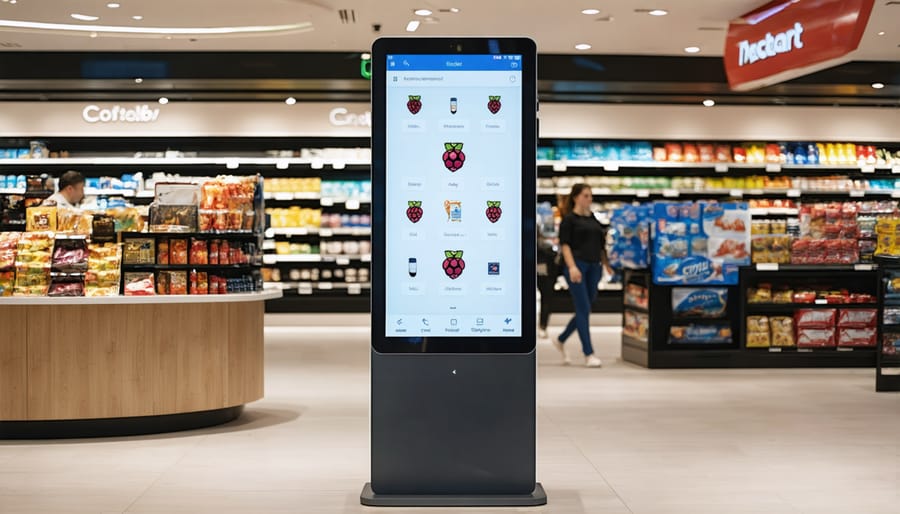
The Raspberry Pi’s compact size and powerful capabilities make it an ideal platform for creating cost-effective digital signage and interactive kiosk solutions. These systems can be deployed in retail environments, educational institutions, corporate offices, and public spaces, offering dynamic content display and user interaction at a fraction of the cost of traditional commercial solutions.
To set up a basic digital signage system, you’ll need a Raspberry Pi (preferably Model 4), a display screen, and software like Screenly OSE or PiSignage. These platforms offer web-based management interfaces where you can schedule content, create playlists, and control multiple displays remotely. The Pi can handle various media formats, including HD videos, images, web pages, and real-time data feeds.
For interactive kiosks, combining a touchscreen display with your Raspberry Pi creates an engaging user experience. Popular applications include information terminals, self-service checkout systems, and museum exhibits. Tools like Kivy framework or Qt enable developers to create custom touch-friendly interfaces, while Chrome in kiosk mode offers a simple solution for web-based applications.
Key considerations for deployment include:
– Power management: Implement automatic power cycling to prevent screen burn-in
– Network connectivity: Use ethernet when possible, or configure reliable Wi-Fi
– Security measures: Disable unnecessary services and implement kiosk-mode restrictions
– Content management: Set up remote access for easy updates and maintenance
– Environmental factors: Ensure proper ventilation and consider protective enclosures
To enhance reliability, consider using industrial-grade SD cards or boot from USB storage. Additionally, implementing watchdog scripts can automatically restart the system if applications freeze or crash, ensuring continuous operation with minimal maintenance.
For multi-screen deployments, you can manage an entire network of displays from a central server, synchronizing content across locations and collecting usage analytics. This scalability makes Raspberry Pi-based solutions particularly attractive for businesses looking to implement digital signage networks on a budget while maintaining professional quality and reliability.
The Raspberry Pi has proven itself to be far more than just a educational tool or hobbyist platform. Its evolution into enterprise environments demonstrates its remarkable versatility and cost-effectiveness for businesses of all sizes. From powering digital signage networks to serving as IoT gateways and enabling edge computing solutions, the Raspberry Pi continues to reshape how companies approach their technology infrastructure.
The business value proposition is compelling: organizations can deploy scalable, affordable solutions without compromising on functionality. With costs significantly lower than traditional enterprise hardware and a vibrant community continuously developing new applications, the Raspberry Pi offers an excellent return on investment for many use cases.
Looking ahead, the future potential for Raspberry Pi in enterprise settings appears increasingly promising. The platform’s ongoing hardware improvements, combined with growing enterprise-grade software support, position it well for emerging technologies like AI at the edge, advanced IoT implementations, and distributed computing networks. As businesses continue to seek efficient, flexible solutions for their digital transformation initiatives, the Raspberry Pi is likely to play an even more significant role.
For organizations considering implementing Raspberry Pi-based solutions, the key is to start small, validate use cases, and scale based on success. With proper planning and implementation, this versatile platform can deliver substantial value while reducing infrastructure costs and complexity.