


The rapid integration of AI-powered learning tools into classrooms creates an urgent ethical imperative for educators, administrators, and technology developers. While artificial intelligence promises personalized learning experiences and enhanced educational outcomes, it simultaneously raises critical concerns about student privacy, algorithmic bias, and the fundamental nature of human-machine interaction in education.
Data security breaches could expose sensitive student information, while AI-driven assessment systems might perpetuate existing societal biases or create new forms of educational inequality. The challenge lies not just in implementing these technologies effectively, but in ensuring they serve all students equitably while preserving the irreplaceable human elements of teaching and learning.
As educational institutions increasingly adopt AI solutions, stakeholders must carefully balance the transformative potential of these tools against their ethical implications. This requires developing robust frameworks for data protection, ensuring algorithmic transparency, and maintaining meaningful human oversight in educational decision-making processes. The future of education depends on our ability to harness AI’s capabilities while upholding our commitment to student well-being, privacy, and educational equity.
Privacy and Data Protection in AI-Powered Learning

Student Data Collection and Storage
The collection and storage of student data in AI-driven educational systems presents significant ethical considerations that educators and institutions must carefully navigate. Following established data privacy guidelines is crucial to protect sensitive student information while leveraging AI’s educational benefits.
Educational institutions must implement robust security measures to safeguard student data, including encryption protocols, secure authentication systems, and regular security audits. This is particularly important when using AI systems that collect various data points such as learning patterns, assessment results, and behavioral indicators.
Compliance with regulations like FERPA (Family Educational Rights and Privacy Act) and GDPR (General Data Protection Regulation) is non-negotiable. Schools should maintain transparent data collection policies, clearly communicating to students and parents what data is being collected, how it’s being used, and who has access to it.
Consider implementing low-cost, secure storage solutions using Raspberry Pi servers for local data management, which can help maintain control over student information while providing necessary computational resources for AI applications. This approach allows schools to balance data accessibility with security requirements, ensuring that student privacy remains protected while still enabling the benefits of AI-enhanced learning.
Remember to regularly review and update data retention policies, ensuring that student information is only kept for as long as necessary and is properly disposed of when no longer needed.
Algorithmic Transparency
In educational AI systems, transparency isn’t just a technical requirement—it’s a fundamental necessity for building trust and ensuring accountability. Educators, students, and parents deserve to know how AI-powered tools make decisions that affect learning outcomes. Understanding AI algorithms used in educational software helps stakeholders make informed choices about implementing these technologies in classrooms.
When AI systems recommend learning paths, grade assignments, or identify students who need additional support, the reasoning behind these decisions should be clear and explainable. This transparency enables teachers to validate AI suggestions against their professional judgment and helps students understand their learning journey.
For example, if an AI system suggests a particular learning resource to a student, both the teacher and student should be able to see why that recommendation was made—whether it’s based on past performance, learning style, or curriculum alignment. This visibility helps prevent the “black box” problem where decisions are made without clear justification.
Educational institutions should prioritize AI tools that provide detailed documentation of their decision-making processes and allow for regular audits of their algorithms. This approach not only promotes accountability but also helps identify and correct potential biases or errors in the system, ensuring fair and effective learning experiences for all students.
Ensuring Equal Access to AI Educational Tools

Hardware Requirements and Cost Barriers
The implementation of AI in education often faces significant hardware barriers, but innovative solutions like Raspberry Pi are making AI more accessible to schools and students. While high-end AI systems typically require expensive hardware, getting started with Raspberry Pi offers an affordable entry point for AI education, with basic setups starting around $50-100.
These compact computers can run lightweight AI models and educational software, making them ideal for teaching programming, machine learning basics, and AI concepts. Schools can set up entire computer labs with Raspberry Pi devices for the cost of just a few traditional computers, dramatically reducing the financial burden of implementing AI education programs.
However, challenges remain. Some advanced AI applications may require more processing power than basic Raspberry Pi setups can provide. Schools must also consider additional costs like peripherals, maintenance, and reliable internet connectivity. To address these issues, many institutions are adopting hybrid approaches, combining Raspberry Pi devices for basic AI education with shared access to more powerful computing resources for advanced projects.
Community initiatives and educational discounts are helping bridge the cost gap. Organizations worldwide are donating hardware, creating resource-sharing programs, and developing optimized AI educational tools specifically for low-cost computing platforms. This democratization of AI education technology ensures that students from various socioeconomic backgrounds can access essential AI learning opportunities, promoting digital inclusion and reducing educational inequality.
Internet Access and Infrastructure
In addressing the digital divide, innovative solutions are emerging to ensure AI educational tools reach students in areas with limited internet connectivity. Low-cost computing devices like Raspberry Pi can serve as local AI processing units, enabling schools to run basic AI educational applications without constant internet access. These devices can be configured to cache learning materials and perform AI computations locally, ensuring continuity in AI-assisted education even in offline environments.
Mesh networks present another promising solution, allowing schools in close proximity to share internet connectivity and AI resources efficiently. By implementing edge computing strategies, schools can distribute AI workloads across local networks, reducing bandwidth requirements while maintaining educational effectiveness.
Mobile-first approaches are particularly valuable in regions where smartphones are more prevalent than computers. Educational AI applications can be designed to work with minimal data usage and offer offline functionality, ensuring students can continue learning even with intermittent connectivity. Additionally, compressed AI models can be developed specifically for low-bandwidth environments, providing core educational features while requiring less robust internet infrastructure.
Community internet hubs and solar-powered learning centers equipped with AI capabilities offer another pathway to digital inclusion. These centers can serve as educational anchors, providing students with access to AI-powered learning tools during specified hours, even in areas lacking widespread internet coverage.
Success stories from rural schools implementing these solutions demonstrate that with creative approaches and appropriate technology choices, the benefits of AI in education can reach students regardless of their geographic location or infrastructure limitations. The key lies in selecting appropriate technologies and developing implementation strategies that work within existing constraints while planning for future infrastructure improvements.
Bias and Fairness in AI Educational Systems
Identifying AI Bias
Detecting and preventing AI bias in educational technology requires a systematic approach and constant vigilance. One effective method is implementing regular audit protocols that analyze AI decision patterns across different student demographics, including factors like socioeconomic background, language proficiency, and learning styles.
Educational institutions can use data validation techniques to ensure their AI training sets represent diverse student populations. This includes collecting feedback from various stakeholder groups and conducting cross-cultural testing of AI systems before deployment. Regular monitoring of AI recommendations and outcomes helps identify potential discriminatory patterns early.
To minimize bias, developers should establish clear metrics for fairness and regularly test their systems against these benchmarks. This might include analyzing whether the AI provides equal attention and resources to all students, regardless of their background or learning pace. Using tools like bias detection algorithms and fairness metrics can help quantify any unintended discrimination in the system’s behavior.
Creating diverse development teams is equally crucial, as it brings multiple perspectives to the design process. These teams should include educators, AI specialists, and representatives from different cultural backgrounds to ensure comprehensive oversight of potential bias issues.
Documentation of AI decision-making processes should be transparent and accessible, allowing educators and administrators to understand how the system arrives at its recommendations. This transparency helps in identifying potential bias sources and implementing necessary corrections promptly.
Creating Inclusive AI Systems
Creating inclusive AI systems in education requires a multi-faceted approach that ensures equitable access and outcomes for all students. Developers and educators must work together to implement strategies that address diverse learning needs, cultural backgrounds, and accessibility requirements.
One effective approach is to use diverse training data that represents various student populations, learning styles, and cultural contexts. This helps AI systems recognize and respond appropriately to different accents, languages, and communication patterns. Additionally, incorporating Universal Design for Learning (UDL) principles into AI development ensures that educational tools are accessible to students with different abilities and learning preferences.
Regular bias testing and auditing should be conducted throughout the development process. This includes checking for demographic biases, language biases, and cultural assumptions that might disadvantage certain student groups. Involving diverse stakeholders – including students, teachers, and accessibility experts – in the testing and feedback process helps identify potential issues early.
Hardware considerations are equally important. Using affordable computing solutions like Raspberry Pi can help bridge the digital divide by making AI-powered educational tools more accessible to schools with limited resources. Additionally, designing AI systems that can function effectively with varying internet connectivity and device capabilities ensures that students in different socioeconomic situations can benefit from these tools.
Documentation and user interfaces should be designed with multiple accessibility options, including screen reader compatibility, adjustable text sizes, and alternative input methods. This inclusive design approach helps ensure that AI educational tools serve as equalizers rather than creating new barriers to learning.
Teacher-AI Collaboration and Human Oversight
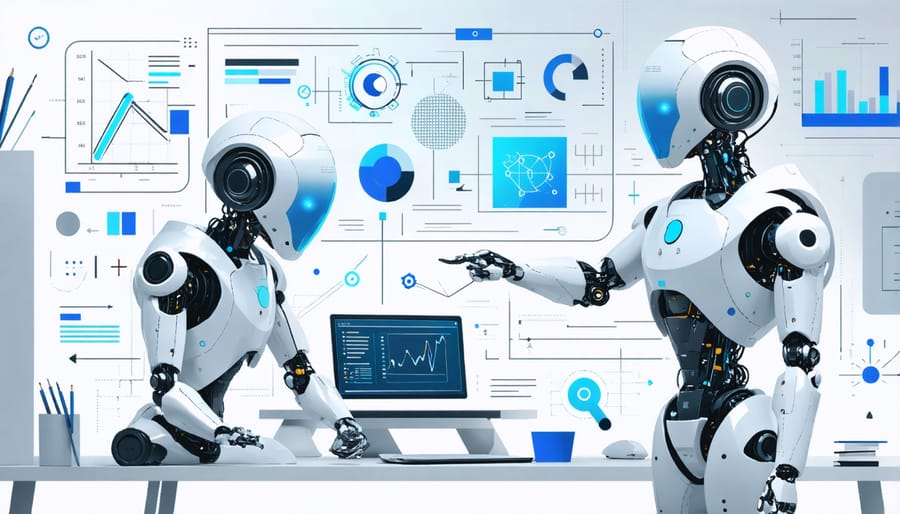
The integration of AI in education shouldn’t mean replacing teachers but rather enhancing their capabilities through strategic collaboration. Teachers remain essential in guiding students, providing emotional support, and ensuring AI tools are used effectively and ethically in the classroom.
Successful teacher-AI collaboration requires a balanced approach where AI handles repetitive tasks like grading multiple-choice questions or generating practice problems, while teachers focus on higher-value activities such as developing critical thinking skills and fostering creativity. This partnership allows educators to spend more time on personalized instruction and meaningful student interactions.
Human oversight is crucial in several key areas. Teachers need to regularly review AI-generated content for accuracy, appropriateness, and alignment with curriculum standards. They should monitor AI-driven assessment systems to ensure fair evaluation and intervene when the technology might misinterpret student responses or learning patterns.
Educational institutions should establish clear protocols for AI implementation, including:
– Regular auditing of AI systems and their decisions
– Teacher training programs on effective AI tool usage
– Guidelines for when human intervention is necessary
– Feedback mechanisms for both students and teachers
Using low-cost computing solutions like Raspberry Pi, schools can create custom monitoring systems that help teachers track AI performance and student engagement in real-time. These systems can flag potential issues for human review while maintaining a transparent learning environment.
Teachers should also be empowered to customize AI tools to better suit their teaching style and student needs. This might involve adjusting difficulty levels, modifying content delivery methods, or fine-tuning feedback mechanisms. By maintaining this level of control, educators ensure that AI remains a supportive tool rather than an autonomous decision-maker in the learning process.
The goal is to create a symbiotic relationship where AI enhances teaching capabilities while preserving the irreplaceable human elements of education. This balance helps maintain high educational standards while leveraging the benefits of technological advancement.
As we look toward the future of AI in education, it’s crucial to maintain a balanced approach that maximizes benefits while addressing ethical concerns. The key challenges we’ve explored – from data privacy and algorithmic bias to accessibility gaps and the changing role of educators – require ongoing attention and proactive solutions from the educational technology community.
Moving forward, successful implementation of AI in education will depend on creating transparent frameworks that protect student privacy while enabling personalized learning experiences. Educational institutions must prioritize ethical AI development by establishing clear guidelines for data collection, ensuring equitable access to AI tools, and maintaining meaningful human oversight in the learning process.
The rise of affordable computing solutions, including single-board computers and open-source platforms, presents opportunities to bridge the digital divide and democratize access to AI-enhanced education. However, this technical progress must be accompanied by strong ethical standards and regular assessment of AI systems’ impact on learning outcomes.
For educators and technologists, the path forward involves continuous collaboration to develop AI tools that complement rather than replace human teaching, while actively working to eliminate bias and ensure inclusive learning environments. By maintaining these ethical considerations at the forefront of AI development in education, we can work toward a future where technology enhances learning opportunities for all students while preserving the fundamental values of education.
Remember, the goal isn’t just to implement AI, but to do so in a way that upholds educational integrity and promotes equitable growth for all learners.